Elephant Gin Brand Guidelines
The German gin with handwritten labels and African botanicals.
Aa
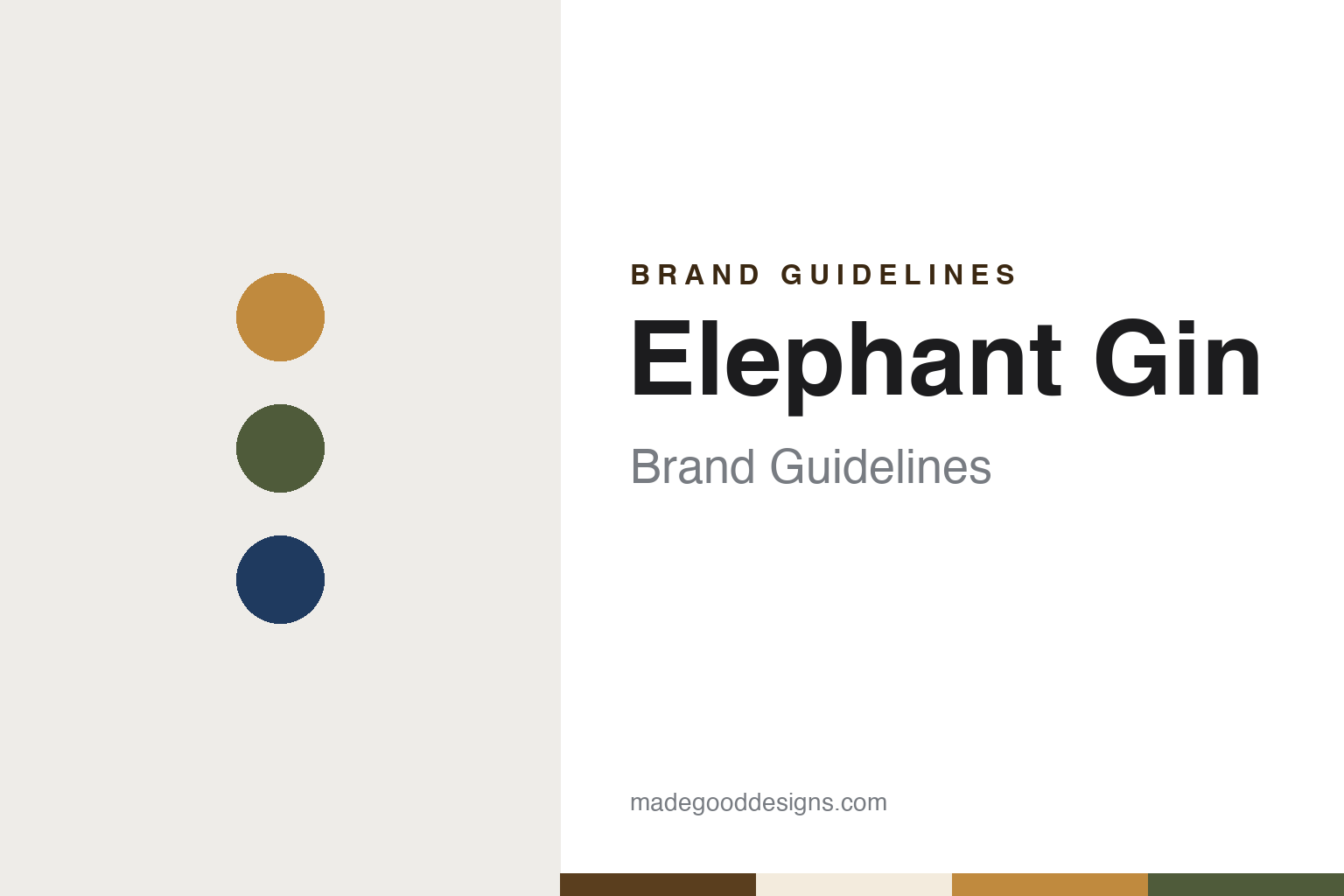
Two constants: a savanna ochre, saddle brown and bush green palette and an old-style book serif register. Abstract homage — not an Elephant Gin product or mark; no label, logo or bottle is reproduced.
A filmmaker, an accountant and Africa
A gin begun in 2011 and first sold in September 2013.
Elephant Gin is a German gin with an African story. The Spirits Business reported in February 2023 that it was founded by the married couple Robin and Tessa Gerlach — Tessa a filmmaker, Robin an accountant who also became the brand’s distiller — after travels in Africa. The magazine said the project began in 2011, that the first bottle was sold in September 2013 and that the couple went full time on the brand in 2015.
The gin was built around African ingredients from the start. When the brand reached Australia in April 2015, the trade magazine The Shout described a 45 per cent London dry gin distilled in small batches in copper stills in Germany, with fourteen botanicals including baobab, buchu and African wormwood, arriving in 500 ml bottles through the importer Luxe Wine + Spirits. The drinks site about-drinks reported in April 2023 that the fourteen botanicals sit alongside fresh, hand-picked German apples.
Conservation was built in as well. The Shout reported in 2015 that the company gave 15 per cent of its profits to two African elephant foundations, and The Spirits Business said in 2023 that 15 per cent of bottle profits had gone to elephant conservation since the launch. The company launched the Elephant Gin Foundation, a London-based non-profit, in August 2022, the magazine reported, to channel money to the anti-poaching rangers of the Big Life Foundation and to the Sheldrick Wildlife Trust; the company said donations had passed one million euros in early 2022.
Colour
Custom glass, handwritten labels and the names of elephants.
The bottle carries most of the brand. The Shout described in 2015 a custom-made bottle with handwritten labels, an embossed crest and a natural cork, and reported that each batch is named after a great tusker of the past or an elephant the brand’s partners help to protect. about-drinks repeated the formula in 2023, describing bottles made individually with handwritten labels, extracts of African maps and the embossed crest, and The Spirits Business reported the same year that the custom bottles are plastic-free.
The names became a design device of their own. In March 2017 The Spirits Business reported the launch of Elephant Strength, a navy-strength gin at 57 per cent, whose bottle carries the names of the “Magnificent Seven,” the great bull elephants known to Kruger National Park in South Africa, and whose label has blue accents and a map of the ocean. The magazine noted that the strength edition was crafted in Germany like the core gin and first sold for a month through The Whisky Exchange.
The Spirits Business listed four core gins in February 2023 — London Dry, Sloe, Strength and Orange Cocoa — and reported on a ready-to-drink Negroni and a limited release that sold out within a day. Miniature bottles followed in 2017 in support of the Sheldrick Wildlife Trust, the magazine said. In April 2023 about-drinks reported that Elephant Gin had been certified as a B Corp, which it presented as a first for a German gin brand.
Typography
Design and documentation.
The seven brands in this group are all German gins: Siegfried, Ferdinand’s, The Duke, Elephant, Gin Sul, Windspiel and Skin Gin. Gin brands in general sit at many different points in the trade, from small companies that still distil and bottle their own spirit to labels made under contract at another distillery or now owned, in whole or in part, by much larger drinks groups, and a single gin can be sold everywhere from a corner shop to a cocktail bar.
A gin’s identity is usually carried less by the liquid than by a bottle, a label and the place it names, because the company behind the name may have changed hands, moved its production or grown far beyond the town where it started. That makes the questions behind each name worth asking plainly: who started it, who owns it now, and where its gin is actually distilled and bottled.
Each guide separates what independent sources record from what the company says about itself — its founding story, its owners over time, where its gin is made and how its bottles and labels have changed — and marks plainly what rests only on the company’s own word.
Aa
An old-style book serif for a gin dressed in handwriting and maps. (Specimen set in EB Garamond, a serif STAND-IN; NOT the Elephant Gin logo.)
Elephant Gin
A distillery of its own, an insolvency and a new owner.
For its first decade the gin was made at a facility about an hour outside Hamburg, The Spirits Business reported in 2023. The couple then bought a wooden building to convert, with construction beginning in early 2020 before lockdowns slowed it; the plans the magazine described included two 250-litre steam-heated stills, a small laboratory still, vacuum stills and a wild garden for herbs and botanicals. In September 2023 the magazine reported that Elephant Gin had opened its own distillery and visitor centre in Wittenburg, near Hamburg, with an Arnold Holstein copper still, rotary evaporators, an African-inspired bar and a garden for botanicals, where visitors can distil and bottle their own gin.
Ownership changed twice in two years. The Italian food site Dissapore reported in December 2022 that Compagnia dei Caraibi, the Italian spirits company that had distributed the gin in Italy for about six years, had acquired Elephant Gin, with the founders staying in charge. The Spirits Business reported in July 2024 that Compagnia dei Caraibi had been unable to finance the agreed business plan, that Elephant Gin had declared insolvency in early 2024 and that the Italian company lost the brand in the process. The Berlin-Charlottenburg local court opened insolvency proceedings over Elephant Gin GmbH on 1 June 2024, according to a July 2024 release from GT Restructuring, the administrator’s firm, which said the insolvency followed charges from loans for the new distillery.
The buyer was Carl-Lambert Leisewitz, head of the delicatessen and spirits producer Laux, and Elephant Gin has belonged to him since 2024. Both reports said the sale secured the Wittenburg site and most of the jobs, that the brand would stay independent and that the management around the Gerlachs would remain. The name needs care online: Mampe, the Berlin spirits house, also uses an elephant, and the gin’s site is elephant-gin.com.
For a design guide, Elephant Gin shows how handwriting, maps and the names of real elephants can turn a bottle into a field journal. Compare Amarula, the South African cream liqueur with an elephant on the bottle, and Monkey 47, the Black Forest gin. For this guide we use savanna ochre, saddle brown and bush green with a serif, an unofficial interpretation; no product or logo is reproduced.
Explore & save
Keep Elephant Gin’s identity on hand — save it to a board in the Made Good inspiration library.
Elephant Gin identity set
Pin the Elephant Gin savanna ochre, saddle brown and bush green palette and the old-style book serif register to your own board.


