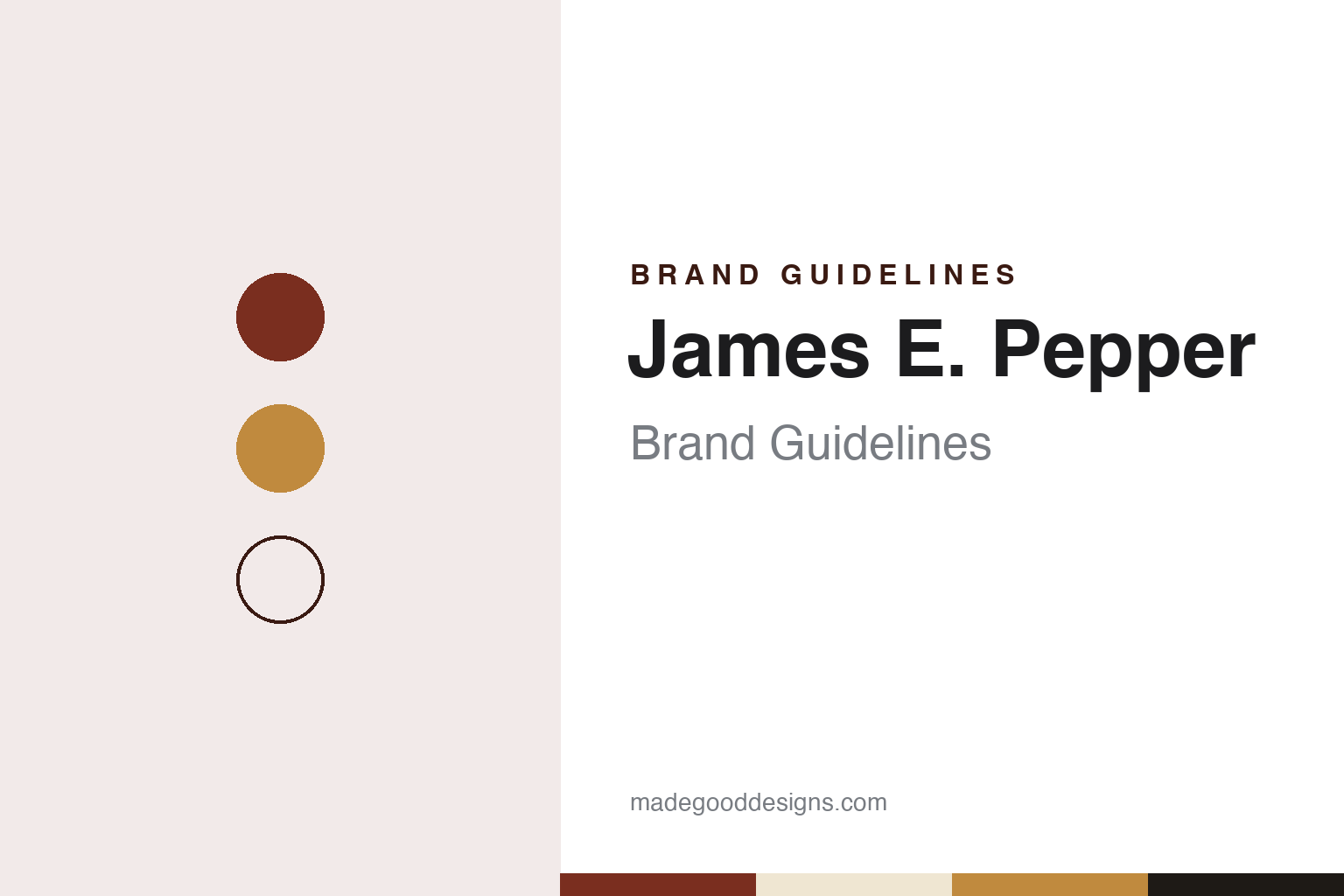
James E. Pepper Brand Guidelines
The “Old Pepper” family whiskey of Kentucky, revived in Lexington.
Aa
Two constants: an oxblood, amber and cream palette and a Victorian serif register. Abstract homage — not a James E. Pepper product or mark; no bottle, label or logo is reproduced.
Old Pepper
Three generations of a Kentucky whiskey name.
James E. Pepper is named after a nineteenth-century Kentucky whiskey maker who sold his family’s whiskey as “Old Pepper.” English Wikipedia describes him as the third generation of his family to make it, and says he promoted it as “The Oldest and Best Brand of Whisky made in Kentucky.” The company today says the brand was “initially produced during the American Revolution and continued through 1967,” and that Pepper kept his grandfather’s Revolutionary-era recipes and nicknamed his whiskey “Old 1776”; those are the company’s claims, and the number has become the name of its modern range.
The family worked at two main sites. The first, the company says, is the distillery that now makes Woodford Reserve, near Versailles in Woodford County. English Wikipedia’s article on Woodford Reserve says distilling began there in 1812, that the distillery was originally established by Elijah Pepper and passed to his son, and that the Pepper family sold the property to Leopold Labrot and James Graham in 1878; it was known as the Oscar Pepper Distillery when the distiller James C. Crow worked there in the mid-nineteenth century.
The second site was in Lexington. The Whiskey Wash reported in 2016 that Colonel Pepper’s operation there drew limestone water from Town Branch Creek from 1879; the company dates the distillery building to 1880. English Wikipedia says the site had begun as the Henry Clay distillery and was later known as the Old Pepper and then the James E. Pepper distillery.
Colour
A bottle-stamp, a cocktail and a closure.
Much of the Pepper story concerns how whiskey was sold. English Wikipedia says that in 1890 Pepper persuaded Kentucky to change its laws so that distillers could bottle whiskey at the distillery, and that he introduced a signed strip stamp across the cork to show a bottle was genuine. The company says the signed strip let him pursue counterfeiters under forgery laws, and that his advocacy was “instrumental” in the Bottled-in-Bond Act of 1897; we give that last point as the company’s claim.
He was also a public figure. English Wikipedia records that he kept a stable of thoroughbreds, travelled in a private rail car named “The Old Pepper,” which the company says was painted with images of his whiskey label, and is credited with popularising the Old Fashioned at the Waldorf-Astoria in New York. The company goes further and says the cocktail was invented in his honour by a bartender at the Pendennis Club in Louisville.
The Lexington distillery outlived him but not the century. English Wikipedia says Schenley bought it around 1934, that it made industrial alcohol during the Second World War, and that distilling on site ended in 1958; it gives 1967 as the year the distillery shut down. The site was listed on the National Register of Historic Places in February 2009. The Whiskey Wash reported in 2016 that developers had begun turning the surrounding complex into an entertainment site in 2013.
Typography
Rye and its houses.
The seven brands in this group are all American whiskey names known for rye, often alongside bourbon: Sagamore Spirit, Old Overholt, Templeton, Pikesville, James E. Pepper, Willett and Catoctin Creek. They sit at very different points in the trade, from family-run distilleries to labels that belong to much larger drinks groups, and a single name can stand for a working distillery, a revived old brand or a whiskey made somewhere else and bottled under the label.
In the United States the word on the label has a legal meaning. Federal rules on spirits labelling (27 CFR 5.143) define rye whisky as whisky made from a fermented mash of at least 51 per cent rye, distilled at 160 proof or less and stored in charred new oak barrels at 125 proof or less; a whisky called “straight” must spend at least two years in those barrels. The same rules set out bourbon on the same pattern, with corn in place of rye. What the rules fix is the recipe and the barrel, not the look of the bottle, so the identity of each brand is carried by its name, its label and the place it claims.
That makes the questions behind each name worth asking plainly: who started it, who owns it now, and where its whiskey is actually distilled, aged and bottled. Each guide separates what independent sources record from what the company says about itself — its founding story, its owners over time, where its whiskey is made and how its labels have changed — and marks plainly what rests only on the company’s own word.
1776
A Victorian serif — the register of an old whiskey ledger. (Specimen set in Old Standard TT, a serif STAND-IN; NOT the James E. Pepper logo.)
James E. Pepper
A defunct name, revived.
The modern brand is a revival. The Whiskey Wash reported in July 2016 that the entrepreneur Amir Peay found the brand defunct, learned that no one held the trademark, and that his company, Georgetown Trading Co., acquired it about eight years earlier; English Wikipedia says Peay, who has no relation to the Pepper family, relaunched the brand in 2008 after years of historical research. The first whiskeys were made elsewhere: The Whiskey Wash named the contract distillers Corsair and MGP of Lawrenceburg, Indiana, and Distillery Trail reported in 2021 that the relaunch was built on partnerships with MGP and Bardstown Bourbon Co. In 2016 the whiskeys were bottled in Bardstown, The Whiskey Wash reported, and Georgetown Trading’s first spirits brand had been John L. Sullivan Irish Whiskey.
Then the brand went home. Distillery Trail reported that Peay began rebuilding the Lexington distillery in 2016, and the company says distilling recommenced there on 21 December 2017, “using the same historic recipe” as when it shut. English Wikipedia says the new still was built by Vendome Copper of Louisville, the firm that built the 1934 system, and that the site includes a museum. In 2021 Distillery Trail reported a new barrel warehouse at Midway, in Woodford County. Not every bottle is made in Lexington: the company says some of its whiskeys contain whiskey distilled at partner distilleries, with the details on back labels and product pages. English Wikipedia, citing CNN in 2021, says the brand reportedly lost three-quarters of its foreign business after the European Union’s 2018 tariffs on American whiskey.
The current range is built on the date. The company sells 1776 Rye and 1776 Bourbon, and has released a 1776 Barrel Proof Rye described as distilled and bottled at its own distillery. Both names take up the “Old 1776” nickname that the company attributes to Colonel Pepper.
For a design guide, James E. Pepper shows how a dormant name can be rebuilt from archives, labels and a building. Compare Woodford Reserve, made at the family’s first distillery site, and Willett, another Kentucky house that returned to distilling in the 2010s. For this guide we use oxblood, amber and cream with a serif, an unofficial interpretation; no product or logo is reproduced.
Explore & save
Keep James E. Pepper’s identity on hand — save it to a board in the Made Good inspiration library.
James E. Pepper identity set
Pin the James E. Pepper oxblood, amber and cream palette and the Victorian serif register to your own board.