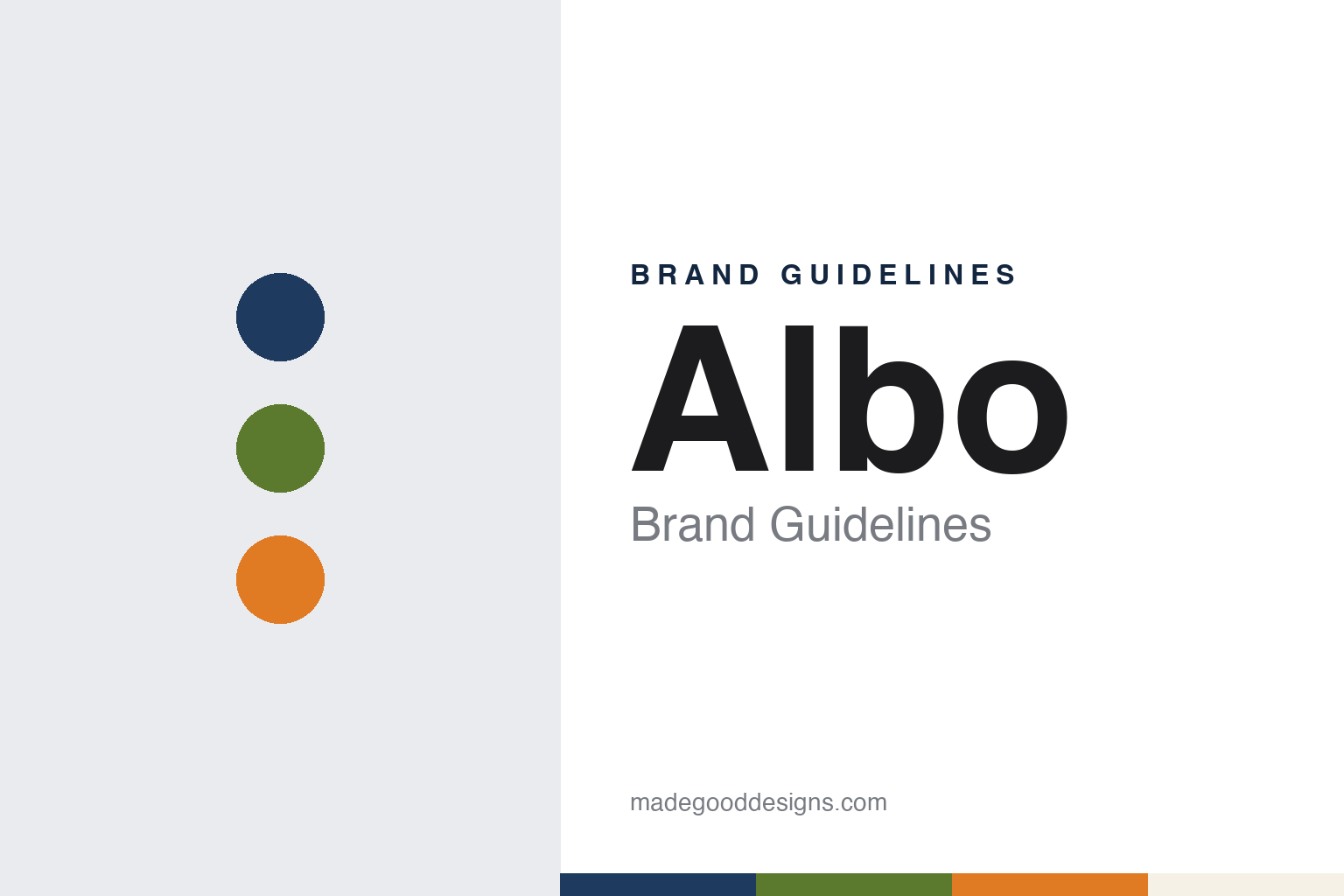
Albo Brand Guidelines
The 1869 Santoña canner now making its tins in Galicia.
Aa
Two constants: a natural blue, olive-oil green and escabeche orange palette and a heritage serif register. Abstract homage — not an Albo product or mark; no tin, label or logo is reproduced.
Albo y Arredondo
A Cantabrian beginning, a Galician home.
Albo is the brand of Hijos de Carlos Albo, a canner of tuna, bonito, sardines, mussels and prepared dishes now based in Galicia. Its roots lie on the other side of northern Spain. The company says it was founded in 1869 in Santoña, a fishing port on the Cantabrian coast, under the name “Albo y Arredondo,” and that its founder was Carlos Albo Kay, a teacher of English, French and mathematics at the town’s Instituto de Manzanedo, which he went on to direct. The Argentine fishing-trade site Pescare, rewriting a Faro de Vigo report in October 2022, gives the same year, town and founder.
By the company’s account the business began small and by hand, making salted anchovies and escabeche, the vinegar-and-spice marinade, before turning at the start of the twentieth century to sterilised, sealed cans — what Spanish canners call “appertized” conserves, after the French inventor Nicolas Appert. It says it came to run as many as eleven factories along the Cantabrian and Atlantic coasts. Its own timeline files that small-scale beginning under 1910 and does not explain how that date relates to the 1869 founding.
In 1929, the company says, it opened a factory in Vigo and moved its offices there, and generations of women from the area worked on its production lines. Vigo, in the province of Pontevedra, remained its base for most of the following century: in 2015 the trade journal Alimarket still described Hijos de Carlos Albo as a Vigo company, with plants in Vigo, at Cillero in Lugo and at Tapia de Casariego in Asturias.
Colour
Three shields, a crest and a colour code.
Albo has sold under more than one name. The company says its Tres Escudos (“three shields”) brand became one of the canned-food suppliers to the Vatican in 1958, with small sardines and bonito del norte; the 2022 Pescare report dates that to 1959. In 2015 Alimarket listed the company’s marks as Albo, Tres Escudos and Kay, which is also the founder’s second surname.
The company also moved into ready meals. It says its factory at Tapia de Casariego, on the Asturian coast, began making prepared dishes in 1960, partly to meet demand from Latin American markets. Advertising followed. Albo says it ran its first television advertisement in 1960; the same page’s timeline places its first television campaign, presenting its bonito del norte to viewers of the state broadcaster RTVE, in the 1970s, alongside advertising on lorries and in newspapers and magazines. Its website keeps a small archive of those films, from the 1960s and 1970s to a 2018 Christmas spot and its 150th anniversary.
The current identity dates from 2019, that anniversary year. Alimarket reported in February 2019 that Albo had dropped the heraldic crest from its logo in favour of a cleaner mark that gave the brand name more prominence, while keeping its corporate colours. The tagline “Tu marca desde 1869” (“your brand since 1869”) was shortened to “Desde 1869,” and the line “Fabricamos solo para ti” (“we make only for you”) was dropped. The update ran from the logo to stationery, work uniforms and the packs of every line, canned fish and prepared dishes alike, rolled out through the year.
It also brought a colour code by recipe: blue for fish in its natural juice, green for olive oil and orange for escabeche, which, Alimarket reported, was meant to help shoppers find each product on the shelf. The first packs to change were mussels, tuna, bonito and anchovies. The report did not name a design agency.
Typography
Design and documentation.
The seven brands in this group are all tinned-fish names, from brands based in Spain, Italy and the United States: Matiz, Palacio de Oriente, Albo, Rio Mare, Mare Aperto, AsdoMAR and Wild Planet. Tinned-fish brands sit at many different points in the trade, from family canneries that still carry a founder’s name to labels that belong to much larger food groups, and the same name can appear on a delicatessen shelf and in a supermarket aisle. Two of the seven share an owner: Italy’s Bolton Group, based in Milan, lists both Rio Mare and Wild Planet among its food brands, having announced its acquisition of Wild Planet in August 2021.
A tinned-fish brand’s identity is carried less by the fish than by the tin: its label, its colours, its name and the place it promises. The company behind a name may have changed hands, moved its canning or bought its fish from far away, which makes the plain questions worth asking: who started the brand, who owns it now, and where its fish is caught, packed and canned.
Each guide separates what independent sources record from what the company says about itself — its founding story, its owners over time, where its fish is processed and how its tins and labels have changed — and marks plainly what rests only on the company’s own word.
Aa
A heritage serif for a canner that dates itself “Desde 1869.” (Specimen set in Fraunces, a serif STAND-IN; NOT the Albo logo.)
Albo
A new owner and a new plant.
Albo left family hands in 2016. In October 2015 Alimarket reported that the family-owned company was close to changing hands, and that in 2009 the family had separated the ownership of its factory buildings from the canning business itself. The company says that in 2016 it sold all of its shares to the Shanghai Kaichuang group, keeping its workforce. Alimarket, in 2019, gave the owner’s name as Shanghai International Ocean Resources, a Chinese holding company that had controlled Albo since 2016; its May 2026 report calls the group Shanghai Kaichuang.
Production has since been gathered in Galicia. Albo says it opened a plant of about 24,600 square metres in 2023 at PLISAN, the logistics and industrial park of Salvaterra de Miño and As Neves in Pontevedra, where it now has its offices and a factory employing more than 200 people, and that it makes its products “from start to finish” itself. Alimarket reported in May 2026 that the plant had been running since April 2023 and that the company had bought the land beneath it, which it had previously occupied under a surface-rights arrangement. The same report said that in late January Albo had announced the permanent closure of its Tapia de Casariego plant, which made only prepared dishes, to concentrate all production in Galicia. Today the company says it makes around a hundred products, from bonito and light tuna to sardines, anchovies, mackerel, octopus, squid, mussels and scallops.
For a design guide, Albo shows how a heritage canner can simplify: it dropped a crest, kept its founding date as the tagline and sorted its range by colour. Compare Calvo, another Galician tuna canner, and Isabel, a Spanish tuna brand. For this guide we use a natural blue, an olive-oil green and an escabeche orange with a serif, an unofficial interpretation; no product or logo is reproduced.
Explore & save
Keep Albo’s identity on hand — save it to a board in the Made Good inspiration library.
Albo identity set
Pin the Albo natural blue, olive-oil green and escabeche orange palette and the heritage serif register to your own board.


