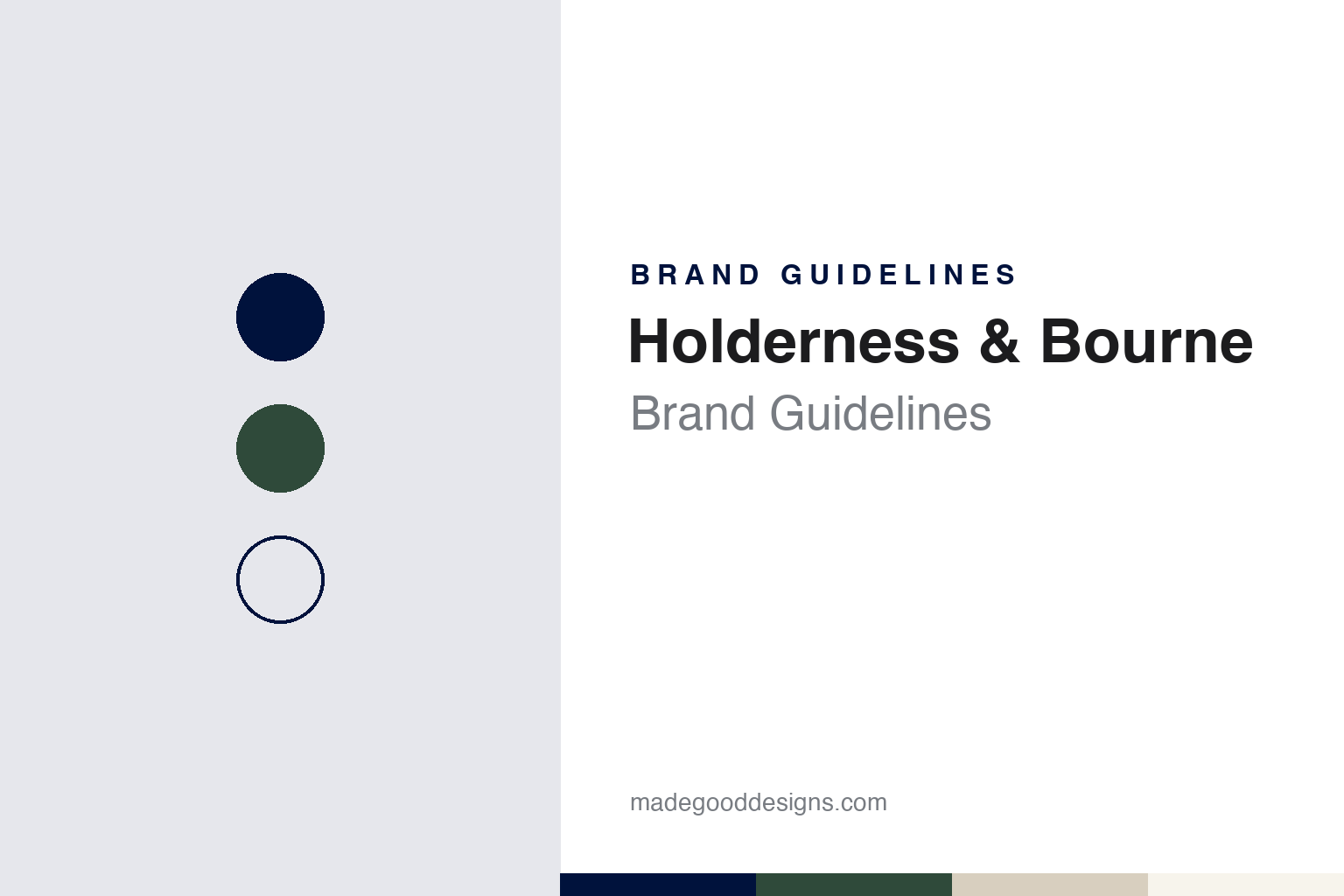
Holderness & Bourne Brand Guidelines
Two names on the door and a sharper golf collar.
Aa
Two constants: a navy, fairway green and stone palette and a tailored serif register. Abstract homage — not a Holderness & Bourne product or mark; no logo, garment or label is reproduced.
Names on the Door
Two business-school golfers and a coffee shop in the garment district.
Holderness & Bourne was founded in 2015 by Alex Holderness and John Bourne, the golf site GolfWRX reported in a November 2022 interview with the pair. They met while studying for MBAs at Yale, where, they told the site, their friendship took shape on the university’s golf course, a C.B. Macdonald design they played at the student rate. The company’s own story adds that they grew up around the game in North Carolina and on Long Island, and shared “a reverence for the works of Donald Ross and C.B. Macdonald.”
Neither came from the clothing trade. After graduating, they told GolfWRX, both took jobs in finance and kept playing golf at weekends, until around 2015 they left those jobs to start the brand. A PGA of America story, reprinted on the company’s website, describes the moment: an 8 a.m. meeting at a coffee shop in New York City’s garment district after a few drinks the night before. “We just kept complaining about the golf shirts we were buying in pro shops and one night we said let’s stop complaining about it and do something about it,” Bourne said. “We just wanted to make a better polo shirt.”
The name was a deliberate choice. “From day one we made the decision to put our names on the door like the old tailoring houses in England,” the founders told GolfWRX. “When the company has your name on it you can’t help but care about everything just a bit more.”
Colour
Quiet branding and a collar that stands up.
The brand began as a reaction against what was in the pro shop. Around 2010 and 2011, the founders told GolfWRX, golf shirts were dominated by “a loose baggy cut and knit collars that laid flat”; they wanted to bring “a tailoring ethos” to the category. The company’s website puts it as a choice golfers should not have to make: “between classic style and a refined fit.” Its list of tenets begins with an old line about clothes: “They say dressing well is a form of good manners,” and adds that it is possible to be comfortable “without looking like an unmade bed.”
The collar became the signature. The company describes a structured collar with premium interfacing, hidden internal collar stays sewn at a diagonal, and an English spread stance — a polo collar meant to stay sharp rather than lie flat. Its shirts carry surnames rather than codes: the website sells pieces such as the Macdonald and the Anderson shirts and the Harwood short.
Restraint is the visual rule. “We never cared much for the exhaustive branding and hyper-athletic looks associated with most modern golf apparel,” the founders write on the company’s website. “We firmly believe that quality speaks for itself, and that branding should be subtle.” In 2022 they told GolfWRX they had made “a strong effort to minimize any H&B branding” on the product, so that the emphasis falls on the logo of the club or resort selling it — and that they had invested in their own embroidery machinery to take charge of that custom-logo work.
Fabrics are described in the company’s own terms. Its fabric guide lists performance jersey and pique knits, a soft pique it calls Swing Knit, a perforated fabric called AIRATION, merino-cashmere and Scottish cashmere, and a Peruvian pima cotton jersey that it says is made in Peru. The founders say the company was launched with “a commitment to responsible manufacturing.”
Typography
Golf apparel and its identities.
The seven brands in this group are all golf clothing names: Peter Millar, TravisMathew, Greyson, Holderness & Bourne, J.Lindeberg, Galvin Green and Linksoul. Five are American and two, J.Lindeberg and Galvin Green, are Swedish. Golf apparel brands sit at many different points in the trade, from founder-run labels that still carry a founder’s name or story to brands that now belong to larger golf, fashion or investment groups, and a single brand can be sold everywhere from a club’s pro shop to a city department store.
A golf clothing brand’s identity is usually carried less by a single garment than by a name, a small logo on a chest or a cap, and the kind of player it promises to dress, because the company behind the name may have changed hands, moved its design studio or grown far beyond the place where it started. That makes the questions behind each name worth asking plainly: who started it, who owns it now, and where its clothing is designed and made.
Each guide separates what independent sources record from what the company says about itself — its founding story, its owners over time, where its clothing is made and how its marks have changed — and marks plainly what rests only on the company’s own word.
Aa
A bookish serif for a brand named like a tailoring house. (Specimen set in Libre Caslon Text, a STAND-IN; NOT the Holderness & Bourne logo or wordmark.)
Holderness & Bourne
From a Flatiron office to a club-shop brand.
The business started small in Manhattan. From 2015 to 2018, the founders told GolfWRX, its headquarters was a one-room office in the Flatiron district with a handful of shirt styles. In the early days they spent time in the garment district learning about American-made fabrics and every step of apparel manufacturing.
Being in Manhattan, the founders said, put them “a short drive away from some of the best golf clubs in the country,” and they started with Winged Foot, where Grant Sturgeon, then the club’s top assistant professional, placed a first order. Wykagyl, Greenwich and Somerset Hills country clubs followed, the founders said, and the brand grew mostly by word of mouth around New York. That club-shop route still shapes it: the product is designed to sit behind a club’s own logo.
The range has widened since. In autumn 2022 the company added its first bottoms, a short and a pant in a cotton-and-performance blend. The pant, they said, looks like a lightweight cotton chino but has performance yarns woven in, with a five-pocket front and chino-style jetted pockets behind; “if we as golfers wouldn’t wear a specific style we won’t launch it,” they added. By late 2022 it had moved to a new headquarters in Armonk, New York, bringing its corporate team and warehouse under one roof, the founders told GolfWRX. Its website now also sells outerwear, sweaters, belts, boys’ sizes a collegiate collection and an “H&B x Yale” line. The two founders still sign the company’s story together.
For a design guide, Holderness & Bourne shows how a founders’ names and a single garment detail can do the work a loud logo does elsewhere. Compare Peter Millar, another club-shop staple, and Linksoul. For this guide we use navy, fairway green and stone with a serif, an unofficial interpretation; no product or logo is reproduced.
Explore & save
Keep Holderness & Bourne’s identity on hand — save it to a board in the Made Good inspiration library.
Holderness & Bourne identity set
Pin the Holderness & Bourne navy, fairway green and stone palette and the tailored serif register to your own board.


