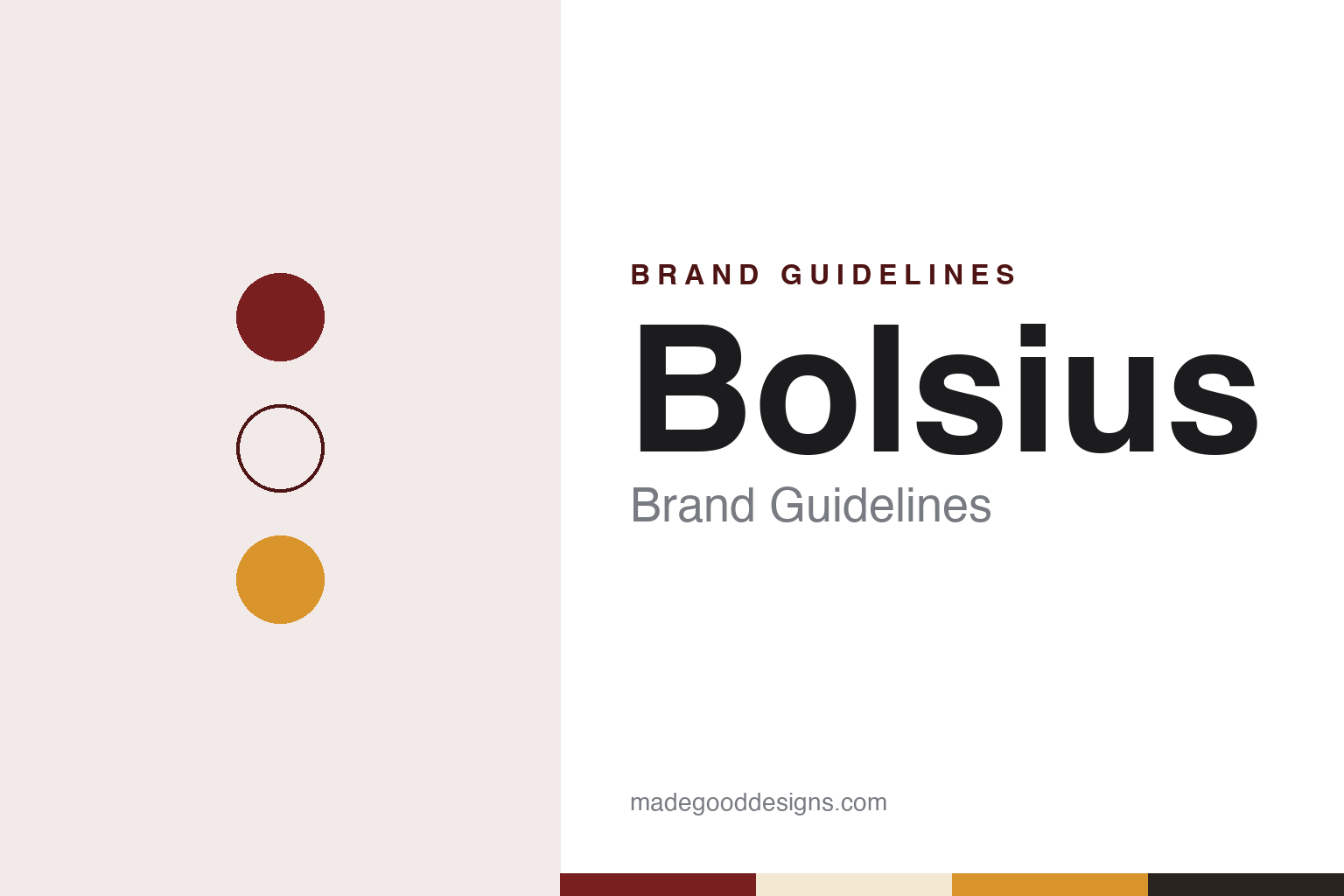
Bolsius Brand Guidelines
The Schijndel candle maker founded as a wax bleachery in 1870.
Aa
Two constants: an altar red, church ivory and flame amber palette and a warm display serif register. Abstract homage — not a Bolsius product or mark; no candle, pack or logo is reproduced.
A wax bleachery on the Kerkendijk
From bleached wax to church candles.
Bolsius began in 1870 in Schijndel, a village in the Dutch province of North Brabant. English Wikipedia, citing De Gelderlander in October 2020, names its founder as Antonius Bolsius. The company’s own history says Antonius, the son of a village doctor, first set up a simple wax bleachery in the garden of his childhood home, and that the business grew from a bleachery on the Kerkendijk, the street where its head office still stands.
Candles came later. The company says that around 1920 the bleachery began to make church candles, using a casting machine invented by Antonius Bolsius and his foreman, Driek van Uden, in which the wick was dipped into liquid wax; candles were also still made by hand, a method it says was taught by Schijndel’s parish priest. In 1927, it says, the Bolsius brothers were named papal purveyors for their church candles.
The Second World War interrupted the trade. Bolsius says that when wax supplies dried up it made plaster figurines instead, including a widely sold “Kniertje,” a figure from the Dutch play Op Hoop van Zegen, and that much of the works was destroyed when Schijndel was on the front line after the airborne landings of 1944. In 1950, the company says, it began making Gothic, household and pillar candles, and over the following decades it turned more and more to decorative candles for the home rather than the church.
Colour
The pressed tealight and the Waxine name.
Two small objects sit at the centre of the Bolsius story. The company credits Lambertus Bolsius, who led the business from the 1950s with P. van der Heijden, with the invention of the pressed tealight in 1959. And in 1991, it says, it bought the waxine activities of Koninklijke Verkade — the Zaandam company better known for biscuits and chocolate — which had made paraffin tea and night lights since 1898, first in a small Amsterdam factory and from 1902 in Zaandam; Bolsius notes that “Waxine” became so familiar in the Netherlands that the brand name turned into a generic word.
The family era ended in 1978. The company says A.J.B. (Anton) Kristen, from a family of candle makers in Delden, took over the business from Lambertus Bolsius that year, and that trading continued as Bolsius Kaarsenfabriek B.V. because Bolsius was the name consumers knew. Under Kristen, it says, the firm installed automated production lines and began selling candles in gift packaging, alongside accessories. A run of acquisitions followed, by the company’s account: the Gouda candle works Koninklijke Stearine Kaarsenfabriek Gouda-Apollo in 1983, the Roermond church-candle maker H. Hoogeland and Sons in 1984, and in 1995 the Kristen candle factory in Delden, a Danish candle factory and two German ones.
In 1998, it says, the church-candle department from Delden was merged into the Roermond works, renamed Kaarsenfabriek Hoogeland-Kristen. Bolsius describes itself today as “an entrepreneurial family company and a small, professional multinational.” Its range takes in rustic candles, which it says it began making in many colours in 2004; dinner and pillar candles; tealights; memorial lights; and a scented line, Bolsius Aromatic, introduced in 2011. No designer, agency or official typeface for the Bolsius wordmark is documented, so the specimen here is a stand-in.
Typography
Design and documentation.
The seven brands in this group are all candle and home-fragrance names: Glade, Bath & Body Works, Chesapeake Bay Candle, Bolsius, ILLUME, Mrs. Meyer’s Clean Day and Price’s Candles. Candle and home-fragrance brands in general sit at many different points in the trade, from small studios that still pour by hand to names that now belong to much larger household-goods groups, and a single brand can be sold everywhere from a supermarket aisle to a boutique shelf.
A candle brand’s identity is usually carried less by a single candle than by a jar, a label, a scent name and the story printed on the box, because the company behind the name may have changed hands, moved its production or grown far beyond the place where it started. That makes the questions behind each name worth asking plainly: who started it, who owns it now, and where its candles are actually made.
Each guide separates what independent sources record from what the company says about itself — its founding story, its owners over time, where its candles are made and how its packaging has changed — and marks plainly what rests only on the company’s own word.
Aa
A warm display serif for a candle maker that began with church candles. (Specimen set in DM Serif Display, a serif STAND-IN; NOT the Bolsius logo.)
Schijndel and Kobylin
A Dutch head office and a Polish factory.
Production moved east over three decades. Bolsius says it set up a manufacturing site in Poland in 1997; it later reduced its number of factories and built a new plant in Kobylin for candles that had needed much manual work, while warehousing moved to Helmond, where Vos Logistics has handled distribution for it since 1998. English Wikipedia says most production now takes place in Kobylin and that the production site in Boxmeer — where, the company says, the Bolsius brothers had sold graveside and party candles made under Anton Kristen from 1963 — closed in 2021.
Expansion abroad also came through brands. Bolsius set up Bolsius Nordic in Stockholm in 1990, it says, and in 2013 took over Eika Kerzen in Germany, adding the Eika brand to its portfolio. For hotels and restaurants it sells under a separate Bolsius Professional name, which it says began in 2009 with an outdoor terrace light. The UK subsidiary, Bolsius UK, is based in Wiltshire, according to English Wikipedia.
The company also presents itself through its impact work. Bolsius says it has been a certified B Corp since 2023 and was recertified under B Lab’s new standards in 2026. Its head office remains on the Kerkendijk in Schijndel, where, for its 125th anniversary, it says it gave the town a bronze statue, “Vrouw met blaker” (woman with candlestick), by the sculptor Niek van Leest.
For a design guide, Bolsius shows how a maker of everyday candles — tealights, dinner candles and church candles — can keep a family name for more than 150 years while ownership and factories change. Compare Yankee Candle and P.F. Candle Co. for two American approaches to the same object. For this guide we use altar red, church ivory and flame amber with a display serif, an unofficial interpretation; no product or logo is reproduced.
Explore & save
Keep Bolsius’s identity on hand — save it to a board in the Made Good inspiration library.
Bolsius identity set
Pin the Bolsius altar red, church ivory and flame amber palette and the warm display serif register to your own board.