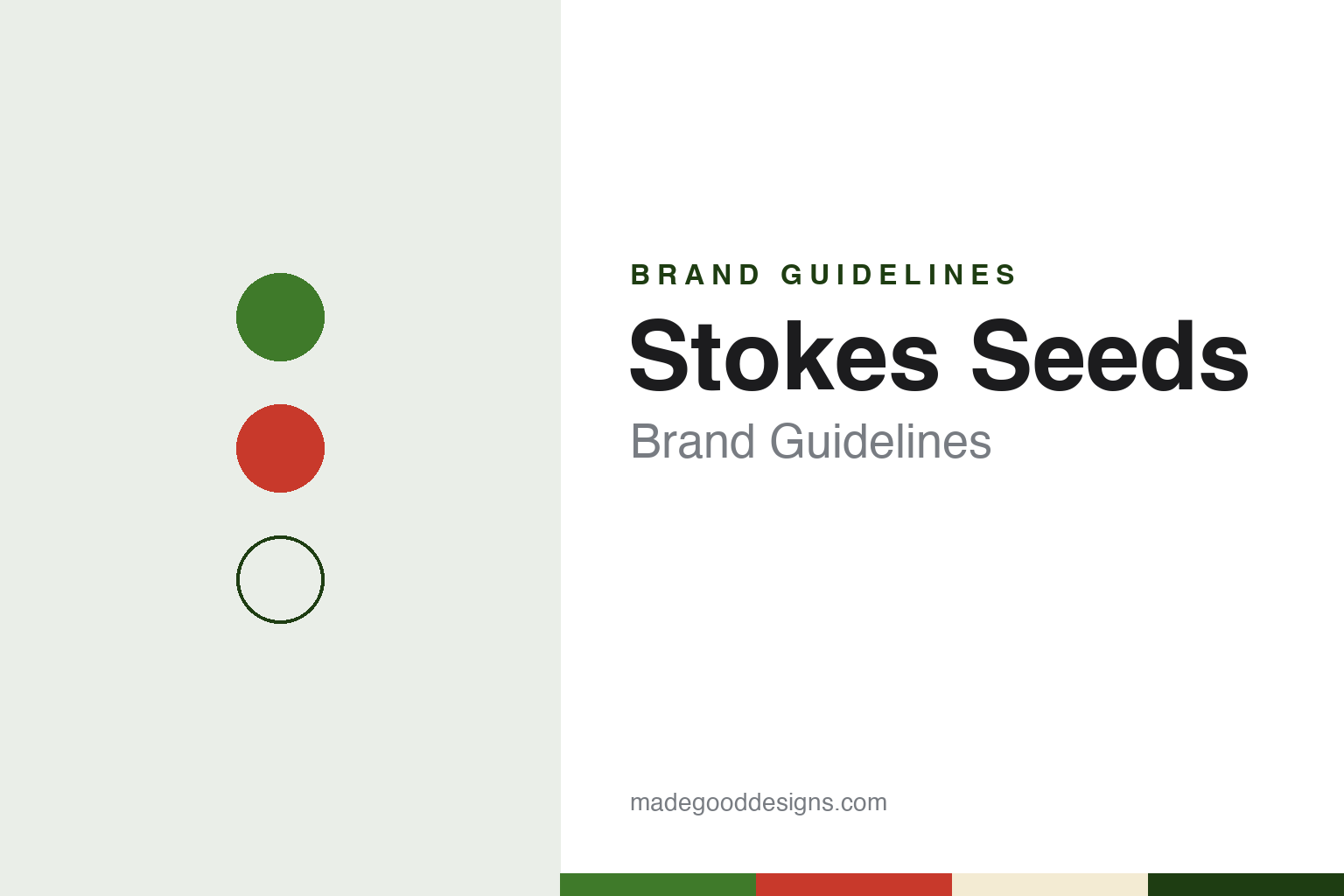
Stokes Seeds Brand Guidelines
A New Jersey seed name, carried on from the Niagara Peninsula since 1934.
Aa
Two constants: a field green, tomato red and seed-paper cream palette and a sturdy grotesque sans register. Abstract homage — not a Stokes Seeds product or mark; no packet, catalogue or logo is reproduced.
From Moorestown to the Niagara Peninsula
A New Jersey partnership, a Canadian salesman and a name that changed hands.
Stokes Seeds is a family-owned vegetable seed distributor with its head office in Thorold, Ontario, on the Niagara Peninsula, and American locations in Buffalo, New York; Vineland, New Jersey; Holland, Michigan; and LaBelle, Florida, the company says. It dates itself to 1881, and its roots lie in New Jersey. The company’s history says Herbert W. Johnson ran a seed business in Moorestown, New Jersey, and that in 1881 Walter P. Stokes became a partner in the newly formed Johnson and Stokes company, which supplied vegetable seed to commercial growers in New Jersey and eastern Pennsylvania. The Globe and Mail, profiling the firm in June 2000, described its origins as a Philadelphia distributor founded in 1881.
The partnership ended in 1906, the company says, and Walter Stokes set up on his own as Stokes Seed Farms at Windermoor Farm near Moorestown. In 1916 his son Francis C. Stokes, a horticulture graduate of Rutgers, took over the firm; the company credits him with work on several New Jersey tomato varieties.
The Canadian chapter began with a salesman. During the Depression, the company says, the Moorestown business struggled and Mr. Stokes put its Canadian business up for sale; in 1934 it was bought by Harry Gale, a Canadian salesman. The Globe and Mail described Gale as a former farmer who had been the firm’s one Canadian sales representative, and reported that the Canadian arm survived when the American company did not, so that the Stokes name became bound up with the Gale family. The newspaper called Stokes a third-generation family company.
Colour
A catalogue written by the family, and a trial programme behind it.
For much of its history the clearest expression of Stokes has been its catalogue. Harry Gale’s son John Gale joined in the 1950s as a commercial salesman, the company says, and later wrote the Stokes catalogue for fifty years. The Globe and Mail reported in 2000 that he was still writing the catalogues and newsletters himself, remained closely involved in choosing products and in quality control, and that the catalogues carried dozens of hybrid flowers and vegetables. The company says that in the Gale years it concentrated on elite open-pollinated strains and on disease-tolerant hybrids.
The same profile set out how the business works. Stokes acts as a middleman, the newspaper said, holding backup inventory, enforcing quality control and standing as a gatekeeper between seed producers and small and medium-sized growers; a grower in Vineland Station, Ontario, told the paper that the company gave him a buffer if he had a problem. Commercial growers accounted for most of its trade, the paper reported, with consumer mail order making up the rest.
Testing is part of the pitch. The company’s about page opens with a line about “helping vegetable growers succeed through reliable genetics, proven performance, and trusted expertise,” and directs commercial growers to territory managers and sales representatives rather than to a shop counter. It says every variety it sells goes through annual, hands-on field trials, and its site keeps a separate seed-trials page. Its about page now describes Stokes as “100% focused on vegetable seeds,” while Seed World, reporting a management appointment in August 2018, described it as a North American distributor of vegetable, flower and herb seed; the current site still lists herbs and flowers in its navigation.
Typography
Design and documentation.
The seven brands in this group are all garden seed houses: Stokes Seeds, Jung Seed, Richters, Pinetree Garden Seeds, Premier Seeds Direct, Eden Brothers and Harris Seeds. Seed houses in general sit at many different points in the trade, from family firms that still carry a founder’s name to catalogue names that now belong to larger groups, and a single brand can be sold everywhere from a garden centre rack to a grower’s order book.
A seed brand’s identity is usually carried less by a single packet than by a name, a catalogue and the place it promises, because the company behind the name may have changed hands, moved its trial grounds or grown far beyond the place where it started. That makes the questions behind each name worth asking plainly: who started it, who owns it now, and where its seed is actually grown, tested and packed.
Each guide separates what independent sources record from what the company says about itself — its founding story, its owners over time, where its seed comes from and how its packets and catalogues have changed — and marks plainly what rests only on the company’s own word.
Aa
A sturdy grotesque sans for a grower’s catalogue. (Specimen set in Archivo, a sans-serif STAND-IN; NOT the Stokes Seeds logo.)
Stokes Seeds
Three generations of Gales, and a push south.
The company says that after 1965 the business returned to the United States and was based in Buffalo, New York, and that it went on to build relationships with breeders in North America, Europe and Asia. Harry Gale ran the company until his death in 1975, The Globe and Mail reported; the company says his two sons then ran it, and that in 1980 John Gale bought the entire company. He chaired its board until 2017, the company says.
The third generation arrived in 1983. The Globe and Mail reported that Wayne Gale, John’s son, left systems consulting in Ottawa that year to return to the family business; the company says he was president from 1995 to 2023. In August 2018 Seed World reported that Wayne Gale had announced Fraser Hetherington as executive vice president, overseeing marketing, product and supplier strategies, with Gale continuing to oversee distribution and finance. That report placed the company’s operations in Thorold, Buffalo and Vineland.
Growth in the United States came through sales teams as well as purchases. In 2000 The Globe and Mail reported that Stokes had long been active in New York State and had recently added a sales team and a distribution centre near Philadelphia. The company says that in 2019 it acquired Siegers Seed Company of Holland, Michigan, and Holland is now one of its four American locat; it says it serves growers across Canada as well.
For a design guide, Stokes Seeds shows how a grower-facing seed house builds its identity on a written catalogue, a trial programme and a name that passed from its founding family to the Gales. Compare Veseys, the Prince Edward Island mail-order seed house, and Burpee. For this guide we use field green, tomato red and seed-paper cream with a sturdy sans, an unofficial interpretation; no product or logo is reproduced.
Explore & save
Keep Stokes Seeds’s identity on hand — save it to a board in the Made Good inspiration library.
Stokes Seeds identity set
Pin the Stokes Seeds field green, tomato red and seed-paper cream palette and the sturdy grotesque sans register to your own board.