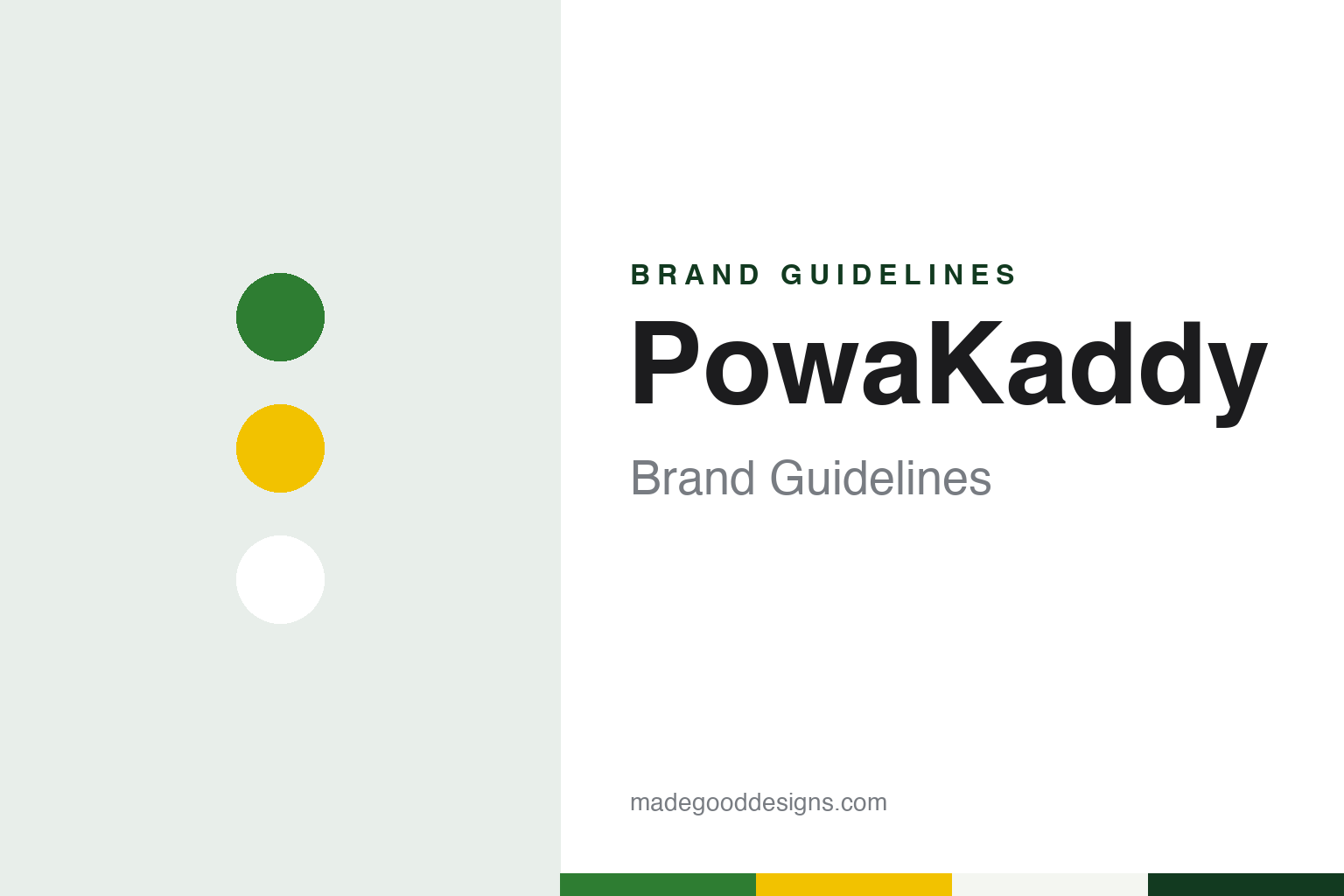
PowaKaddy Brand Guidelines
The Sittingbourne electric trolley, born 1983.
Aa
Two constants: a fairway green, trolley yellow and white palette and a sturdy grotesque sans register. Abstract homage — not a PowaKaddy product or mark; no trolley, logo or badge is reproduced.
A watchmaker’s gearbox
A broken trolley, a repair shop in Kent and a trip to Birkdale.
PowaKaddy began with a repair job. Golf Business News, marking the company’s 40th anniversary in July 2023, describes its founder Joe Catford as a Kent-based watchmaker and keen golfer who, in the late 1970s, began designing an electric trolley of his own. National Club Golfer told the same story in July 2023: a friend at his club owned one of the early electric trolleys, it kept breaking, and Catford was the only person he knew who could fix it. His answer was a trolley driven through a helical reduction gearbox instead of the chains and belts used before, built at first for friends.
The work moved into an automotive repair shop that Catford opened in Sittingbourne, which Golf Business News says became PowaKaddy’s first headquarters. The brand’s formal start came in 1983, when Catford, his business partner John Martin and his son David Catford took prototypes of the PowaKaddy Classic to The Open Championship at Royal Birkdale and came home with more than 500 orders; the first trolleys shipped late that year. English Wikipedia also gives 1983 as the founding year and Sittingbourne as the place.
The early machines were not the folding units golfers know now. National Club Golfer notes that the first models came in three parts that had to be put together before a round, and that early trolleys ran on wet car batteries that leaked, later replaced by sealed batteries. In 1988 came the Rio, a power-assisted pull trolley, which Golf Business News says drew a strong response after a targeted advertising campaign.
Colour
Green for golf, then yellow, and three decades of owners.
The colours have a documented story. National Club Golfer reported in 2023 that PowaKaddy’s original branding was white and green — “green for golf” — and that yellow arrived around the turn of the millennium. The company does not publish official colour values, so the tones in this guide are our own reading of that history.
Ownership changed often. Catford and Martin sold the business to Sunleigh plc: Golf Business News dates the sale to 1988, while English Wikipedia gives 1989. Golf Business News says Sunleigh appointed John deGraft-Johnson managing director in 1991, with David Catford staying on as technical and operational head. Joe Catford, the same account says, went on to found Hill Billy, a rival trolley brand.
Around the millennium the company changed hands again. English Wikipedia describes a management buyout of about 1999 by John deGraft-Johnson, David Wells and Mike Snapes with Close Brothers Private Equity; Golf Business News dates the deal to 2000 and says the deGraft-Johnson team also bought the Hill Billy brand, bringing the two names together. The first Freeway range arrived in 1999, and in 2001 PowaKaddy launched the RoboKaddy, its first remote-controlled trolley.
Private equity followed. English Wikipedia, citing Wealth Bulletin of January 2004, says Close Brothers sold PowaKaddy that year to a team backed by Graphite Capital; Golf Business News dates the formation of the PowaKaddy Group under Graphite to 2005. English Wikipedia says the company went into administration in November 2006, after problems with its P5 model, and was then run under Barclays Ventures.
Typography
Design and documentation.
The seven brands in this group are all names from the golf course’s carrying and clothing trade: OGIO, Sun Day Red, PowaKaddy, Motocaddy, Stewart Golf, BIG MAX and Clicgear. They cover golf bags, push carts, electric trolleys and a new apparel label.
A bag or trolley brand’s identity is usually carried by a name, a mark and a recognisable product shape rather than by any one model, because the company behind the name may have changed hands, moved its manufacturing or changed the way it sells. That makes the questions behind each name worth asking plainly: who started it, who owns it now, and where its products are actually designed and made.
Each guide separates what independent sources record from what the company says about itself — its founding story, its owners over time, where its products are made and how its range has changed — and marks plainly what rests only on the company’s own word.
Aa
A sturdy grotesque sans for a practical, engineered trolley brand. (Specimen set in Archivo, a sans-serif STAND-IN; NOT the PowaKaddy logo.)
PowaKaddy
Back in the founder’s family, still in Sittingbourne.
The family came back. In August 2012 John deGraft-Johnson and David Catford bought PowaKaddy out of administration, English Wikipedia says, citing Golf Monthly; Golf Business News describes the same 2012 deal as the pair buying the brand back. Companies House shows the present company, PowaKaddy International Limited, took that name in October 2012, lists David Catford and John deGraft-Johnson as its directors, and records David Catford as holding 75 per cent or more of its shares. The earlier PowaKaddy company was renamed and later dissolved, the register shows.
Under the new owners the trolleys kept changing shape. Golf Business News lists the return of the Freeway range on a new PowaFrame chassis in 2013, a “Plug ’n’ Play” battery connection in early 2014, the folding C2 in April 2017 and the FW7s GPS in July 2017. English Wikipedia notes that the Freeway II, with push-button controls, was discontinued at the end of 2010 and replaced by the Freeway Sport. The FX and CT ranges followed in March 2020, the CT8 GPS in March 2022 and the RX1 GPS in February 2023. National Club Golfer notes that lithium batteries, lighter than the old lead-acid packs, allowed smaller frames such as the CT8’s.
The company still names Sittingbourne as its home. Its website places the PowaKaddy headquarters in Sittingbourne, England, and says product design and development happen there. Beyond electric trolleys, the range also takes in push trolleys, golf bags and accessories, English Wikipedia notes.
For a design guide, PowaKaddy shows how a single mechanical idea from a watchmaker’s bench can carry a name through four decades and several owners while staying in the same Kent town. Compare Motocaddy, the Hertfordshire electric trolley brand, and Stewart Golf, another British trolley maker. For this guide we use fairway green, trolley yellow and white with a sans, an unofficial interpretation; no product or logo is reproduced.
Explore & save
Keep PowaKaddy’s identity on hand — save it to a board in the Made Good inspiration library.
PowaKaddy identity set
Pin the PowaKaddy fairway green, trolley yellow and white palette and the sturdy grotesque sans register to your own board.


