Motocaddy Brand Guidelines
Hertfordshire’s electric trolley, formed 2004.
Aa
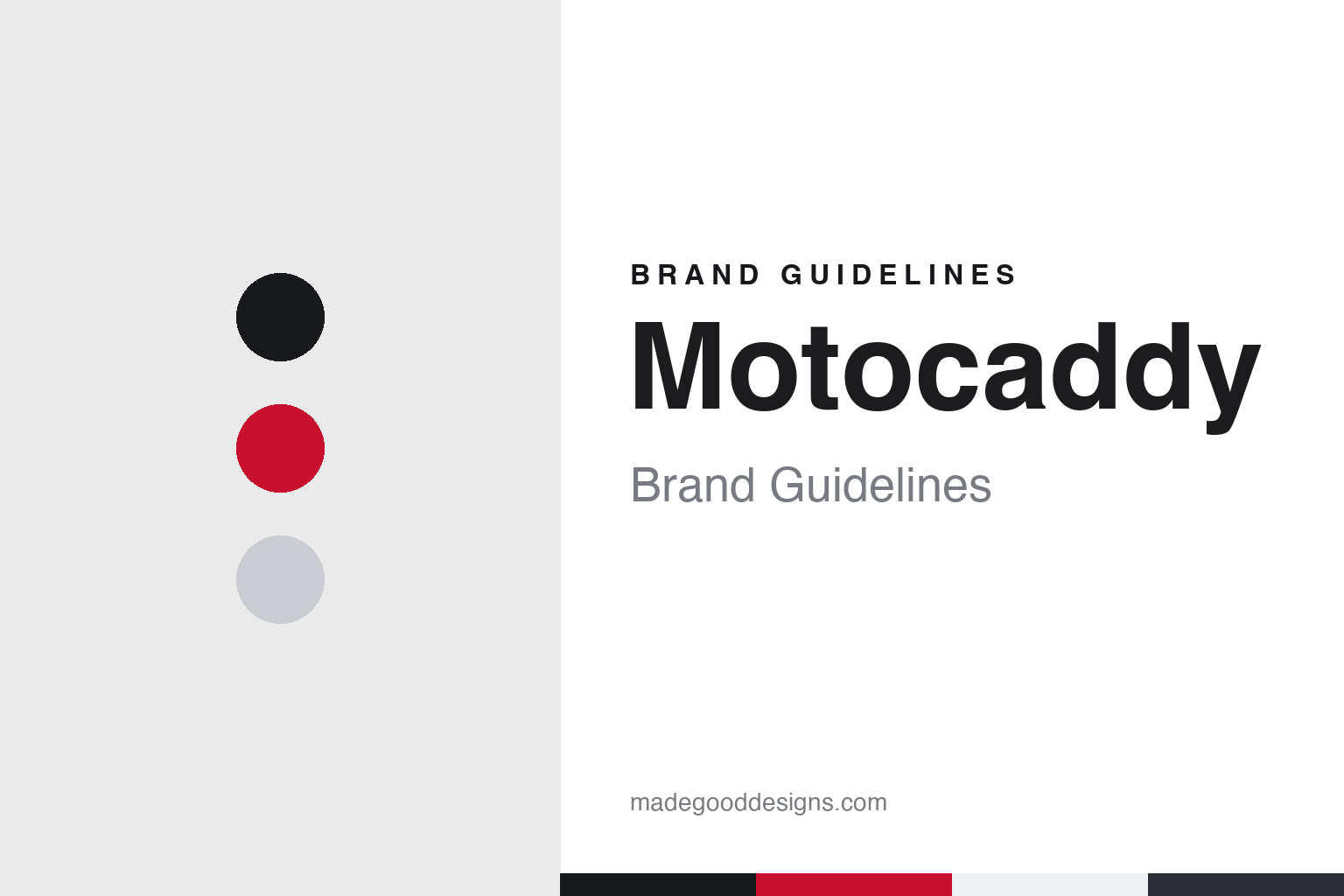
Two constants: a carbon black, graphite and signal red palette and a condensed technical sans register. Abstract homage — not a Motocaddy product or mark; no trolley, logo or badge is reproduced.
A trolley company from 2004
A registered shell, a new name and an entry-level model.
The company says it is a British business founded in 2004 to bring good design, build and function to golfers looking for reliable, affordable electric trolleys. The public register matches that date: Companies House shows Motocaddy Limited was incorporated in July 2004, traded briefly as Future Golf Brands Limited, and took the Motocaddy name in February 2006. Its registered office is at a distribution centre at Start Hill, near Bishop’s Stortford in Hertfordshire, and its registered activity is the manufacture of sports goods.
The company does not name founders on its own pages, and the trade press of the 2010s describes it through its managers rather than a single founder figure. Golf Retailing reported in October 2019 that the entry-level S1 electric trolley had been introduced in 2006, the year the Motocaddy name was adopted, and Golf Monthly reviewed a revised S1 in May 2016, noting its Quickfold mechanism, soft-touch handle and universal battery tray.
The business changed hands from within. Golf Retailing reported in January 2015 that the senior management team had led a buyout in 2010, and a release by the law firm Birketts in October 2019 quoted the departing chief executive, Tony Webb, looking back on “the original MBO back in 2010.” Companies House shows the holding company, Motocaddy Holdings Limited, was formed in June 2010.
Colour
Lithium, remote control and a factory that makes only trolleys.
Motocaddy’s product story is largely a battery story. In January 2015 Golf Retailing interviewed the then chairman David Wells, sales director Neil Parker and marketing manager Oliver Churcher. Wells told the magazine that lead-acid batteries were bulky and constrained a trolley’s design, and that “lithium allows more flexible and compact designs.” The company also sold its LitePower lithium batteries as replacements for trolleys of other makes, the magazine reported.
That same month the brand launched the S7, a remote-controlled trolley, and the waterproof Dry-Series trolley bag, Golf Retailing reported; Parker said remote control had until then been available in the UK only at the luxury end of the market.
On making, the documented picture is limited but specific. Golf Retailing reported in 2015 that Motocaddy’s trolleys were subcontracted to a factory that made only trolleys and that Motocaddy took nearly all of its output; the article did not say where that factory was, and the company does not state it on its about pages. Motocaddy described doing its own research and development, and the magazine reported that the company ran its own websites in twelve regions and supplied distributors in other markets.
Later trade reports list a range that ran from push trolleys to the compact M-TECH, which Golf Retailing called the company’s newest model in October 2019, alongside golf bags, GPS units and a trade-in and recycling scheme. In November 2020 Golf Business News reported that investment since the sale had gone into new trolleys, bags and GPS touchscreen units.
Typography
Design and documentation.
The seven brands in this group are all names from the golf course’s carrying and clothing trade: OGIO, Sun Day Red, PowaKaddy, Motocaddy, Stewart Golf, BIG MAX and Clicgear. They cover golf bags, push carts, electric trolleys and a new apparel label.
A bag or trolley brand’s identity is usually carried by a name, a mark and a recognisable product shape rather than by any one model, because the company behind the name may have changed hands, moved its manufacturing or changed the way it sells. That makes the questions behind each name worth asking plainly: who started it, who owns it now, and where its products are actually designed and made.
Each guide separates what independent sources record from what the company says about itself — its founding story, its owners over time, where its products are made and how its range has changed — and marks plainly what rests only on the company’s own word.
Aa
A condensed technical sans for a brand built on batteries and remote control. (Specimen set in Barlow Condensed, a sans-serif STAND-IN; NOT the Motocaddy logo.)
Motocaddy
Private investors, a US base and a German arm.
In October 2019 Motocaddy sold a majority stake to a private investment group, Ethos Partners, Golf Retailing and GolfMagic reported. The chief executive, John Helas, who had joined in 2018 from the Black & Decker group, stayed in post with Parker and product development director Paul Straker, while Wells and Webb stepped down in January 2020 and kept non-executive roles for a transition. Ethos brought in Brian Phillips, a former KPMG chartered accountant, as chairman. Companies House shows control of Motocaddy Holdings passing to a newly formed company in October 2019. In November 2020 Golf Business News reported a reshaped board: a new chairman, David Hollander, a former UK managing director of Dyson and former chief executive of the shower maker Aqualisa; a chief financial officer, Richard Inglis, appointed earlier that year; and Nick Brooker as international sales director, succeeding Neil Parker, who moved to a non-executive role after 15 years with the business.
The brand then built bases abroad. In October 2020 Golf Business News reported the appointment of Roger Teat, formerly of Cobra Puma Golf, as president of Motocaddy USA, based in Carlsbad, California, where the company’s US site says it has offices for sales, fulfilment and support. In August 2021 the company announced that it had acquired B+M Golf Vertriebs GmbH, a distribution and service agency in Bochum, Germany, completed on 31 July 2021, to serve golfers in Germany and Austria under managing director Thorsten Kueck.
For a design guide, Motocaddy shows how a trolley brand formed in the 2000s can build its identity around engineering features — lithium power, remote control and GPS — rather than a long history. Compare PowaKaddy, the Kent trolley maker founded in 1983, and Clicgear, the push-cart brand. For this guide we use carbon black, graphite and signal red with a condensed sans, an unofficial interpretation; no product or logo is reproduced.
Explore & save
Keep Motocaddy’s identity on hand — save it to a board in the Made Good inspiration library.
Motocaddy identity set
Pin the Motocaddy carbon black, graphite and signal red palette and the condensed technical sans register to your own board.