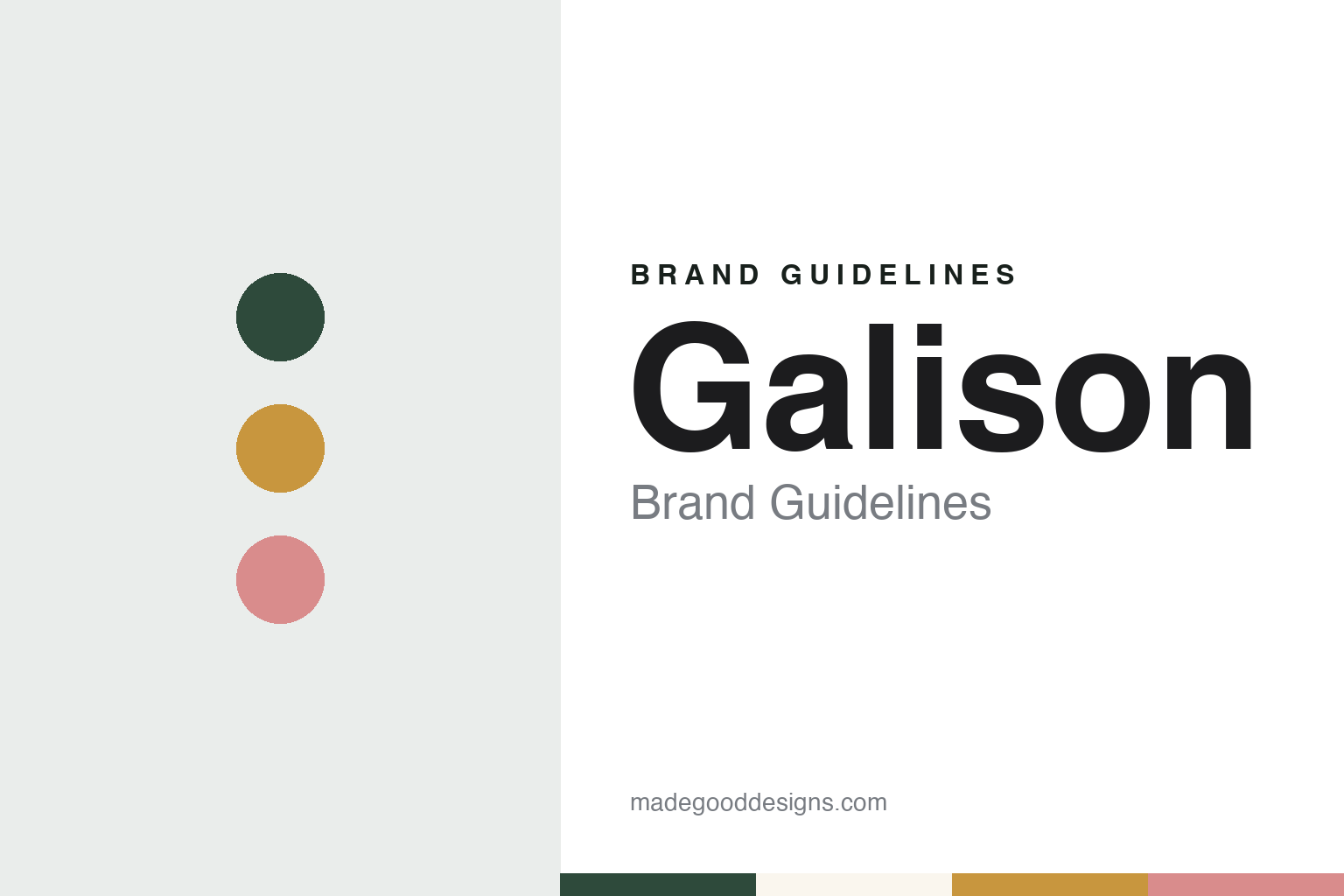
Galison Brand Guidelines
The New York art-paper publisher behind foil and shaped puzzles.
Aa
Two constants: a museum green, foil gold and notecard rose palette and a stationer’s serif register. Abstract homage — not a Galison product or mark; no box, logo or puzzle image is reproduced.
Museum art on paper
A New York stationer that started with museum pictures.
Galison was founded in 1979 and is based in New York City. Its own “About Us” page sums up the early years in one line: the company worked with museums to make selected art images widely available in the form of smartly designed paper products. Boxed notecards, stationery and journals were the business long before jigsaws were.
By the early 2010s the company had grown into a small group. When Publishers Weekly reported its sale on 8 March 2012, it described the parent, GMG Publishing Corp., as a New York-based international publisher of fine-art stationery and paper gifts, founded in 1979 and sold by its founder and owner. GMG then had four parts: Galison Publishing, for boxed notecards, stationery, journals and other gifts; Mudpuppy Press, for toys, gifts, educational puzzles and games; Galison Holiday, for holiday greeting cards; and Galison Custom, which developed proprietary gift and stationery products for companies, non-profits and retailers.
The buyer was the McEvoy Group, the San Francisco–based media company whose book businesses then included Chronicle Books, Princeton Architectural Press and becker&mayer!. Publishers Weekly said Galison would remain based in New York. Two months later, on 14 May 2012, the magazine reported that the McEvoy Group had named Bill Miller, a former Barnes & Noble vice-president for merchandising, gift, product development and calendars, as president of Galison Publishing — by then described as Galison, Mudpuppy, Galison Holiday and Galison Private Label. The same report said Miller had most recently worked as a consultant for clients including Jonathan Adler and The New York Times.
Colour
From notecards to a puzzle catalogue.
Jigsaw puzzles now lead the Galison website’s menu, ahead of craft kits, games and stationery. The company’s puzzle pages describe a range built entirely on named artists and licensed partners: every puzzle, Galison says, features original artwork from its roster. The names it puts forward include the illustrator Michael Storrings, whose cityscapes and seasonal scenes it calls the most represented in its catalogue, and Joy Laforme, alongside licensed work from Andy Warhol, Jean-Michel Basquiat, Frank Lloyd Wright, William Morris and the London store Liberty, whose fabric prints are translated into puzzles. Other regular contributors it names include Wendy Gold, Julie Seabrook Ream, Anne Bentley, the photographer Gray Malin, Victoria Ball and Louise Cunningham Starling.
The catalogue is sorted by season and subject as much as by artist. The puzzle menu groups titles under themes such as autumn and Halloween, winter and the holidays, landscapes and cityscapes, cats and dogs, birds, and flowers and nature, with a separate shelf for what the company calls Galison Classics. Piece counts run from small minis to large projects, and the site sorts every title by size as well as by theme.
Formats are where the brand distinguishes itself. Besides standard rectangular boxes, Galison lists foil puzzles, with metallic accents printed onto the piece surface; shaped puzzles, whose outline follows the picture — bouquets, buildings, animals, hearts; double-sided puzzles; panoramic puzzles; wooden puzzles, which it describes as having thicker pieces with irregular, whimsical shapes; lenticular puzzles with a ridged 3D surface; and surprise puzzles, where the box shows only part of the finished image. It also makes book-shaped puzzles, greeting-card puzzles, puzzle ornaments and advent-calendar puzzles.
On materials, Galison says its standard puzzles use thick chipboard with a linen-style matte finish meant to reduce glare, that the greyboard and packaging contain recycled paper and that the packaging is FSC-certified. It adds that every box includes a full-size reference print of the finished image. The wider shop still carries journals, planners, greeting cards and bookmarks, plus craft kits — paint-by-number, punch needle, origami and rubber stamps — and card and trivia games.
Typography
Design and documentation.
The seven brands in this group are all jigsaw puzzle makers: Eurographics, Galison, Castorland, Jumbo, MasterPieces, Heye and Mudpuppy. Puzzle brands in general sit at many different points in the trade, from family firms that still carry a founder’s name to labels that now belong to larger toy, games or publishing groups, and a single brand can be sold everywhere from a toy shop to a museum gift store.
A puzzle brand’s identity is usually carried less by a single picture than by a box, a name and the artwork it commissions, because the company behind the name may have changed hands, moved its production or grown far beyond the place where it started. That makes the questions behind each name worth asking plainly: who started it, who owns it now, and where its puzzles are actually made.
Each guide separates what independent sources record from what the company says about itself — its founding story, its owners over time, where its puzzles are made and how its boxes have changed — and marks plainly what rests only on the company’s own word.
Aa
A stationer’s serif for an art-paper publisher. (Specimen set in Cormorant Garamond, a serif STAND-IN; NOT the Galison logo.)
Galison
Three brands under one New York roof.
Galison does not work alone. Its sister brand Mudpuppy handles the children’s side — the toys, educational puzzles and games that Publishers Weekly listed as Mudpuppy Press in 2012 — while a third name, Brass Monkey, appears on the Galison shop as the label on sticker books and is listed among the frequently featured names on its puzzle pages.
The connection to Chronicle Books, which Publishers Weekly named among the McEvoy Group’s businesses at the time of the 2012 purchase, is also visible today: Chronicle Books’ own website lists Galison + Mudpuppy among its publishing partners.
What holds the Galison brand together visually is the artwork rather than a house style. The company began by putting museum pictures on notecards, and its puzzles keep that publisher’s role: the artist’s or licensor’s name goes on the box with the picture, and Galison’s own name acts as the imprint underneath.
For a design guide, Galison shows how a stationery publisher can turn named artwork and gift formats into a puzzle brand — compare its sister Mudpuppy and Liberty Puzzles, another American puzzle maker built on art. For this guide we use museum green, foil gold and notecard rose with a serif, an unofficial interpretation; no product or logo is reproduced.
Explore & save
Keep Galison’s identity on hand — save it to a board in the Made Good inspiration library.
Galison identity set
Pin the Galison museum green, foil gold and notecard rose palette and the stationer’s serif register to your own board.


