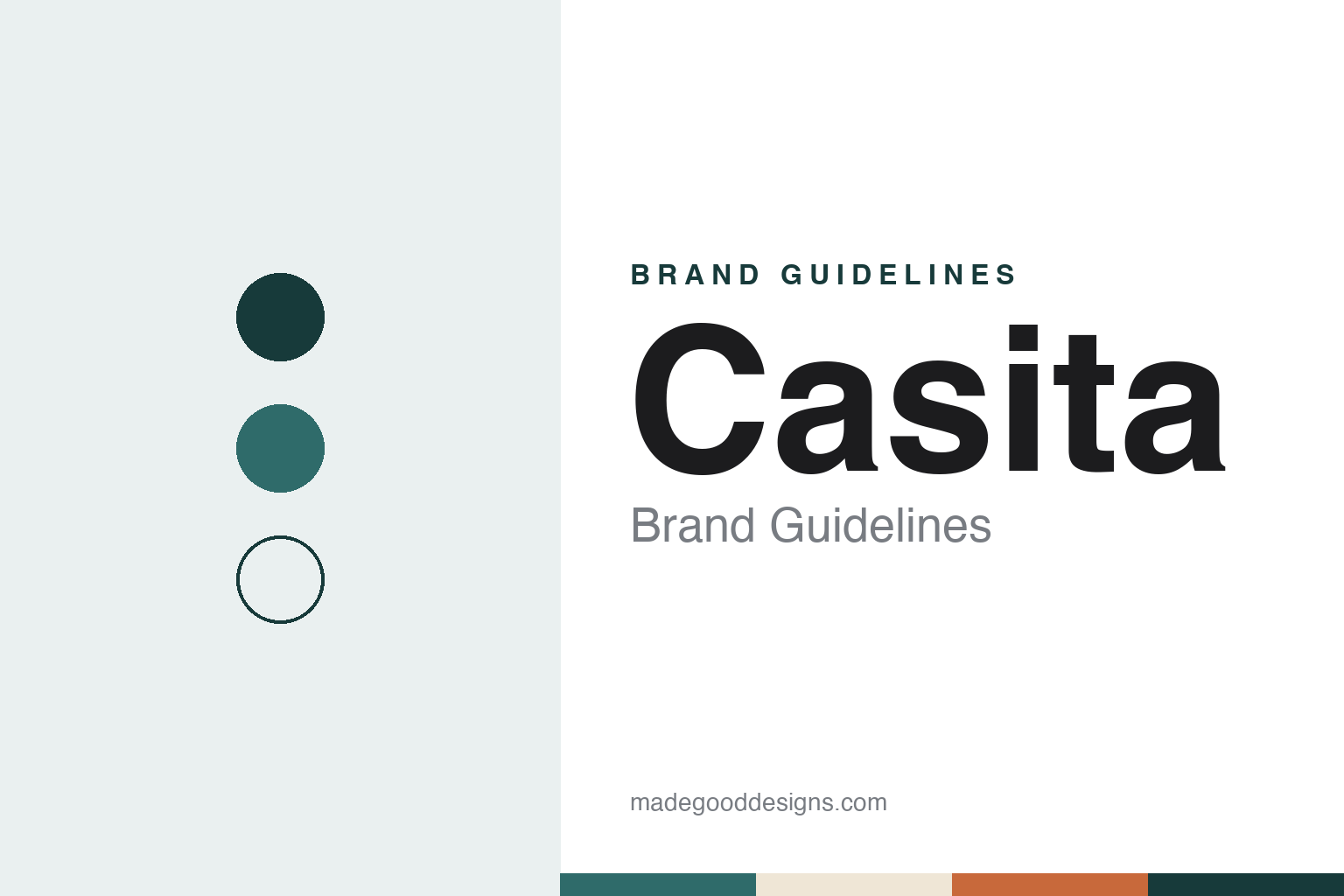
Casita Brand Guidelines
Two moulded halves sealed into one shell, a Spanish word for a little house, and a showroom off Interstate 45.
Aa
Two constants: a lake teal, gelcoat cream and Texas clay palette and a Soft rounded serif register. Abstract homage — not a Casita product or mark; no trailer, decal or logo is reproduced.
Rice, Texas
A little house on wheels, sold off Interstate 45.
Casita is a small travel trailer with a moulded fibreglass body, and the name says what it is meant to be. Casita is Spanish for a little house, a fitting word for a camper sold in Texas. The trailers are sold from a showroom in Rice, Texas, a small town on Interstate 45 just north of Corsicana, south of Dallas.
The company dates its manufacturing to 1983. An “About Us” page on the Casita Travel Trailers website, archived by the Wayback Machine in August 2014, says that Casita Enterprises, Inc. has been manufacturing since 1983, and describes the business as family owned and operated. The footer of the same page carried a copyright line beginning in 1983. That founding year is the company’s own account.
The 2014 site also shows how the brand presented itself at the time. Its menu grouped the trailers by length: a 13-foot Patriot; the Spirit, Freedom and Liberty in 16- and 17-foot versions; and a 17-foot-only Independence. The page also listed the dealership address in Rice, by the interstate exit, and a toll-free number that the website still uses in 2026.
The model names follow a single theme. Patriot, Spirit, Freedom, Liberty and Independence all draw on the language of American national ideals, and later names such as Heritage and Discovery continue the idea. For a product sold largely to people planning long road trips across the country, the names work as a small vocabulary of open roads and personal independence.
Casita belongs to a particular corner of the RV market: the small, rounded fibreglass trailer. Other names in that corner include Scamp and Oliver. The shape itself is the most recognisable part of the brand: a smooth shell with a curved roof, rounded corners and a single seam running around its middle.
Colour
Two moulded halves and a sealed floor.
That seam explains how the trailers are made. On its current website the company says every Casita is built with a fibreglass top and bottom hull that are secured and sealed together with fibreglass, giving a single body with no roof seams. It contrasts this with conventional trailers built with siding over a frame. In practice the design means that much of the trailer’s exterior is one continuous moulded surface rather than panels, trim and joints.
The company says the same approach continues underneath. According to the Casita website, every trailer has an all-fibreglass bottom pan, and the base floor is completely sealed in fibreglass. The company describes the models as hand made and says the manufacturer of Casita trailers is family owned. It also says each trailer is checked at several stages in the factory, including a rain test before delivery.
The range in 2026 is still organised by length, as it was a decade earlier. The website lists a 15-foot Patriot; a group of 17-foot models, the Spirit, Independence, Heritage and Liberty; and two 24-foot Discovery models, labelled LC and FM. Compared with the 2014 menu, the Patriot has grown from 13 to 15 feet, the Freedom name no longer appears, and the larger Discovery has been added at the top of the range.
The site also offers Standard and Deluxe versions, a build-and-price tool, a feature comparison and a page of optional add-ons, together with user manuals, a warranty page and a first-trip planner for new owners.
Owners play a large part in how the brand is seen. The Casita website says owners hold several Casita rallies across the United States every year and that these are organised by customers rather than by the company. It also encourages owners to modify their trailers, saying there are hundreds of do-it-yourself options. The website also keeps a photo gallery of the trailers.
Typography
Design and documentation.
Small travel trailers and recreational vehicles occupy a particular corner of the road-going world. Some are built in compact factories in small towns, often by families who have run the business across more than one generation; others come from much larger groups that hold many nameplates under one roof. A lightweight moulded shell and a towing hitch can look much the same from one maker to the next, so the name on the side has to do a good deal of the work.
That is why the plain questions matter here: who started the company, who owns it today, where the trailers are actually built, and how the product range has changed over time, from the first floor plan to the latest one. Owner clubs, rallies and enthusiast forums often keep that history alive as carefully as the makers do. Model names, body shapes and liveries tend to persist for decades, while the people and owners behind them change.
Each guide in this group sets out what independent, dated sources record next to what the company says about itself, and marks clearly where a fact rests only on the maker’s own account.
Aa
A soft rounded serif — friendly and smooth, like a moulded shell with no sharp corners. (Specimen set in Fraunces, a serif STAND-IN; NOT the Casita logo.)
Casita
A family business and a franchise showroom.
Casita has stayed with the same structure it described in 2014. The company’s current “The Company” page says the business is family owned, and adds that it has no shareholders and no private equity owners. By contrast, several other RV brands in this series belong to large groups such as Thor Industries.
The way the trailers are sold is also distinctive. The present website describes Casita Travel Trailers in Rice as a Texas licensed franchise dealer and says that for decades it has been a dealer of Casita trailers. Customers can buy at the showroom, order a trailer through the build-and-price pages, or arrange delivery or pickup. The site lists in-stock trailers alongside the order pages, and its sales, parts and service functions all point back to the same Rice address.
The brand’s public language stays close to the product. The website talks about the fibreglass shell, the sealed floor and the low weight of the trailers, and it presents ownership as membership of a wider “Casita family” of owners and rallies. Across the archived 2014 site and the 2026 site, the name, the town, the telephone number and the length-based way of presenting the models have stayed the same.
For a design guide, Casita shows how a small maker can build a recognisable identity out of one moulded shape and a short list of patriotic model names, without a large corporate brand system around it. Compare Scamp, another small moulded fibreglass trailer, and Oliver Travel Trailers, another fibreglass trailer maker. For this guide we use lake teal, gelcoat cream and Texas clay with a serif, an unofficial interpretation; no product or logo is reproduced.
Explore & save
Keep Casita’s identity on hand — save it to a board in the Made Good inspiration library.
Casita identity set
Pin the Casita lake teal, gelcoat cream and Texas clay palette and the Soft rounded serif register to your own board.


