Plymouth Brand Guidelines
Chrysler’s Mayflower marque, 1928–2001.
Aa
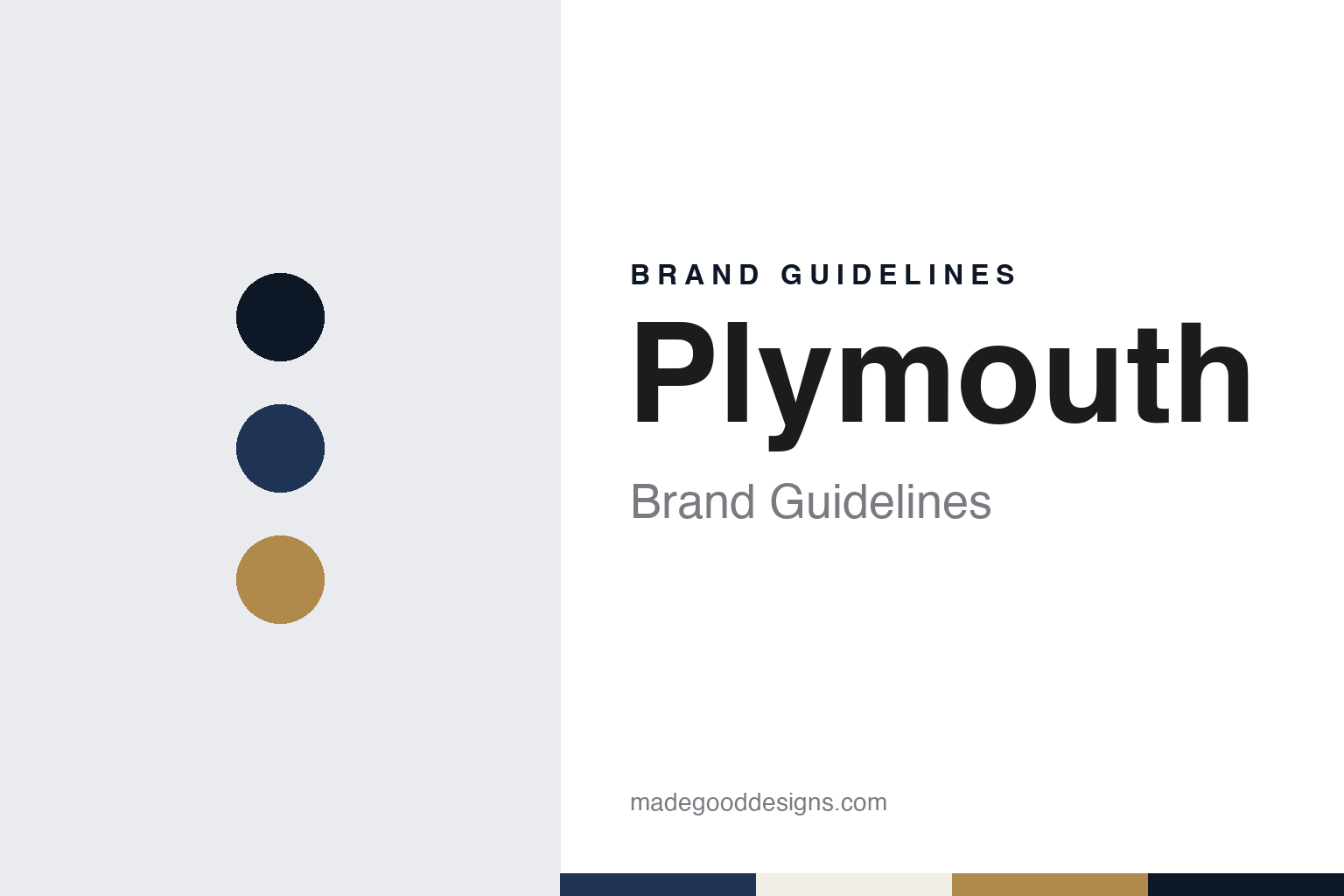
Two constants: a Mayflower navy, sail white and brass palette and a nautical serif register. Abstract homage — not a Plymouth product or mark; no car, badge or logo is reproduced.
The Mayflower marque
A low-priced Chrysler with a ship on the badge.
Plymouth was the low-priced marque of Chrysler Corporation, launched in 1928 and phased out after the 2001 model year. The New York Times, writing in November 1999 as the brand’s end was announced, called it “the brainchild of Walter P. Chrysler,” who wanted to round out his offerings with a low-priced model, and said it was named for the Pilgrim colony in Massachusetts. Wikipedia says the car was introduced at Madison Square Garden in New York on 7 July 1928, aimed at the low-priced market, where its rivals were Chevrolet and Ford.
The car grew out of earlier Chrysler products. Wikipedia traces it to the Maxwell, which Walter Chrysler inherited when he took control of the Maxwell-Chalmers company in the early 1920s. The Maxwell was reworked and rebadged as the Chrysler Model 52 for 1926, and in 1928 it was redesigned again as the Chrysler-Plymouth Model Q, although print advertisements simply called it Plymouth. The “Chrysler” part of the nameplate was dropped with the Model U in 1929. Plymouths were sold at the start through Chrysler dealers; from 1930, Wikipedia says, they were carried by Chrysler, DeSoto and Dodge dealers alike.
The Times ties the name to the Pilgrims. Wikipedia and the enthusiast site Allpar add a second account: that the executive Joe Frazer proposed “Plymouth” because farmers knew Plymouth binder twine, made by the Plymouth Cordage Company of Plymouth, Massachusetts, and that Walter Chrysler liked the idea of a name farmers already recognised. Allpar, in its history of the name, also recounts that dealers were supplied with Pilgrim costumes so that an employee could lead a “Plymouth Parade” introducing the new car, and dates the start of Plymouth production to 11 January 1928. The emblem, Wikipedia says, showed a prow view of the Mayflower, the ship that landed the Pilgrims at Plymouth Rock, and Allpar describes the ship on the radiator of the early cars.
Colour
Fins, a cartoon bird and shared showrooms.
Through the postwar decades the ship shared the car with other signatures. Wikipedia credits the Chrysler stylist Virgil Exner with the 1955 redesign and with the Forward Look design theme that Plymouth advertised for 1957 with the tagline “Suddenly, it’s 1960.” The Times recalled that all 1957 Chrysler Corporation cars, Plymouth included, “sprouted soaring tail fins,” and that in 1949 Plymouth had offered an all-steel station wagon called the Suburban. Wikipedia says the Fury, introduced for 1956 as a special model in the Belvedere series, replaced the Belvedere as the de luxe series in 1959.
Borrowed branding arrived in 1968 with the Road Runner, a stripped-down coupe based on the Belvedere. Wikipedia says Plymouth paid Warner Bros. for the use of the name and likeness of the Road Runner from the Wile E. Coyote cartoons, and paid separately to develop a “beep, beep” horn; later model years brought new Road Runner decals. The Times listed Road Runners and Barracudas among the cars that defined Plymouth in the late 1960s and early 1970s.
The same newspaper identified the difficulty that followed. Plymouth sold the Voyager minivan, which Wikipedia dates from the 1984 model year, but “Dodge and later Chrysler got their own versions,” the Times wrote, “pointing up a problem that has plagued the brand: Its models were duplicated by its corporate siblings, making it hard to forge a distinct identity.” Wikipedia says Chrysler tried to reposition Plymouth in the 1990s as its entry-level brand, with a new sailboat logo and advertising that focused on value. By the late 1990s the line had narrowed to the Voyager minivans, the Breeze sedan, the Neon compact and the Prowler, a hot-rod-styled roadster that Wikipedia describes as the last model unique to Plymouth.
Typography
Badges, signs and retirement.
A car brand lives in a handful of physical objects long before it reaches a screen. The badge on the grille and the tailgate, the script on a front wing, the hood ornament where one exists, and the emblem moulded into a steering-wheel hub are all small pieces of metal or plastic that have to read at a glance and survive weather, washing and years of handling. Each one is a design brief in miniature: a mark that works in chrome, in paint and in relief, at the size of a coin and at the size of a showroom sign.
Dealer signage carries the same mark at architectural scale. Pole signs, fascia lettering, service-bay headers and the colours of a showroom interior turn a badge into a place, and they are usually specified by the carmaker so that one dealership looks like the next. When a manufacturer retires a marque, that whole system has to be undone in stages: signs come down or are re-skinned for a sister brand, parts and service support continue for cars already on the road, and the badges themselves pass into the hands of owners, clubs and collectors. A retired marque often keeps a second life in that afterlife, carried by the people who still drive and restore the cars.
Aa
A nautical serif — the register of a radiator emblem and a showroom brochure. (Specimen set in Fraunces, a serif STAND-IN; NOT the Plymouth logo.)
Plymouth
A ship that sailed into the sunset.
DaimlerChrysler, the company formed by the merger of Chrysler with Daimler-Benz, announced on 3 November 1999 that it would phase out Plymouth at the end of the 2001 model year. The Times headlined its report “Plymouth Becomes a Ghost Ship” and opened with the line that Plymouth was “about to sail into the sunset.” Wikipedia says the name had already ended in Canada after the 1999 model year, that the PT Cruiser, conceived as a Plymouth, was launched as a Chrysler, and that the Prowler and the Voyager moved to the Chrysler badge. The Neon was the last Plymouth model; Wikipedia says the final car was assembled on 28 June 2001 at the Belvidere Assembly plant in Illinois, after which the Neon carried the Dodge badge in the United States.
The Times illustrated its farewell with drawings of a 1928 coupe, a finned 1957 Fury and a 1970 Barracuda, taken from the brochure collection of Steve Hayes. Its account of the marque ran from Walter Chrysler’s low-priced model and the Pilgrim name, through the tail fins of 1957, to the Road Runners and Barracudas of the muscle-car years and the shared minivans that followed. Wikipedia records the 1990s sailboat logo as part of Chrysler’s effort to recast Plymouth as its entry-level brand, a ship again on the badge of a marque named after the Pilgrims.
For a design guide, Plymouth shows how a single emblem can carry the story behind a name for decades, and, in the Times’s own reading, how hard it becomes to keep a distinct identity when the same cars are sold under other badges in the same showrooms. Compare Ford and Chevrolet, the rivals Wikipedia names in Plymouth’s low-priced market, and Pontiac, another retired American marque. For this guide we use Mayflower navy, sail white and brass with a serif, an unofficial interpretation; no product or logo is reproduced.
Explore & save
Keep Plymouth’s identity on hand — save it to a board in the Made Good inspiration library.
Plymouth identity set
Pin the Plymouth Mayflower navy, sail white and brass palette and the nautical serif register to your own board.