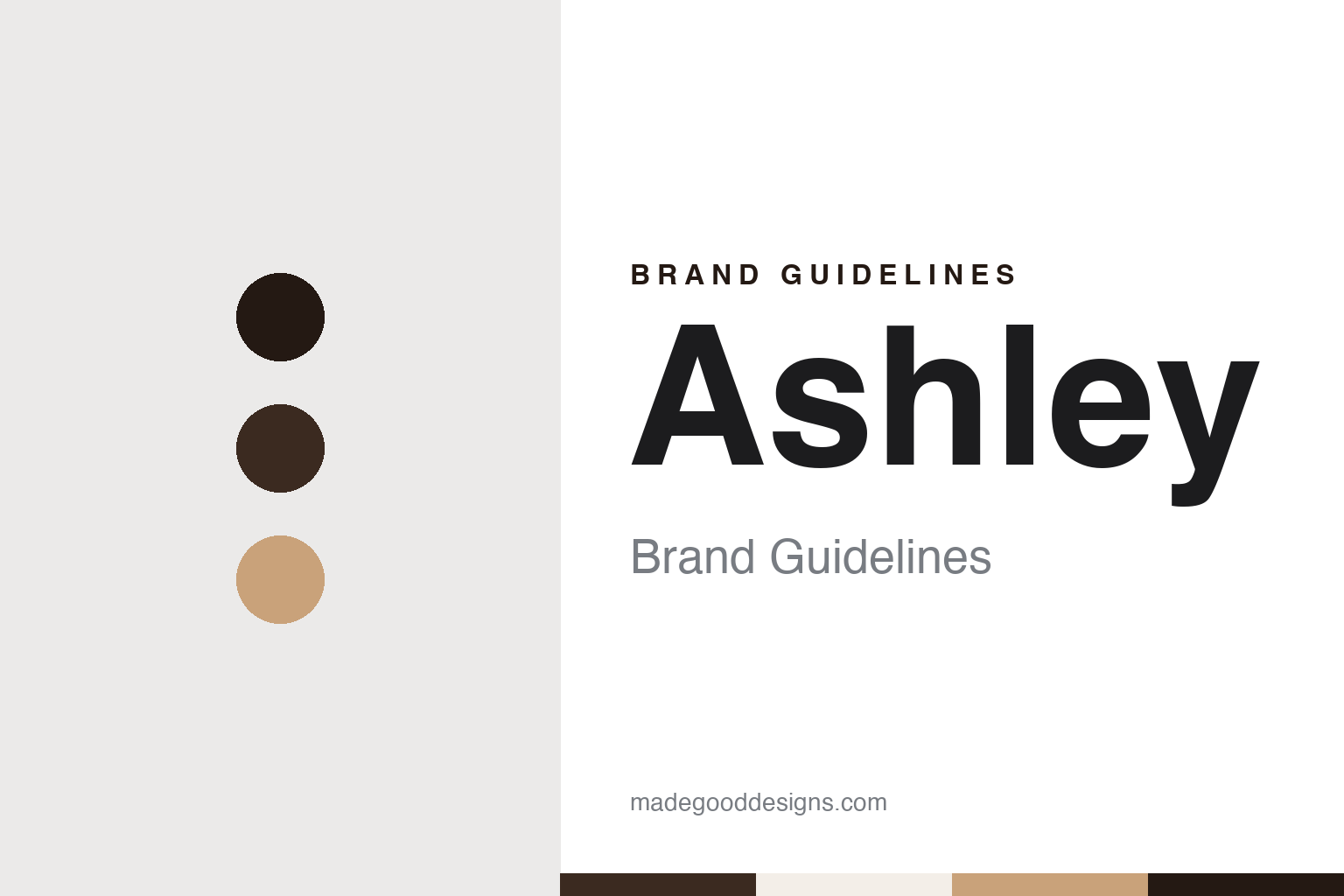
Ashley Brand Guidelines
The Chicago furniture name that moved to Arcadia, Wisconsin.
Aa
Two constants: a walnut brown, oak tan and showroom linen palette and a rounded retail sans register. Abstract homage — not an Ashley product or mark; no furniture, storefront or logo is reproduced.
Chicago to Arcadia
A sales agency, a table factory and a buyout.
Ashley began as a selling business rather than a factory. The International Directory of Company Histories, in a profile published by St. James Press in 2001, says Carlyle Weinberger started the company in Chicago in 1945 as a furniture sales operation. Its speciality was wooden occasional furniture: it bought goods made by local companies and marketed them in Chicago, which the directory describes as the main arena of furniture sales at the time. English Wikipedia adds that the company later opened a branch in Goshen, Indiana.
The name moved north through a supplier. In 1970, the directory says, Ashley invested in a small start-up in western Wisconsin, Arcadia Furniture, which it describes as founded that year by Ron Wanek; English Wikipedia names Thomas Brosseau as Arcadia’s founder. According to the directory, Wanek had grown up on a dairy farm near Winona, Minnesota, and had worked in a Winona factory owned by Eugene Vogel that made wooden cabinets for stereo speakers and televisions. He moved across the Mississippi to Arcadia and took Vogel’s son Chuck Vogel with him. The new plant did production work for Ashley, chiefly wooden occasional tables, and also made stereo and television cabinets.
The supplier then bought the customer. In 1976, the directory says, Wanek and other investors bought out Weinberger and took control of Ashley Furniture. For a time the two kept separate identities, with Arcadia as the production arm and Ashley as the sales arm, before merging under the name Ashley Furniture Industries Inc. By 1982 the corporate headquarters had moved from Chicago to Arcadia, where it remains. The directory notes that the company sat far from the furniture-making centres of the South, in a small town in Wisconsin, and that Ron Wanek approved new designs himself.
Colour
Bedroom sets, a gloss finish and motion furniture.
Through the 1980s the company widened what it made. The directory says Ashley moved away from what consumers thought of as “heirloom pieces” toward furniture with more immediate style, aimed at middle-income buyers, and that it began making bedroom furniture in 1983, reasoning that American homes had one living room but several bedrooms. It sold to wholesalers such as Levitz and to mass retailers such as Sears, Kmart and Montgomery Ward, as well as to smaller stores.
The look that defined Ashley’s wood furniture in that decade came from a finish. In 1986, according to the directory, the company introduced its Millennium line, built on a polyester finishing technique that gave wood furniture a high gloss. The pieces came initially in shiny black, in occasional tables and bedroom sets, and then in colours such as emerald green, and the directory describes them as contemporary in feeling. The same gloss later appeared as moulding on a youth bedroom line introduced in the mid-1990s, alongside a ready-to-assemble range of desks and hutches for home offices.
Upholstery came next. Because the Arcadia works lacked the equipment for upholstered goods, the directory says, Ashley bought an existing plant in Ecru, Mississippi, from a subsidiary of Sklar-Peppler in 1994. Late in the decade it began making mattresses and box springs to sell with its bedroom sets, and in 1999 it bought Gentry Furniture of Ripley, Mississippi, a maker of reclining sofas and sectionals, keeping that plant for motion furniture while Ecru made stationary pieces. The directory also lists assembly and distribution plants in Seattle, Pomona in California, New Brunswick in New Jersey and Orlando, which took in parts imported from Asia. English Wikipedia says the company now has factories and sourcing offices in Asia as well as in the United States.
In February 2015 The New York Times reported that the federal Occupational Safety and Health Administration had cited Ashley over safety violations at its Arcadia plant.
Typography
Design and documentation.
For a furniture or mattress retailer, the brand is met first at the scale of a building. Showroom signage has to read from a highway or a car park, so the name usually sits in a single bold wordmark on the façade, often lit at night and repeated on pylon signs at the entrance to a retail park. Inside, the identity steps back and the furniture takes over.
Room settings are the retailer’s main design tool. Sofas, beds and tables are grouped into staged living rooms, dining rooms and bedrooms, with rugs, lamps and accessories that suggest a way of living rather than a single product. Aisle markers, price-tag holders and department headers carry the brand colours in small doses so they do not compete with the rooms.
Catalogues, printed and digital, extend those room settings onto the page: wide photographs, generous white space, a consistent typeface for headings and a restrained palette for captions. On the road, delivery-truck graphics act as moving billboards, so the wordmark is usually large, high-contrast and readable at a glance from another lane. Together, these touchpoints let a home-furnishings name stay recognisable from the street to the doorstep.
Aa
A rounded retail sans — the register of a storefront sign and a showroom tag. (Specimen set in Figtree, a sans-serif STAND-IN; NOT the Ashley logo.)
Ashley
A maker’s name carried onto its own stores.
For decades Ashley was a name on furniture sold by other retailers. That changed in 1999, when, according to the International Directory of Company Histories, the company branched into retailing by licensing stores to independent dealers. The stores were called Ashley Furniture HomeStores and sold only Ashley goods, and the directory says they were placed in areas where the company did not otherwise have strong distribution. English Wikipedia describes the chain today as a mix of corporate-owned stores and independently owned stores licensed to sell Ashley products, including mattresses and accessories, and treats Ashley HomeStore as a retail brand of its own.
Retail and manufacturing have since been run together at the top. Furniture Today reported in January 2017 that Mark Dufresne had left the post of chief executive of Ashley Global Retail, and that Todd Wanek, president and chief executive of Ashley Furniture Industries, would oversee both the manufacturing and retail businesses. The same report noted that Dufresne’s family firm in Winnipeg had operated Ashley HomeStores as a licensee.
The company has stayed in family hands. The 2001 directory described it as privately held by Ron Wanek, Chuck Vogel and their sons, with Todd Wanek a co-owner and chief operating officer, and said the owners had preferred to keep it under local control rather than take it public. English Wikipedia now describes Ashley Furniture Industries as owned by the father and son Ron and Todd Wanek, with its headquarters plant in Arcadia.
Ashley has also bought into bedding brands. In March 2024 Retail Dive reported that Ashley Home, an affiliate of Ashley Global Retail, had acquired Resident Home, the owner of the mattress brands Nectar, DreamCloud, Awara and Siena, and that Resident’s co-founders, Eric Hutchinson and Ran Reske, would stay on as co-chief executives.
For a design guide, Ashley shows how a maker’s name can become a shopfront: a Chicago sales label taken over by its Wisconsin supplier, then carried onto stores that sell nothing else. Compare La-Z-Boy, another manufacturer with its own galleries, and Rooms To Go, a retailer built on whole-room sets. For this guide we use walnut brown, oak tan and a linen white with a sans, an unofficial interpretation; no product or logo is reproduced.
Explore & save
Keep Ashley’s identity on hand — save it to a board in the Made Good inspiration library.
Ashley identity set
Pin the Ashley walnut brown, oak tan and showroom linen palette and the rounded retail sans register to your own board.