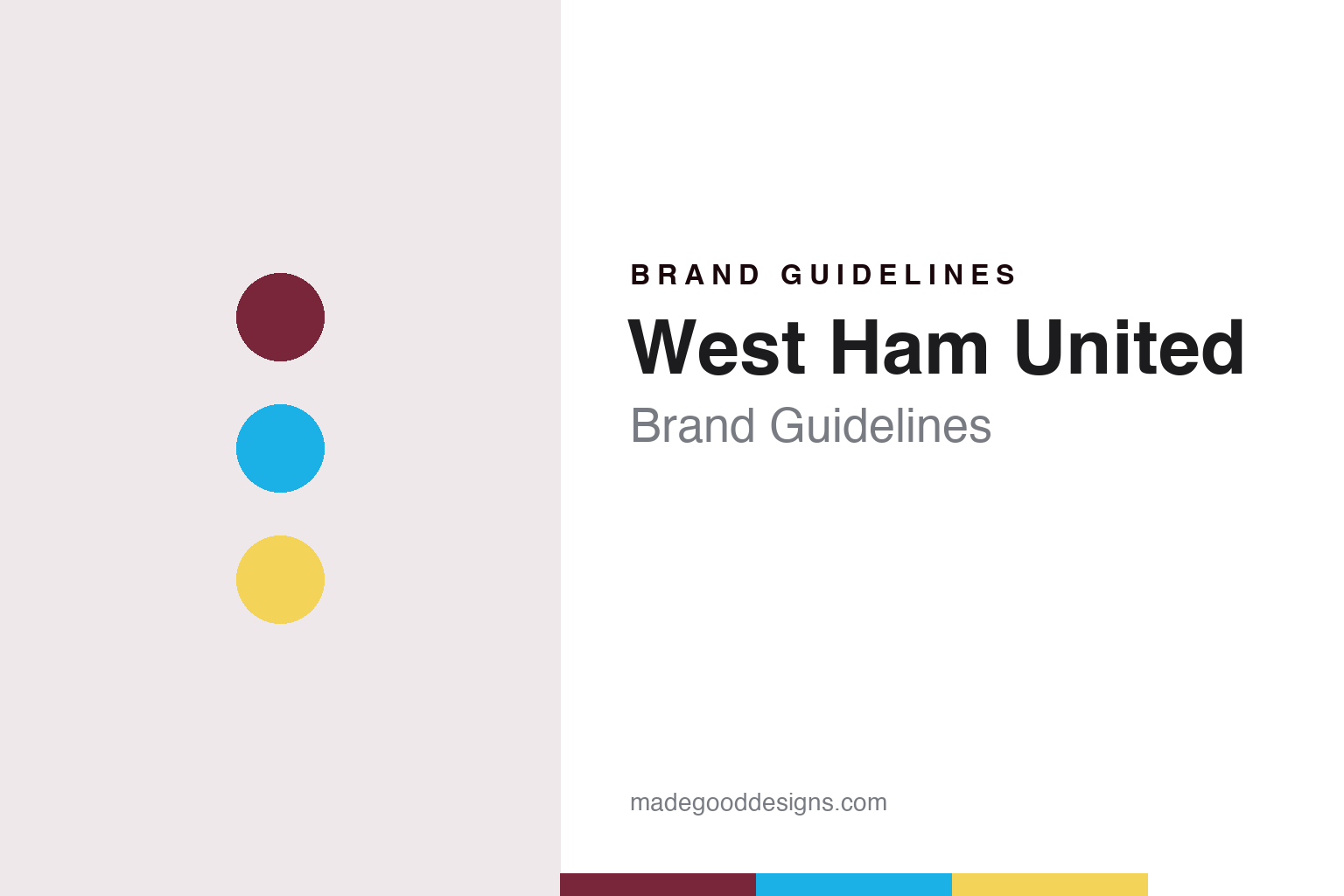
West Ham United Brand Guidelines
A shipyard’s football team that kept the riveters’ tools on its badge.
Aa
Two constants: a claret, sky blue and gold palette and a condensed sans register. Abstract homage — not a West Ham United crest, kit or mark; no logo is reproduced.
Thames Ironworks
A works team on the River Lea, and a club named after its borough.
West Ham United began as a shipyard side. English Wikipedia says the club was founded in 1895 as Thames Ironworks F.C., the works team of the Thames Ironworks and Shipbuilding Company, by the foreman and local referee Dave Taylor and the company’s owner, Arnold Hills. The team was announced in the Thames Ironworks Gazette in June 1895. The yard stood at Leamouth Wharf in Blackwall and in Canning Town, on both banks of the River Lea where it meets the Thames, and it built HMS Warrior among many other ships.
The early players came from the yard. Wikipedia lists a ship’s fireman, a clerk, several boilermakers and an apprentice riveter, Charlie Dove, among the works employees who played. The team was reformed in 1900 as West Ham United, taking the name of the county borough where it played, and the nicknames that stuck, the Hammers and the Irons, both point back to the ironworks.
The colours took a few years to settle. Wikipedia says the side originally wore navy blue, the sporting colours of Harrow School and Oxford University, both of which Hills had attended and represented, and used other kits including sky blue shirts with white shorts from 1897 to 1899. The club permanently adopted claret and blue, the house colours of Thames Ironworks, as its home colours in 1903, and the familiar claret shirt with sky-blue sleeves first appeared in 1904. Wikipedia records a story that the kit came from Aston Villa via a wager won by the sprinter William Belton, and notes that the story is often disputed.
The grounds moved east and then north. As Thames Ironworks the team played at Hermit Road in Canning Town and briefly at Browning Road in East Ham, Wikipedia says, before the Memorial Grounds in Plaistow from 1897. In 1904 the club moved to the Boleyn Ground in Upton Park, its home for more than a century.
The Boleyn Ground took its name from a building next door. Wikipedia says Green Street House, an originally Tudor group of buildings beside the ground, was known as Boleyn Castle because of a tradition linking it to Anne Boleyn, a tradition with no documentary evidence behind it. The house was demolished in 1955, but its tower had already started to appear on the club’s badge, and the club had taken over Boleyn Castle FC as its reserve side when it moved to the site.
In 2016 the club left Upton Park for the London Stadium in Stratford, the former Olympic Stadium, after a bidding and legal process that ran for several years.
Colour
Rivet hammers, a borrowed castle, and a hull-shaped shield.
The hammers on the badge are working tools. English Wikipedia says the Thames Ironworks team first used the Union Flag as its badge, but the principal element of the club crest became a crossed pair of rivet hammers, the tools used in shipbuilding. Teams of riveters at the yard heated rivets until they were white hot, passed them through holes punched near the edges of iron plates, and two men outside the hull, one right-handed and one left-handed, hammered the glowing ends flat.
The same tools appear in local heraldry. Wikipedia says crossed hammers were incorporated into the coat of arms of the County Borough of West Ham and of its successor, the London Borough of Newham, which gives the crest a link to the borough as well as to the yard.
A tower joined them from the 1950s. Wikipedia says a yellow or white tower was added intermittently, probably to represent the tower of Green Street House beside the Boleyn Ground. In the late 1990s the crest was redrawn with a wider yellow castle and fewer cross-shaped windows, the peaked roofs removed. When the club rebuilt the west stand at the Boleyn Ground, finished in 2001–02, the castle from the badge was built into the main entrance, with a pair of towers each carrying large club badges.
The castle went when the club left the ground. The Drum reported on 13 July 2014 that supporters had voted on new crest designs that removed the castle linked to the Boleyn Ground ahead of the move to the Olympic Stadium in 2016–17, with the new design to take effect from that season. Wikipedia says the 2016 crest keeps the crossed hammers alone, which the club says was inspired by the crest of the Bobby Moore era, and adds the word “London” beneath them; the club described the simpler approach as a strong statement of West Ham United. The shield takes the shape of the cross-section of the hull of HMS Warrior, the warship built by Thames Ironworks.
That crest is now under review. Footy Headlines reported on 21 August 2026 that the club had begun a supporter consultation called “Forging Our Future,” with an online survey running from 20 August to 13 September 2026 asking whether the badge should be kept or changed and which visual elements represent the club’s heritage. Concepts are to be developed with the Fan Advisory Board through the 2026–27 season, followed by a supporter vote in spring 2027, with any new crest targeted for the 2028–29 season.
Typography
Clubs, crests and colours.
English club crests draw on a small set of visual sources. Some borrow directly from heraldry, with rampant lions, shields, mottoes and stars arranged in the manner of a coat of arms. Others take an animal associated with a club’s nickname, such as a fox, a bird or a hammer-bearing figure, and render it as a simple silhouette. Many lean on the arms of the town or city the club represents, adapting towers, ships, rivers or civic symbols into a badge that can sit on a shirt, a programme cover or a stadium wall.
Crests change over time. Clubs redraw them to work at small sizes, on screens and on merchandise, to simplify fine detail, or to register a mark as a trademark. A redesign can be contentious, because supporters often treat the badge as part of their own identity, and several clubs now run fan consultations, surveys or supporter panels before a new crest is adopted. Some redesigns have been revised or withdrawn after supporters objected.
Shirt sponsorship sits alongside the crest on the kit. Sponsor names, kit-maker logos and sleeve partners appear on the front of the shirt, and they change far more often than the badge itself, which is one reason the crest and club colours carry so much of a club’s visual continuity.
Aa
A condensed sport sans — the register of a shirt number and a stand sign. (Specimen set in Oswald, a sans-serif STAND-IN; NOT the West Ham United logo.)
West Ham United
Two co-chairmen, a Czech investor, and a new home in Stratford.
The modern ownership dates from 2010. English Wikipedia says David Sullivan and David Gold acquired a controlling share in West Ham in January 2010, giving them operational and commercial control, and later increased their holdings. Both had said the club should move to the Olympic Stadium after the 2012 Games, which was in the borough of Newham.
Other investors followed. Wikipedia says the American investor J. Albert “Tripp” Smith bought a stake in September 2017, and that on 10 November 2021 the club announced that the Czech businessman Daniel Křetínský had acquired a shareholding. Gold’s daughter Vanessa Gold became joint-chair with Sullivan in 2023, and Wikipedia says Sullivan stood down as chairman on 6 June 2026.
The move to Stratford reshaped the identity. The Drum’s 2014 report tied the crest change directly to leaving the Boleyn Ground, and the castle that had been built into the old stadium’s entrance did not travel. The London Stadium carries the claret and blue instead, with the crossed hammers and the word London on the crest.
The colours hold the brand together. Wikipedia says the claret shirt with sky-blue sleeves, which first emerged in 1904, has been the usual form of the home kit, while the club continued to use its earlier favoured colours for away kits. The combination ties West Ham to the Thames Ironworks house colours rather than to any later sponsor or maker.
The club played in the Premier League until the end of the 2025–26 season; English Wikipedia says it was relegated that May and is competing in the Championship in 2026–27, aiming to return.
For a design guide, West Ham United shows how a working tool can carry a club’s whole story, outlasting the castle that was added to it and leaving the next redesign to its supporters. Compare Arsenal, whose cannon also came from local history, and Aston Villa, which also wears claret and blue. For this guide we use claret, sky blue and hammer gold with a condensed sans, an unofficial interpretation; no product or logo is reproduced.
Explore & save
Keep West Ham United’s identity on hand — save it to a board in the Made Good inspiration library.
West Ham United identity set
Pin the West Ham United claret, sky blue and gold palette and the condensed sans register to your own board.


