Arsenal Brand Guidelines
A works team from a Woolwich armaments factory that kept the cannon as its badge.
Aa
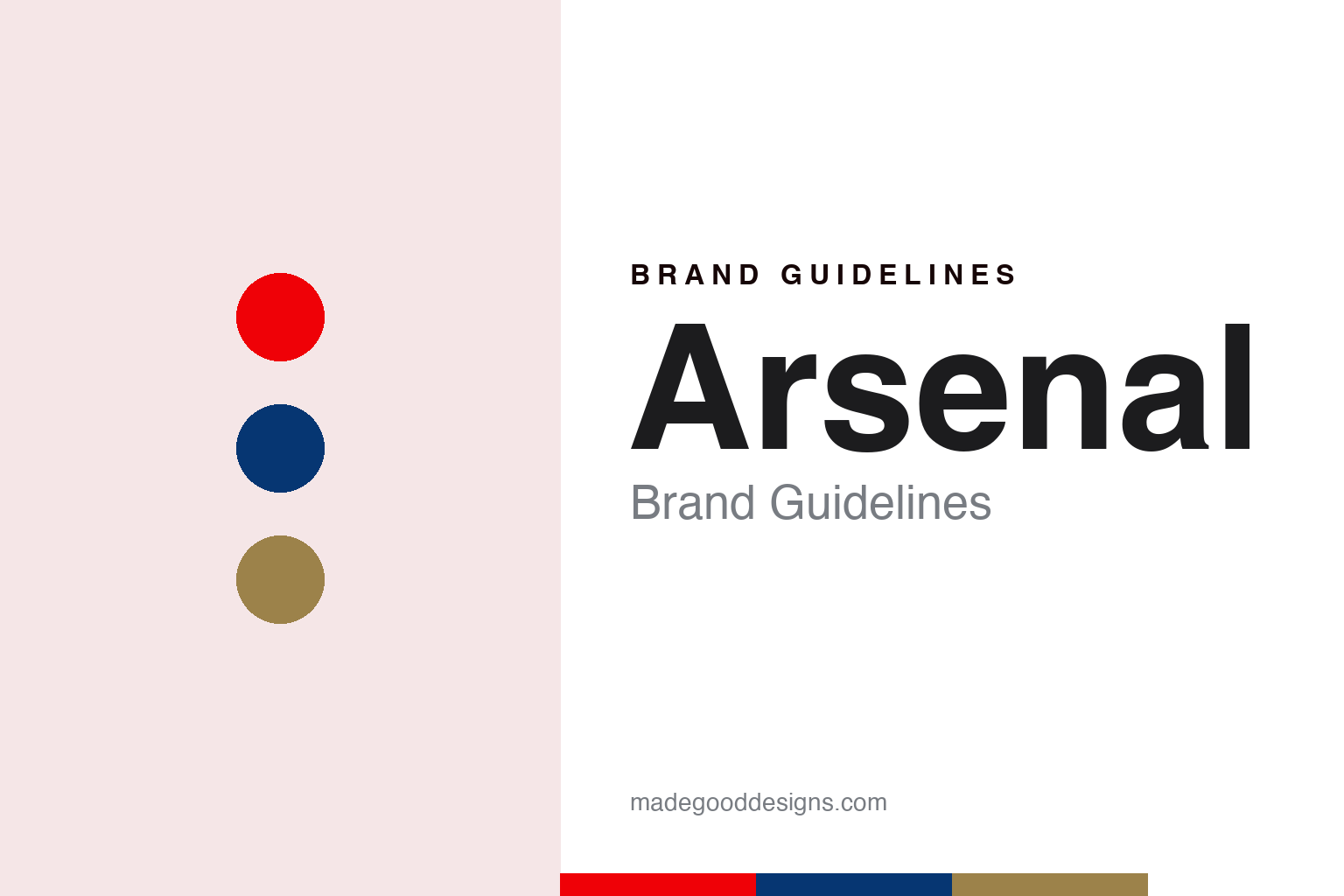
Two constants: a red, navy and gold palette and a condensed sans register. Abstract homage — not an Arsenal crest, kit or mark; no logo is reproduced.
Dial Square
A workshop, a borrowed red shirt and three changes of name.
Arsenal began inside a weapons factory. English Wikipedia says that in October 1886 the Scotsman David Danskin and fellow munitions workers at the Royal Arsenal in Woolwich, south-east London, formed the Dial Square Football Club, named after a workshop at the heart of the Arsenal complex. Each member contributed sixpence. The club played its opening match on 11 December 1886.
The name changed quickly. Wikipedia says the club had become Royal Arsenal by January 1887, playing on Plumstead Common and then at the Manor Ground. It was renamed again in 1893, when it became a limited liability company and registered as Woolwich Arsenal with the Football League. In 1913 it moved across the river to a new Arsenal Stadium at Highbury in north London, and from 1919 it began dropping “The” from “The Arsenal” in official documents, settling on the name it uses today.
The red came from Nottingham. Wikipedia says two of Dial Square’s founding members, Fred Beardsley and Morris Bates, were former Nottingham Forest players who had moved to Woolwich for work. With no kit available, they wrote home for help and received a set of shirts and a ball. The shirt was redcurrant, a dark red, worn with white shorts and blue-and-white hooped socks.
The modern shirt dates from 1933. Wikipedia says manager Herbert Chapman, wanting his players to be more distinctly dressed, added white sleeves and changed the shade to a brighter pillar box red. Two stories are told about the sleeves: that Chapman saw a supporter wearing a red sleeveless sweater over a white shirt, or that he copied an outfit worn by the cartoonist Tom Webster, a golf partner. The red body with white sleeves has been worn ever since, with two exceptions: all-red shirts in 1966–67, which Wikipedia says proved unpopular, and commemorative redcurrant shirts in 2005–06, the final season at Highbury. In 2008–09 the plain white sleeves were replaced with red sleeves carrying a broad white stripe.
Away colours were long white or navy. Wikipedia says that after the Football Association banned navy shirts in 1968 as too close to referees’ black, the club introduced yellow shirts with blue shorts for 1969–70, and yellow and blue became the usual away scheme for decades.
Colour
Three cannons, then one, then a redrawn one.
The cannon is as old as the club’s name. English Wikipedia says the Royal Arsenal crest unveiled in 1888 showed three cannons viewed from above and pointing north, similar to the arms of the Metropolitan Borough of Woolwich. They are sometimes mistaken for chimneys, but each has a carved lion’s head and a cascabel. The crest was dropped after the move to Highbury in 1913 and reinstated in 1922 as a single cannon pointing east, with the nickname “The Gunners” beside it. In 1925 the cannon was reversed to point west and its barrel slimmed.
The 1949 crest added civic heraldry and lettering. Wikipedia says it placed the cannon below the club’s name, set in blackletter, above the arms of the Metropolitan Borough of Islington and a scroll carrying a new Latin motto, Victoria Concordia Crescit — “victory comes from harmony” — coined by the club’s programme editor, Harry Homer. It was rendered in colour, which eventually settled as red, gold and green.
A badge on the shirt was a later habit. Wikipedia says that until the 1960s one was worn only for high-profile matches such as FA Cup finals, usually as a red monogram of the club’s initials on white. Under Chapman in the 1930s the monogram became an Art Deco badge in which the letters A and C framed a football, set in a hexagonal border, and it was used as a design feature around Highbury, above the main entrance and inlaid in the floors. From 1967 a white cannon was regularly worn on the shirt.
The 2002 redesign was driven by protection. Wikipedia says repeated revisions had left the club unable to copyright the 1949 crest, and that despite registering it as a trademark and winning a long legal battle with a street trader, Arsenal sought fuller protection. In 2002 it introduced a crest with modern curved lines and a simplified style. The cannon faces east again, the name is set in a sans-serif above it, and dark blue replaced green. The Arsenal Independent Supporters’ Association criticised the design as ignoring the club’s history and said fans had not been properly consulted.
Variants have followed. For the 125th anniversary season of 2011–12, Wikipedia says the shirts carried an all-white crest framed by oak leaves, for the Royal Oak pub where founders met, and laurel leaves, with the motto “Forward.” From 2021–22 the cannon-only badge returned on the away kit, spreading to all three kits in 2024–25.
Typography
Clubs, crests and colours.
A football club’s identity works across a wide range of surfaces. The crest sits at the centre of it: a compact mark that has to read on a shirt seen from the far side of a stadium, on a television scoreboard graphic, on a phone app icon and on a stitched scarf. Clubs revise their crests from time to time, usually simplifying detail, tightening outlines or redrawing lettering so the mark reproduces cleanly at small sizes and in a single colour.
Kit colours carry the identity as much as any logo. A club’s home colours are often older than its crest, and supporters recognise them at a glance, so designers tend to treat them as fixed while the cut, trim and pattern of the shirt change from season to season. Away and third kits give more room for experiment.
Shirt sponsors add a second brand to a highly visible surface a club owns, which means the crest, the kit maker’s mark and the sponsor’s wordmark have to sit together without crowding. Stadium signage, from gate numbers to the name on the stand roof, extends the same system into architecture, wayfinding and the backdrop of every broadcast.
Aa
A condensed sport sans — the register of a shirt number and a stand sign. (Specimen set in Oswald, a sans-serif STAND-IN; NOT the Arsenal logo.)
Arsenal
A Colorado owner, a new stadium and three kit makers.
The club changed hands gradually. The Guardian reported on 11 April 2011 that Kroenke Sports Enterprises, which had been building a stake since 2007, had taken control of Arsenal after reaching undertakings with the major shareholders Danny Fiszman and Lady Nina Bracewell-Smith, and would now bid for the remaining shares. Peter Hill-Wood agreed to continue as chairman. The paper noted that KSE already owned the Denver Nuggets, the Colorado Avalanche and the Colorado Rapids. Wikipedia says Stan Kroenke bought out the remaining large shareholder, Alisher Usmanov, in August 2018, and moved to become sole owner. The parent company, Arsenal Holdings plc, is an unlisted public limited company.
The ground moved in 2006. Wikipedia says Highbury, designed by the football architect Archibald Leitch and rebuilt in the 1930s with Art Deco West and East stands, was the club’s home from September 1913 until May 2006. The new stadium at Ashburton Grove, about 500 metres away, was completed in July 2006 and named the Emirates Stadium after its sponsor, the airline Emirates.
Kit makers have rotated. Wikipedia says Nike took over from Adidas in 1994 and moved the away colours to two-tone blue. The Independent reported in July 2014 that Puma had replaced Nike, launching the kits at its Carnaby Street store and switching to new home, away and third shirts every season. Adidas has made the kits since the 2019–20 season.
The club has a costumed mascot. Wikipedia says Gunnersaurus Rex, a green dinosaur, appeared at Highbury in the 1990s, based on a young supporter’s drawing that won a Junior Gunners competition; his backstory is that he hatched from an egg found during renovations at Highbury.
Arsenal plays in the Premier League, where the crest appears on broadcast graphics and on the stadium’s exterior.
For a design guide, Arsenal shows how a single object — a cannon from a Woolwich factory — can survive a move across London, several redraws and a full modernisation. Compare Liverpool FC, whose badge rests on a civic bird, and Manchester United, whose crest keeps a ship from Manchester’s arms. For this guide we use pillar box red, crest navy and cannon gold with a condensed sans, an unofficial interpretation; no product or logo is reproduced.
Explore & save
Keep Arsenal’s identity on hand — save it to a board in the Made Good inspiration library.
Arsenal identity set
Pin the Arsenal red, navy and gold palette and the condensed sans register to your own board.