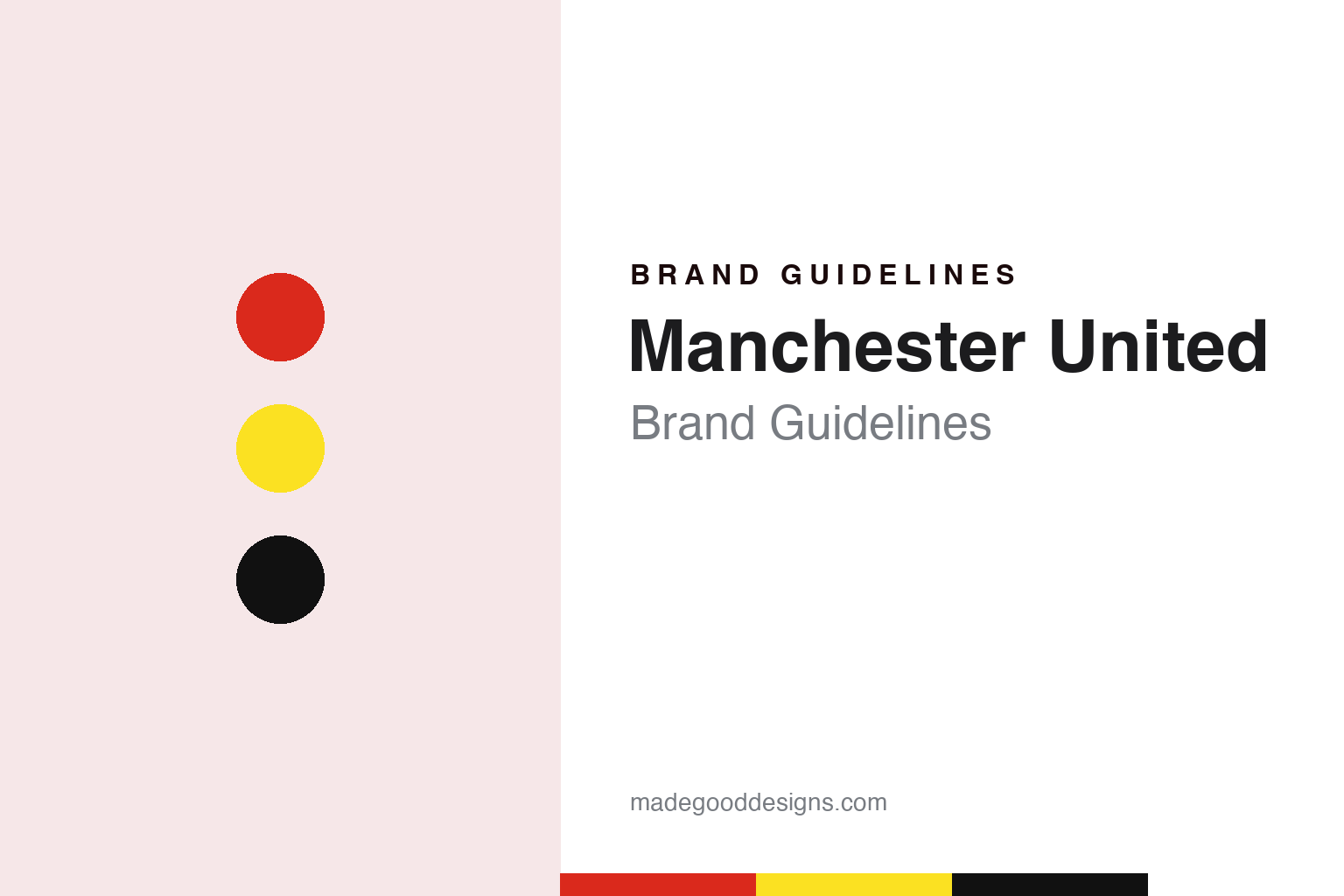
Manchester United Brand Guidelines
A railway team from Newton Heath that took a city’s ship and a devil for its crest.
Aa
Two constants: a red, gold and black palette and a condensed sans register. Abstract homage — not a Manchester United crest, kit or mark; no logo is reproduced.
Newton Heath
A railway depot, a change of name and a red shirt.
Manchester United began as a works team. English Wikipedia says the club was founded in 1878 as Newton Heath LYR Football Club, formed by workers at the Lancashire and Yorkshire Railway depot at Newton Heath, in the north-east of Manchester. Its early games were against other railway departments and companies, and it wore the railway company’s colours of green and gold in a recorded match against Bolton Wanderers’ reserves in 1880.
The colours did not settle at once. Wikipedia records a Newton Heath uniform of 1879 described as “white with blue cord,” a team photograph from 1892 thought to show red-and-white quartered jerseys, green and gold jerseys between 1894 and 1896, and white shirts with navy shorts from 1896. The club became a limited company in 1892.
The decisive change came in 1902, when the club took the name Manchester United. Wikipedia says the colours changed at the same time to red shirts, white shorts and black socks, and that combination has remained the standard home kit since. There were departures: from 1922 to 1927 the home shirt was white with a deep red “V” around the neck, and for part of 1934 a cherry-and-white hooped shirt was used before red returned.
The club played in Clayton before moving in 1910 to Old Trafford, the stadium it still uses.
Small kit details have also been fixed over time. Wikipedia notes that black shorts and white socks are sometimes worn with the home shirt to avoid clashes, and that from 1997–98 white socks were preferred for European night games for visibility. Away shirts have usually been white with black shorts, with exceptions in black, navy, blue and grey. Wikipedia says the third kit was traditionally all blue, and that a green-and-gold halved shirt was worn between 1992 and 1994; an all-grey away kit was dropped during the 1995–96 season.
Colour
A ship from the city arms, a devil from a nickname.
The crest has two sources. English Wikipedia says it is derived from the coat of arms of Manchester City Council, and that the only element of those arms left on the current badge is the ship in full sail, a reference to the Manchester Ship Canal and the city’s trade.
The second element is the red devil. Wikipedia says the devil comes from the club’s nickname, “the Red Devils,” which was inspired by Salford’s rugby club. The devil appeared on club programmes and scarves in the 1960s, was incorporated into the crest in 1970, and the crest went onto the chest of the shirt in 1971.
The devil also has a heraldic footing. In 1975, according to Wikipedia, the College of Arms granted a heraldic badge — a devil holding a trident in red — to the English Football League for use by Manchester United. That gives the club’s mascot figure a formal description alongside its use on scarves and shirts.
Shirts carry a supplier’s mark too. The Guardian reported in July 2014 that Adidas would become the club’s kit supplier from the 2015–16 season, ending Nike’s spell as supplier. Wikipedia describes the current home kit as a red shirt with Adidas’s three stripes in red on the shoulders, white shorts and black socks — tone-on-tone, so the stripes do not break up the red. For the club’s centenary as Manchester United in 2001, a reversible white-and-gold away design was released, though the match shirts themselves were not reversible.
Typography
Clubs, crests and colours.
A football club’s identity works across a wide range of surfaces. The crest sits at the centre of it: a compact mark that has to read on a shirt seen from the far side of a stadium, on a television scoreboard graphic, on a phone app icon and on a stitched scarf. Clubs revise their crests from time to time, usually simplifying detail, tightening outlines or redrawing lettering so the mark reproduces cleanly at small sizes and in a single colour.
Kit colours carry the identity as much as any logo. A club’s home colours are often older than its crest, and supporters recognise them at a glance, so designers tend to treat them as fixed while the cut, trim and pattern of the shirt change from season to season. Away and third kits give more room for experiment.
Shirt sponsors add a second brand to a highly visible surface a club owns, which means the crest, the kit maker’s mark and the sponsor’s wordmark have to sit together without crowding. Stadium signage, from gate numbers to the name on the stand roof, extends the same system into architecture, wayfinding and the backdrop of every broadcast.
Aa
A condensed sport sans — the register of a shirt number and a stand sign. (Specimen set in Oswald, a sans-serif STAND-IN; NOT the Manchester United logo.)
Manchester United
A listed company, a family owner and a minority partner.
Ownership has changed several times. Wikipedia says the club was rescued by four local businessmen in 1902, including John Henry Davies, later passed to the Gibson family and then to Louis Edwards, who took control in 1964; his son Martin Edwards became chairman in 1980. Manchester United was floated on the London Stock Exchange in 1991.
In 2005 the club was bought by Malcolm Glazer through Red Football and taken off the stock exchange. The Guardian, reporting Glazer’s death in May 2014, noted that the takeover had been financed with debt placed on the club and that his family would retain control, with his sons Joel and Avram already running the club. Wikipedia adds that some shares were listed on the New York Stock Exchange from 2012, while the Glazer family kept control. The 2005 takeover prompted a group of supporters to form a new club, F.C. United of Manchester.
The latest change came in 2024. The Guardian reported on 20 February 2024 that Sir Jim Ratcliffe’s minority buy-in had been completed, through a company named Trawlers Limited, after approval by the Premier League and the Football Association. Ratcliffe, the owner of INEOS, gained control of the club’s football policy, and figures from Ineos Sport joined the board. The Guardian reported in December 2024 that his stake had since increased. The Glazer family remained the majority shareholders.
The Premier League provides the competition in which the club’s crest is regularly seen, on sleeve badges and broadcast graphics alongside the league’s own lion. Wikipedia says the club has plans for a new stadium near Old Trafford, with the existing ground to be reduced in size for the women’s team and academy.
For a design guide, Manchester United shows how a crest can combine civic heraldry with a nickname and hold its colours steady for more than a century. Compare Liverpool FC, whose crest also borrows a city symbol, and Adidas, whose stripes sit on the shirt. For this guide we use devil red, crest gold and sock black with a condensed sans, an unofficial interpretation; no product or logo is reproduced.
Explore & save
Keep Manchester United’s identity on hand — save it to a board in the Made Good inspiration library.
Manchester United identity set
Pin the Manchester United red, gold and black palette and the condensed sans register to your own board.