AND1 Brand Guidelines
The Player logo, trash-talk tees and the Mixtape.
Aa
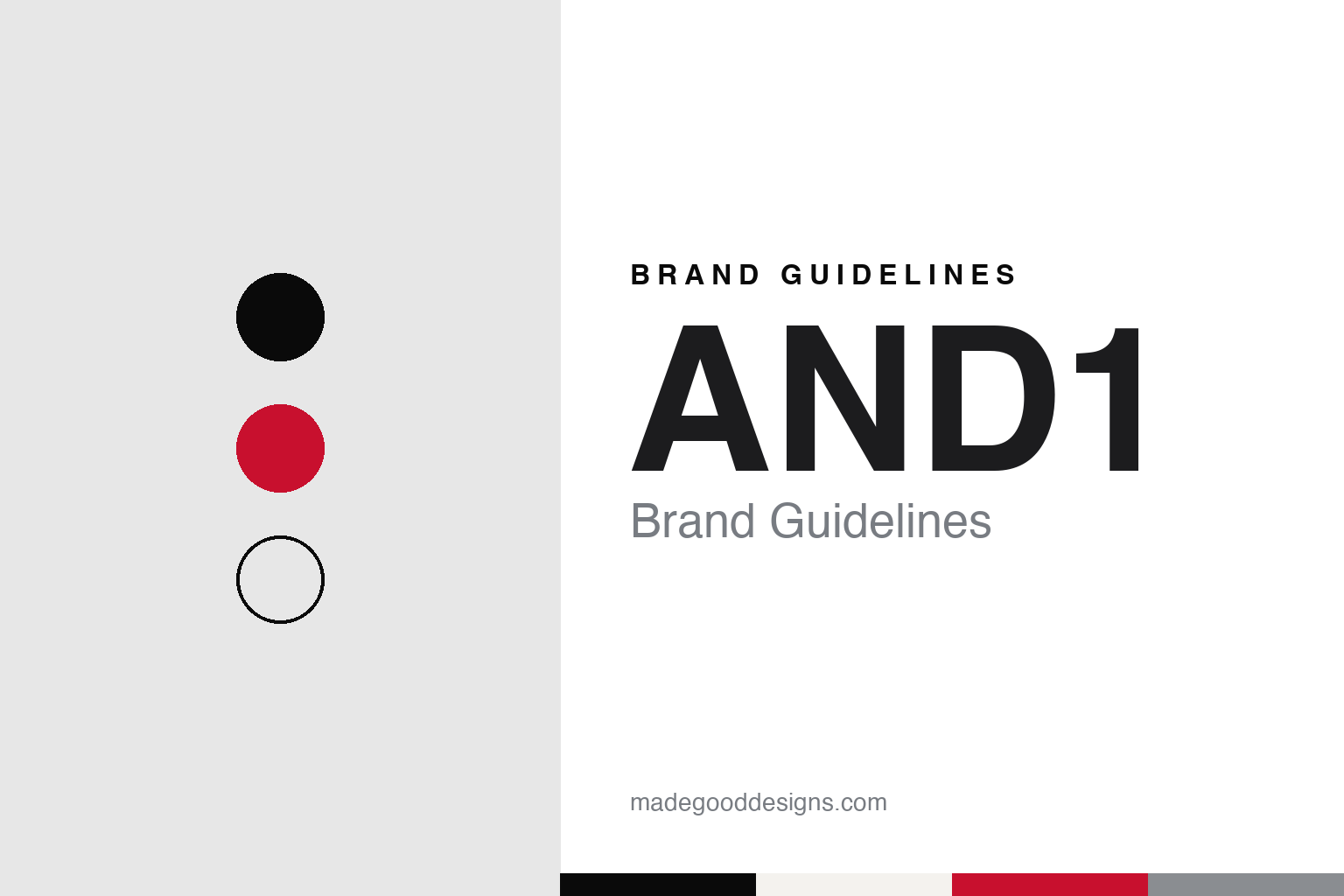
Two constants: a black, white and red palette and a condensed poster sans register. Abstract homage — not an AND1 product or mark; no shoe, Player logo or slogan graphic is reproduced.
And one
A basketball phrase turned into a company.
AND1 takes its name from the court. The New York Times Magazine explained in November 1999 that “and one” is what players say when they are fouled while making a shot, meaning they will get a free throw as well. Wikipedia records that the company began in 1993 as a partnership of Jay Coen Gilbert, Seth Berger and Tom Austin, then graduate students at the University of Pennsylvania’s Wharton School.
Berger later described the start to Knowledge at Wharton. He said the idea came while he was at the school, where he had worked on a business plan for a basketball retail store and then for a database business aimed at basketball players. When that failed within weeks, he said, he and his partners looked at an industry in which the large companies spread themselves across many sports, and decided to focus on the basketball player alone. The company’s early products, he said, were T-shirts aimed at young players, and none of the partners had experience in clothing or footwear. Wikipedia says the brand began by selling T-shirts out of the back of a car, and that Foot Locker soon took them.
The Times described a company run from suburban Philadelphia with a marketing strategy that favoured playground legends over polished league stars, and rap-promotion techniques over corporate advertising. Berger, the paper said, had realised in 1993 that basketball lacked a company that reflected the culture of the players at its base. Jay Gilbert, then AND1’s director of product and marketing, told the Times that the company had to guard against becoming corporate and keep reinventing itself. In 1996, Wikipedia says, AND1 signed Stephon Marbury as its spokesman and released basketball shoes; Latrell Sprewell’s shoe, the AND1 Spree, followed in 2002. Tom Austin left the company in 2003, Wikipedia records.
Colour
The Player, the slogans and the tape.
The brand’s mark is a figure, not a word. The New York Times Magazine in 1999 described the AND1 logo, called the Player, as a faceless, raceless, brawny ballplayer in mid-move, printed on the tag of a pair of shorts. The paper told of young players who had the figure tattooed on their arms, among them Larry Hughes, who went on to endorse the brand as a player for the Philadelphia 76ers. Alongside the Player came trash-talking T-shirts, with lines such as “Call 911, I’m on Fire”; Wikipedia cites another early slogan, “Pass. Save Yourself The Embarrassment.”
The Times said the brand broke into national view in spring 1999 with television commercials for Latrell Sprewell, in which Sprewell calls himself “the American dream” over guitar notes echoing Jimi Hendrix’s version of “The Star-Spangled Banner.” The paper noted that the company’s aggressive image offended parts of the sports mainstream.
Then came the tape. DJ Set Free, who worked in AND1’s marketing department, told WBUR’s Only A Game in 2018 that in late 1998 the company’s head of marketing, Jeffrey Smith, showed him VHS tapes of streetball footage. He took them home, matched kick drums to dunks and snares to jump shots, and cut the footage to music in a studio; the tapes went to street teams at the record labels Tommy Boy and Rawkus, who took them to clubs and courts. Wikipedia says the footage centred on the streetballer Rafer “Skip to My Lou” Alston, that AND1 summer tours began in 1999 and became the AND1 Mixtape Tour in 2002, and that from 2002 to 2008 the tours were shown on ESPN under the name Streetball. The last Mixtape release, AND1 Mixtape X, came out in 2008, Wikipedia says.
Typography
Athletic apparel and sneaker brands.
The brands in this group are athletic apparel and sneaker names. On a sneaker, a brand’s identity is usually carried by a handful of small, repeated places rather than by one large surface: the mark stitched or printed on the side panel, the label sewn to the tongue, the heel tab, the insole print and the box the pair is sold in. Each of those places is small, and each is seen at a different distance — the side mark from across a street, the tongue label from arm’s length, the insole only once the shoe is in the hand.
The box is a design surface of its own. It carries the name, the colours and often a lid graphic, and for many buyers it is the first piece of the brand they hold. Names in this category also change hands, move into licensing or return after a gap, so the same mark can appear on very different shoes over the years.
Each guide separates what independent sources record from what the company says about itself — who started the brand, who owns it now, how its marks and advertising have changed — and marks plainly what rests only on the company’s own word.
Aa
A condensed poster sans — the voice of a slogan tee. (Specimen set in Anton, a condensed sans STAND-IN; NOT the AND1 logo.)
AND1
A run of owners after the founders.
The founders sold in 2005. SGB reported on 16 May 2005 that American Sporting Goods, whose chairman was Jerry Turner, had acquired AND1; Berger told Knowledge at Wharton that ASG was a private footwear company based in Anaheim, California. Wikipedia says Berger and Gilbert left soon after the sale. Brown Shoe Company completed its purchase of American Sporting Goods on 17 February 2011 and then sold AND1 to Galaxy, a newly formed brand-management company, SGB reported in October 2011. In June 2014, SGB reported, Sequential Brands Group agreed to acquire Galaxy Brand Holdings and with it Avia, AND1, Nevados and Linens ’N Things.
Sequential filed for Chapter 11 protection on 31 August 2021, SGB reported. In November 2021 SGB reported that Galaxy Universal, a portfolio company of Gainline Capital Partners led by chief executive Eddie Esses, had agreed to acquire AND1, Avia, Gaiam and SPRI through that process, with the deal expected to close that month. Galaxy said the purchase continued its strategy of bringing brands under one management operation that controls marketing, design, sales, sourcing and manufacturing. Galaxy Universal has owned AND1 since 2021, Wikipedia records.
The brand has kept leaning on basketball figures. Wikipedia says AND1 named Kevin Garnett its creative director and global ambassador in 2018 and later signed the Toronto Raptors guard Fred VanVleet, and that in 2022 Netflix released the documentary Untold: The Rise and Fall of And1, directed by Kevin Wilson Jr.
For a design guide, AND1 shows how a figure and a tone of voice can carry a brand: a faceless player on a tag, and slogans written like a heckle from the sideline. Compare Avia, which Galaxy Universal also bought from Sequential in 2021, and Starter, another American sportswear name that has passed between owners. For this guide we use court black, tee white and a foul red with a condensed sans, an unofficial interpretation; no product or logo is reproduced.
Explore & save
Keep AND1’s identity on hand — save it to a board in the Made Good inspiration library.
AND1 identity set
Pin the AND1 black, white and red palette and the condensed poster-sans register to your own board.