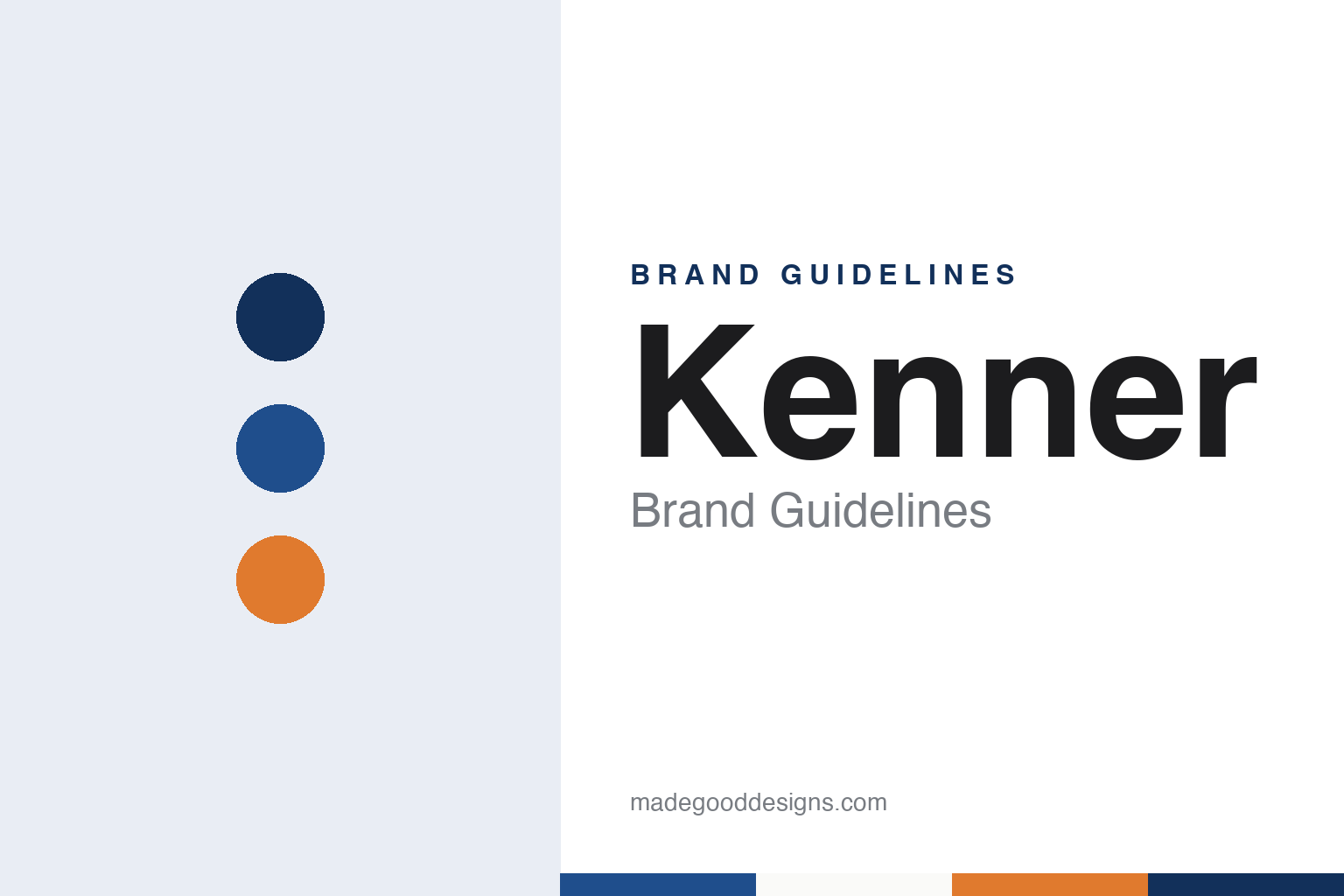
Kenner Brand Guidelines
The Cincinnati toy company named for the street it started on.
Aa
Two constants: a Kenner blue, oven orange and bubble aqua palette and a slab-serif toy-catalogue register. Abstract homage — not a Kenner or Hasbro product or mark; no toy, mascot or logo is reproduced.
Kenner Street
Three brothers, a soap business and a bubble gun.
Kenner Products was a toy company founded in Cincinnati, Ohio, by three brothers: Albert, Philip and Joseph L. Steiner. The Cincinnati Enquirer, in a history by Jeff Suess published on 3 December 2015, dates the founding to 1947; English Wikipedia gives 1946. The Enquirer says the company was named for Kenner Street, near Cincinnati’s Union Terminal, where the brothers had previously owned the Cincinnati Soap Co., a business they sold to Procter & Gamble in 1938. A Los Angeles Times report of 15 May 2002 likewise says the brothers named the toy company for the Cincinnati street on which their offices were located.
The product that started the company came out of that soap background. The Los Angeles Times says the brothers were in the soap and soft drink business in 1947 when Albert watched a boy waving a bubble wand through a soap solution, and that they decided to make a gun that would shoot bubbles, which the paper names the Bubble Rocket. The Enquirer names the company’s opening toy the Bubbl-Matic Gun, inspired by a boy making bubbles with a hand dipped in soapy water, and Wikipedia lists it as the Bubble-Matic, a version of which was still on sale in the mid-1960s.
Television carried the company from a local business to a national one. The Enquirer says Kenner sponsored the children’s programme Captain Kangaroo in 1958, and the Los Angeles Times says the company was advertising its products on national television by that year. English Wikipedia lists the toys that followed: the Girder and Panel building sets in 1957, the Give-a-Show projector in 1959, the Easy-Bake Oven and the Electric Mold Master in 1963, and the Spirograph drawing toy in 1966. The Enquirer describes the Easy-Bake Oven as a toy that let children bake real treats with the heat of a 100-watt light bulb, and adds Close ’n Play phonographs and the Baby Alive doll to the list of Kenner products; the Los Angeles Times also names Baby Alive and the Six Million Dollar Man figures.
Colour
General Mills, Star Wars, Tonka and Hasbro.
The Steiners sold Kenner to the food company General Mills in 1967, according to both the Enquirer and the Los Angeles Times; the Times says Joseph Steiner retired four years later. General Mills added Parker Brothers and Cincinnati’s Rainbow Crafts, the maker of Play-Doh, to its toy division, the Enquirer says, and English Wikipedia dates the merger of Rainbow Crafts into Kenner to 1971. In 1976, the Enquirer says, Kenner moved its headquarters into the Kroger Building on Vine Street and built a manufacturing plant in Oakley and a distribution centre in Norwood.
The licence that shaped the company’s later reputation came next. The Enquirer says George Lucas approached several toy companies about Star Wars before Kenner signed, and that the Kenner designer Jim Swearingen, a University of Cincinnati graduate, read the script and urged his bosses to take it on. Because the designers wanted to make the spaceships as well as the characters, the paper says, they chose plastic action figures 3¾ inches tall rather than the larger dolls of the time. The figures were not ready for Christmas 1977, so Kenner sold an “Early Bird Certificate Package”, a cardboard stand and a promise that four figures would be delivered the following year. The Enquirer quotes Kenner’s then-president Bernie Loomis, from a collectors’ book by Stephen J. Sansweet and Anne Neumann, as saying he decided to give children a picture and their parents a promise.
The same success, the Enquirer says, helped Kenner win further licences, among them Care Bears, Strawberry Shortcake, Ghostbusters and Batman. English Wikipedia says General Mills spun off its Kenner and Parker Brothers toy divisions in 1985 as Kenner Parker Toys. The New York Times reported on 5 September 1987 that Kenner Parker Toys, then of Beverly, Massachusetts, had agreed to be acquired in a friendly deal by the Tonka Corporation of Minneapolis, after two months of resisting a hostile offer from New World Entertainment; the paper described Kenner Parker as a maker of dolls, action figures and the Monopoly game. Under Tonka, Wikipedia says, Kenner Products was reconstituted as a division.
Hasbro bought Tonka, and Kenner with it, in 1991. The Enquirer says the Oakley plant was closed and the headquarters moved to Elsinore Place near Eden Park, and that Hasbro closed Kenner and its Cincinnati office in 2000. Kenner has not operated as a company since; English Wikipedia describes it today as a toy brand owned by Hasbro, which reintroduced the name in 2010 on its Star Wars: The Vintage Collection figures. The Enquirer notes that the Rhode Island-based Hasbro continued to make Star Wars toys, though no longer in Cincinnati.
Typography
Design and documentation.
A toy company’s name usually reaches people indirectly. Children meet the characters, the dolls and the games first, and the maker’s mark sits in a corner of the box, on the base of a figure or on the back of the instructions. For many toy makers the corporate logo works more like a signature than a headline, a small, repeatable sign that has to sit beside a crowd of louder product names without competing with them.
The places where that mark does its main work are mostly trade settings: the cover of a dealer catalogue, the spine of a retail display, the stand or showroom at a toy fair where buyers see a season’s range before it reaches shops. A company that changes owners, merges with a rival or licenses its name may carry several versions of its mark across those settings at once, and older boxes keep earlier versions in circulation long after a redesign.
Each guide follows the company rather than any single toy: who founded it and where, who has owned it since, how its name and mark have changed, and which lines it is remembered for, with the company’s own account marked as its own.
Aa
A slab-serif toy-catalogue face — the register of a mid-century catalogue page and a Saturday-morning ad. (Specimen set in Bitter, a slab-serif STAND-IN; NOT the Kenner logo.)
Kenner
A street name, a bird and a slogan.
Kenner’s identity began with a place. The company took its name from a short Cincinnati street rather than from its founders, and it kept that name through three corporate owners. A central advertising device was a character: English Wikipedia says the company introduced a mascot, the Kenner Gooney Bird, in 1962, together with the slogan “It’s Kenner! It’s fun!”, and the Enquirer describes the bird squawking that slogan in Kenner’s advertisements. Wikipedia adds that in 1968 the company commissioned Jim Henson to make an Easy-Bake Oven advertisement featuring the Gooney Bird as a puppet, that the puppet was reused in 1969 as the Sesame Street character Little Bird, and that the bird had been phased out of Kenner’s advertising by 1974.
Licensed lines gave the brand much of its later visual range. Wikipedia says Kenner’s Super Powers Collection of DC Comics figures, produced from 1984 to 1986, was closely modelled on the character depictions in DC’s own style guide, with each figure performing an action when squeezed, and that Kenner commissioned Jack Kirby and George Pérez to design figures of characters they had created or co-created. DC named Kenner among the honourees in its 1985 anniversary publication Fifty Who Made DC Great. Later lines took a looser approach: for The Real Ghostbusters from 1986 and the Dark Knight Collection from 1990, Wikipedia says, Kenner’s designers created their own costumes, weapons and vehicles rather than copying the source material.
Cincinnati has marked the company’s history in public. The Enquirer’s 2015 article announced a Kenner symposium at the city’s main public library, with a discussion of the company’s history led by a member of the Steiner family, a screening of the documentary Plastic Galaxy with former Kenner toy designers, and an exhibit of Kenner toys from the 1940s through the 1990s curated by two collectors in the library’s Cincinnati Room.
For a design guide, Kenner shows how a toy brand can be built from a borrowed street name, a mascot and a spoken slogan, and how a licensed product line can borrow a partner’s style guide in one decade and invent its own look in the next. Compare it with Play-Doh, the Cincinnati modelling compound that joined Kenner under General Mills, and Spirograph, the drawing toy Kenner sold in the United States from 1966. For this guide we use Kenner blue, oven orange and bubble aqua with a serif, an unofficial interpretation; no product or logo is reproduced.
Explore & save
Keep Kenner’s identity on hand — save it to a board in the Made Good inspiration library.
Kenner identity set
Pin the Kenner blue, oven orange and bubble aqua palette and the slab-serif toy-catalogue register to your own board.