Apollo Brand Guidelines
The Johor Bahru wafer and layer-cake maker now run by a Baskin-Robbins franchisee.
Aa
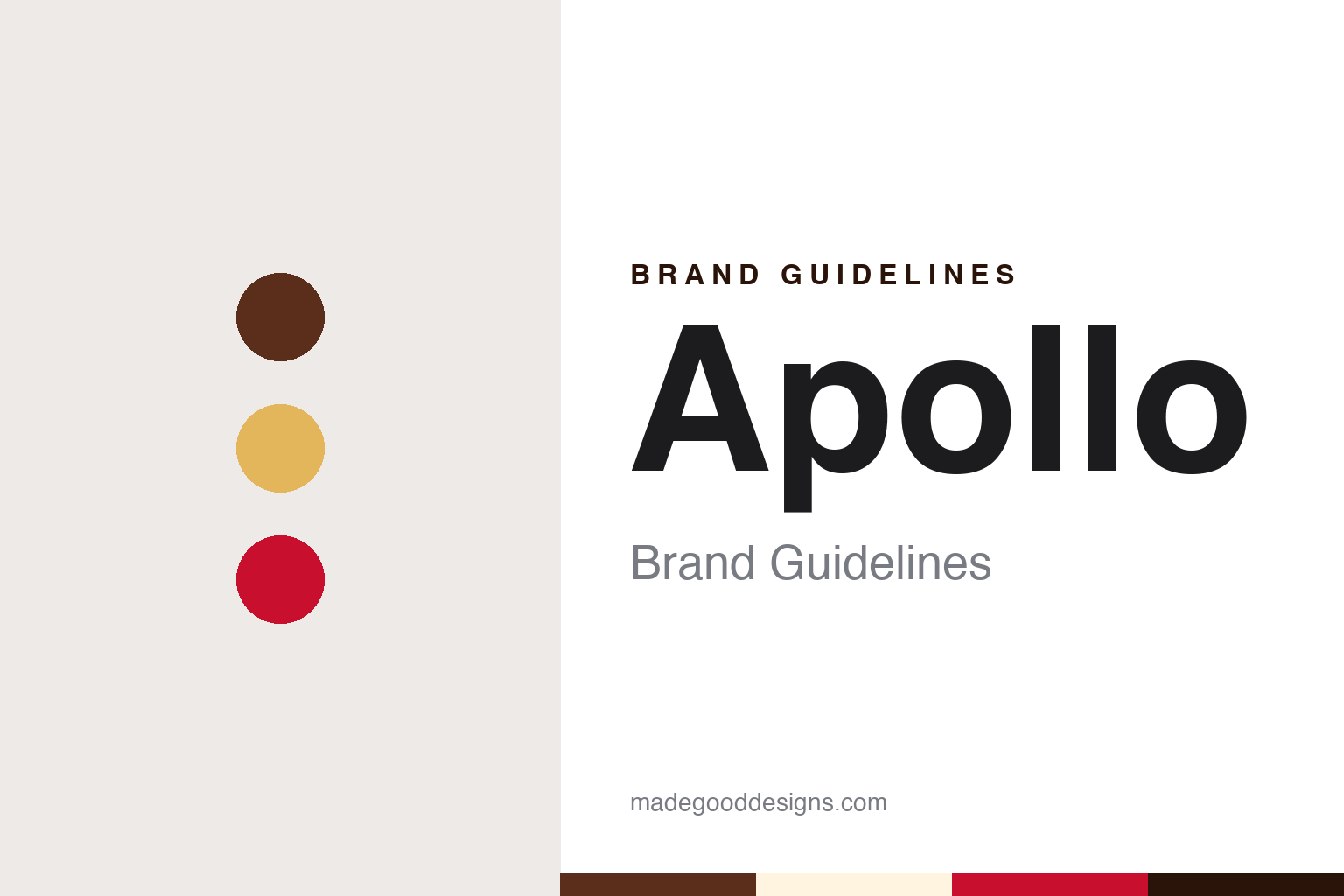
Two constants: an Apollo chocolate, gold and red palette and a rounded snack sans register. Abstract homage — not an Apollo product or mark; no wrapper, logo or label is reproduced.
Larkin
A snack-shop staple from Johor Bahru.
Apollo is a Malaysian snack brand known for chocolate wafers, stick wafers and layer cakes, which it pitches at corner shops — the kedai runcit — as much as at cafés and office pantries. The company says the brand has been “part of Malaysia’s snacking story” since 1953, starting from what it calls “a small local setup.” Its website gives no founder’s name or founding story beyond that date, so the year is the company’s own.
The business is based in the Larkin Industrial Area of Johor Bahru, the state capital of Johor at the southern tip of the peninsula, where its head office and principal place of business stand; a corporate office sits in Mid Valley City, Kuala Lumpur. The listed parent, Apollo Food Holdings Berhad, joined Bursa Malaysia in 1996, according to The Edge Malaysia, and today trades on the Main Market under the stock name APOLLO in the consumer products and services sector.
The group has two operating companies, both wholly owned, its 2026 annual report says. Apollo Food Industries (M) Sdn Bhd makes compound chocolate, chocolate confectionery and layer cakes, and trades them for export; Hap Huat Food Industries Sdn Bhd distributes and markets the same products inside Malaysia.
The company’s 2009 website already described the same core: chocolate wafers, layer cakes, chocolate layer cakes and Swiss rolls, made with “world class wafer and layer cake manufacturing machinery from Europe,” and sold in Singapore, Indonesia, Thailand, the Philippines, Vietnam, China, Hong Kong, Taiwan, Japan, India, the Middle East, Mauritius and the Maldives.
Colour
Wafers, layer cakes and a new owner.
The biggest change in Apollo’s recent history came at the end of 2023. On 15 December that year The Edge Malaysia reported that Apollo Food’s shares would be suspended, as it was likely to be a takeover target. Three days later Scoop Capital Sdn Bhd bought the controlling shareholder’s stake — 51.31 per cent of the company, the New Straits Times reported — which triggered a mandatory general offer for the rest. When the offer closed in January 2024, Scoop Capital held 78.42 per cent, The Edge Malaysia reported. In May 2024 it sold a 4 per cent stake to bring the company’s public shareholding spread back into compliance with listing rules, KLSE Screener reported.
Apollo’s 2026 annual report says Dato’ Cheah See Yeong is deemed interested in the company through his shares in Scoop Capital, and that the Scoop Capital group is the master franchisee of Baskin-Robbins in Malaysia and Singapore. Cheah was appointed executive chairman on 31 January 2024, and his son, Cheah Jia Ming, managing director on the same day. The annual report describes Scoop Capital as the company’s immediate and ultimate holding company. Market reaction was quick: in March 2024 The Edge Malaysia reported that the shares had reached an all-time high since the 1996 listing.
Under the new owners the brand has been given a louder public face. The company’s website now presents Apollo as “100% Malaysian at heart,” with the line “Timeless Treats, Trusted by Generations” the vision “To delight the world, One bite at a time.” Its news pages record an outdoor advertising debut at an AFC Asian Cup qualifier between Malaysia and Vietnam in 2025, the opening of its first innovation lab, and recognition at The Edge Malaysia’s Centurion Club awards in 2025 and at the BrandLaureate World Halal Best Brands awards in 2026. In February 2026 a KLSE Screener headline summed up the aim as breaking Apollo away from “the school-bag staple mould.”
Typography
Malaysian food and drink brands.
The seven brands in this group all make food or drink, and all of them come from Malaysia: Ayamas, Adabi, Aik Cheong, Apollo, Cintan, Dutch Lady and Massimo. Malaysian food and drink brands in general sit at many different points in the trade, from family firms that still carry a founder’s name to names that now belong to much larger food groups, and a single brand can be sold everywhere from a neighbourhood sundry shop to a supermarket shelf.
A food or drink brand’s identity is usually carried less by a single product than by a pack, a name and the meal or snack it promises, because the company behind the name may have changed hands, moved its factory or grown far beyond the town where it started. That makes the questions behind each name worth asking plainly: who started it, who owns it now, and where its products are actually made and packed.
Each guide separates what independent sources record from what the company says about itself — its founding story, its owners over time, where its products are made and how its packaging has changed — and marks plainly what rests only on the company’s own word.
Aa
A rounded, friendly sans for a corner-shop snack. (Specimen set in Fredoka, a sans STAND-IN; NOT the Apollo logo.)
Apollo
Made in Johor Bahru, sold at home first.
Apollo’s products are made in Malaysia, the company says, and its annual report places manufacturing with its Johor Bahru subsidiary. Home sales dominate: in the financial year to 30 April 2026, the domestic market accounted for about 76 per cent of revenue and exports for the remaining 24 per cent, with Indonesia the largest export market, the 2026 annual report says. The same report says its layer-cake and chocolate confectionery lines ran at close to 80 per cent of capacity, and that two new layer-cake lines were due to be commissioned by the end of July 2026, which the company expected to raise layer-cake capacity by about 40 per cent.
The company says its manufacturing holds halal certification, ISO 22000 food-safety certification and Good Manufacturing Practice certification, and its website adds HACCP. Those are the company’s own statements about its certifications.
A note on names: Apollo is a common brand name, and this guide is about the Malaysian wafer and layer-cake brand of Apollo Food Holdings Berhad, not the many unrelated companies called Apollo; the company’s website is apollofood.com.my.
For a design guide, Apollo shows how a long-lived snack brand can be repositioned by new owners: the core products remain wafers and layer cakes while the tone moves away from the school-bag staple toward what the company calls a brand that is “playful yet reliable.” Compare Munchy’s, another Johor snack maker that changed hands, and Baskin-Robbins, whose Malaysian franchisee now controls Apollo. For this guide we use chocolate brown, wafer gold and a red with a rounded sans, an unofficial interpretation; no product or logo is reproduced.
Explore & save
Keep Apollo’s identity on hand — save it to a board in the Made Good inspiration library.
Apollo identity set
Pin the Apollo chocolate, gold and red palette and the rounded snack sans register to your own board.