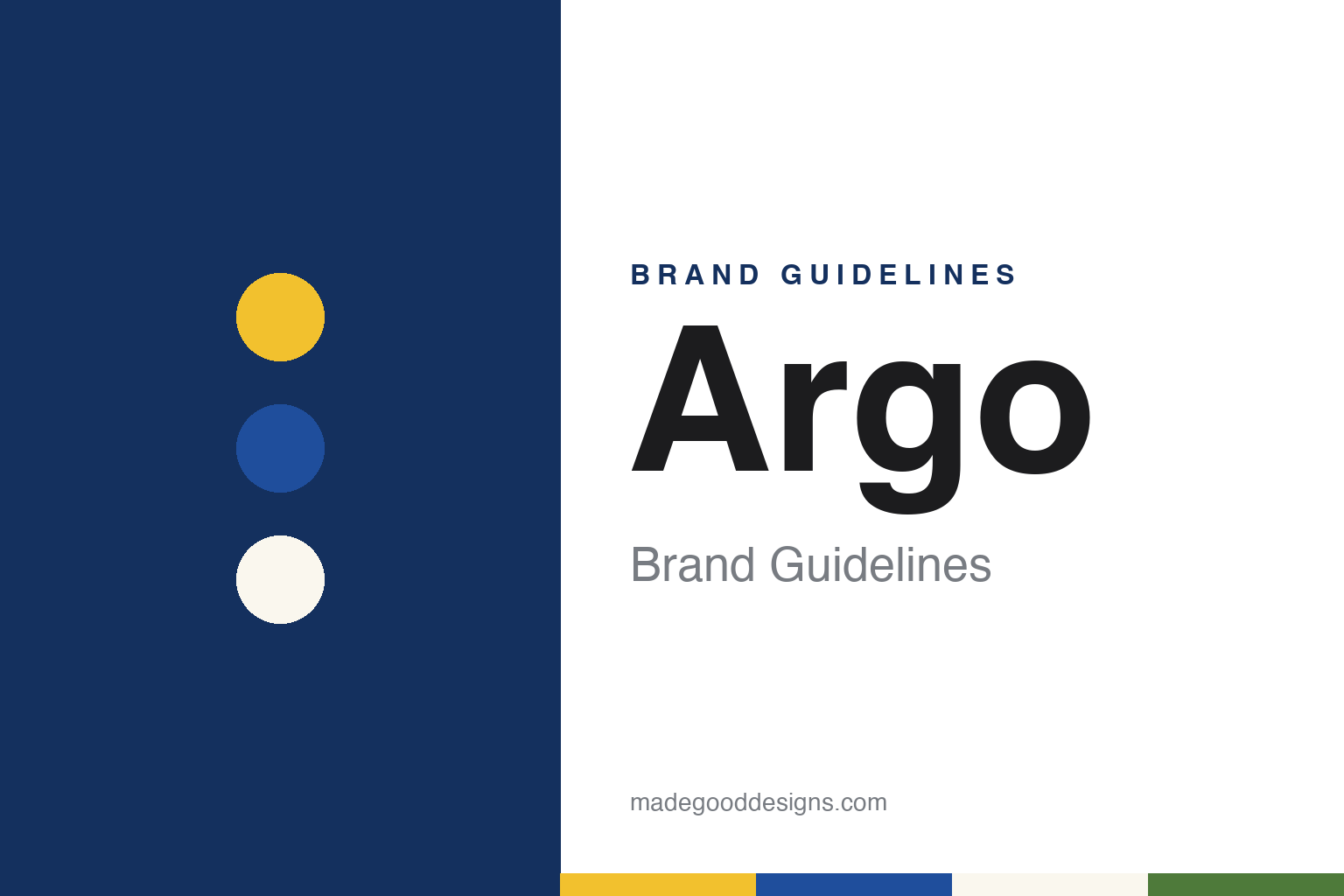
Argo Brand Guidelines
A Nebraska corn mill, an Illinois company town and a yellow canister with a blue cap.
Aa
Two constants: a canister yellow, cap blue and starch white palette and a heavy grotesque sans register. Abstract homage — not an Argo product or mark; no package, label or logo is reproduced.
A corn mill in Nebraska
A family business on the plains, a merger of starch makers and a neighbourhood named for a factory.
Argo is an American brand of corn starch and baking powder, owned today by ACH Food Companies, the American subsidiary of the British group Associated British Foods. Its story begins on the plains. The brand’s own history page says a corn milling plant, later called Argo Manufacturing, was incorporated in Nebraska in 1891, and that Argo Corn Starch was launched in 1892.
The business came out of a well-known Nebraska family. English Wikipedia’s article on J. Sterling Morton, the Nebraska City newspaper editor who served as President Grover Cleveland’s secretary of agriculture and founded Arbor Day in 1872, lists his son Carl Morton as the founder of the Argo Starch Company and president of the Glucose Sugar Company. Its article on Carl’s brother Joy Morton names Argo Starch alongside Morton Salt among Joy Morton’s brands.
Where the name came from is less certain. Argo says the origin of the word remains a source of conjecture, and offers one explanation: customer price lists were printed in alphabetical order, so a starch called Argo would appear above its competitor Kingsford’s. The two names did not stay rivals. The company says that in 1899 Argo, Kingsford’s and two other starch makers merged to form the United Starch Company, a forerunner of the Corn Products Refining Company.
That corn refiner became the brand’s home for most of the twentieth century. English Wikipedia’s article on E. T. Bedford, a Standard Oil executive, says he founded the Corn Products Refining Company in 1902; its article on Ingredion, the business that grew out of it, dates the company to a merger of American corn refiners in 1906 and says it began producing Argo laundry cornstarch in 1908. Packaging Digest wrote in March 2015 that Argo corn starch was introduced in a carton in 1902.
The company also gave its brand name to a place. English Wikipedia’s article on Summit, Illinois, says that in 1907 Corn Products began building a corn-processing plant south of Summit, in what is now Bedford Park, a village named after E. T. Bedford. Two plots nearby were laid out as a company-town neighbourhood called Argo after the factory, and Summit annexed it in 1911. The article says the name Argo is still in widespread use there, and Ingredion’s article records that in the 1960s the company began producing high-fructose corn syrup at the Argo plant.
Colour
Corn Products, CPC International, Bestfoods, Unilever and ACH.
The parent company changed shape several times. English Wikipedia’s articles on Ingredion and on Hellmann’s and Best Foods say Corn Products Refining merged with The Best Foods, Inc., the mayonnaise business, in 1958 to form Corn Products Company, which renamed itself CPC International in 1969. In 1997, the Ingredion article says, CPC International renamed itself Bestfoods to concentrate on packaged foods and spun off its corn-refining business as Corn Products International, the company now called Ingredion. Argo stayed on the packaged-food side, alongside the corn syrup Karo and Mazola corn oil.
That side was then sold twice in two years. A Unilever announcement of 23 April 2002 said the brands had come to it with its acquisition of Bestfoods in October 2000, and that it had signed a definitive agreement to sell 19 food brands sold across North America to ACH Food Companies, Inc., of Memphis, Tennessee, a subsidiary of Associated British Foods. The major brands it named were Mazola cooking oil, Argo and Kingsford’s corn starches, Karo and Golden Griddle syrups and Henri’s salad dressing, sold in the United States, Puerto Rico and Canada. The deal also included a manufacturing facility in Argo, Illinois. Patrick Cescau, Unilever’s foods director, said the brands simply fell outside its brand focus.
Associated British Foods announced the purchase the same day. Its statement, written for a British market, listed Argo and Kingsford’s as “cornflour” brands and said ACH would also take on manufacturing assets in Puerto Rico and New Jersey. FoodNavigator reported on 3 July 2002 that the acquisition had reached completion that Tuesday, after regulatory clearance. ACH Food Companies has owned Argo since 2002.
The group has added to the same family of brands since. English Wikipedia’s article on Associated British Foods says it bought the Tone’s spice business and Fleischmann’s yeast from Burns Philp in 2004. The Argo website today carries an ACH Food Companies copyright and links to Fleischmann’s Yeast, Karo Corn Syrup, Mazola and a separate Argo Foodservice site. The range on the consumer site is two products: Argo Corn Starch and Argo Baking Powder.
Typography
Design and documentation.
The baking shelf of a grocery store holds a particular kind of product: condensed and evaporated milk in small cans, chocolate chips and baking chocolate in bags and bars, corn starch in a box and baking powder in a tin. They are ingredients rather than finished foods, bought to be measured into something else, and a single can or tin may sit in a kitchen cupboard for months between uses.
That shapes how their packaging works. A name, a colour and a simple device have to be recognised on a crowded shelf, and then again in a cupboard, often by someone following a recipe that names the product. Directions, measurements and recipes printed on the pack are part of the design as well, read in the kitchen with flour on the counter and the oven already warming.
Each guide separates what independent sources record from what the company says about itself — who started the brand, who owns it now, where it is made and how its labels have changed — and marks plainly what rests only on the company’s own word.
Aa
A heavy, wide grotesque — the plain, shelf-stable register of a pantry staple. (Specimen set in Archivo Black, a sans STAND-IN; NOT the Argo logo.)
A corn maiden and a canister
Recipes on the label, a centenary redesign and a project named for a lid.
Argo’s own timeline treats the package as the place where the brand speaks. The company says a 1940s Argo label carried a recipe for Creative Clay, a homemade moulding material children could use to make ornaments and gifts, and that consumer interest led it to publish leaflets of Argo Play Clay projects in 1993. It dates a new corn maiden on the front of the package to 1964.
The centenary brought a redesign. Argo says that in 1992 it marked its 100th anniversary with a significant package redesign that added a 100th Anniversary seal and a slimmer corn maiden on the face panel, while the back and side panels carried nine recipe collections with food photography.
The larger change came in the structure of the pack. Packaging Digest reported on 11 March 2015 that Argo had moved from its carton to a 16-ounce resealable plastic canister under an internal plan called Project AMBIR, short for “Argo Must, Be, In, Resealable”. The magazine said the label graphics were designed by Lift Packaging+Promotions Creative, and that the canister was yellow, square and easy to grip, topped with a threaded blue cap from Berry Plastics and dressed in glue-applied labels printed by Hammer Packaging that kept familiar Argo graphics. It noted that Argo’s packaging had seen few graphic changes in its long history, and said ACH filled the new canister at its own plant in time for the 2008 baking season before extending the format to a 12-ounce baking powder container with a blue flip-top cap.
The company’s own dates match that account and carry it forward. Argo says it introduced resealable containers and a new baking powder product in 2008, taller cylinder containers in 2019, and an updated logo in 2021 to contemporise the brand. In 2026, it says, Argo Baking Powder launched with a new formula.
For a design guide, Argo shows how a pantry ingredient with a name of uncertain origin can carry its identity through a century of owners on the package itself, from recipes printed on the label to a corn maiden on the front and a canister in yellow and blue. Compare it with Karo, the corn syrup that has travelled with it through Corn Products, Bestfoods and ACH, and Clabber Girl, another American baking powder sold in a familiar can. For this guide we use canister yellow, cap blue, starch white and husk green with a heavy sans, an unofficial interpretation; no product or logo is reproduced.
Explore & save
Keep Argo’s identity on hand — save it to a board in the Made Good inspiration library.
Argo identity set
Pin the Argo canister yellow, cap blue and starch white palette and the heavy grotesque sans register to your own board.