Pompeian Brand Guidelines
An olive oil name from Lucca, a warehouse in Baltimore and a run of family owners.
Aa
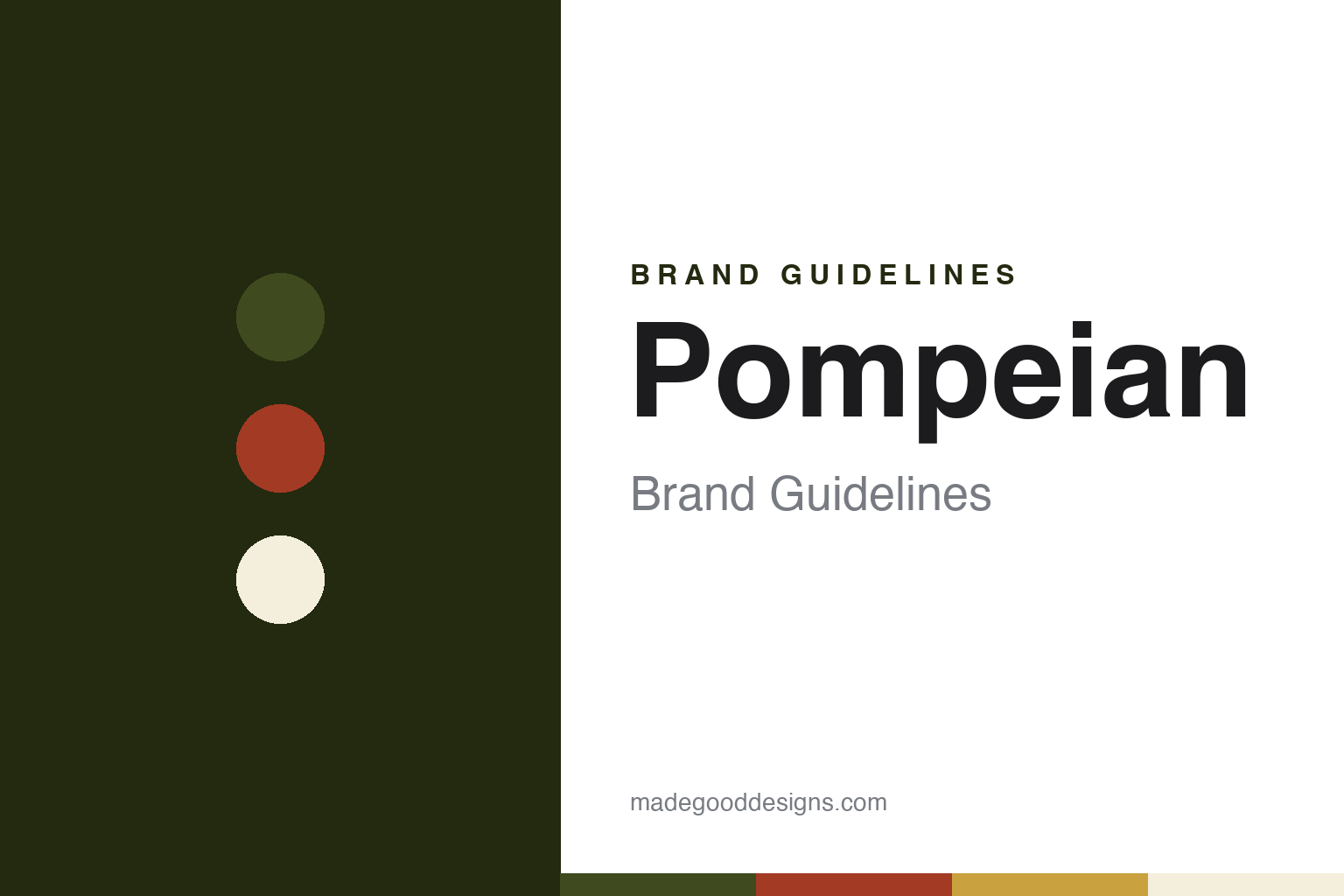
Two constants: a grove olive, Pompeii red and oil gold palette and an inscriptional capital serif register. Abstract homage — not a Pompeian product or mark; no bottle, label or logo is reproduced.
From Lucca to Highlandtown
An Italian trading name, a salesman’s purchase and a warehouse by the harbour.
Pompeian is an American brand of olive oil, vinegars, grapeseed oil and cooking sprays, run from Baltimore, Maryland. The company tells its own story as beginning in Lucca, Italy, in the late nineteenth century. The company says Lucca’s position near the port of Genoa made it a natural trading post, and that Pompeian olive oil was exported from there to markets abroad, the United States among them.
The American chapter starts with a purchase. The company says that a young entrepreneur named Nathan Musher bought the Pompeian Olive Oil Company in 1906 and carried on producing oil in Italy for export to the United States. A family history published by Columbia University, written for a professorship endowed by his son, tells a plainer version: Nathan Musher, who had emigrated and worked as a travelling salesman for the Singer Sewing Machine Company, settled his family in Washington, DC, and bought a small olive oil business from an Italian neighbour. That business, the page says, was Pompeian. The same page records that his son Albert Musher later served as president of the Pompeian Olive Oil Company.
Baltimore became the brand’s home early. A Baltimore Heritage tour listing for April 2024 says the Pompeian Olive Oil Company was established in Baltimore in 1906, and that its factory and distribution centre on Pulaski Highway has been its home since 1912. The Baltimore Sun reported in November 2015 that the plant opened on that site in the company’s sixth year, in the Highlandtown area of the city. English Wikipedia says the Mushers built warehouses in Genoa, Tortosa, Barcelona, Málaga and Baltimore, and the company says that in the late 1920s the family stopped production in Lucca and moved the business to Baltimore, where Pompeian is still bottled.
Colour
The Hoffbergers, the Morenos, the Devicos and a Spanish cooperative.
The brand has changed hands several times. The company and English Wikipedia both say the Hoffberger family, Baltimore entrepreneurs with several packaged-goods businesses and later owners of the Baltimore Orioles, took over in 1930 and expanded Pompeian across the country. The company says the Moreno family of Spain acquired it in 1975. A Pompeian press release dated 16 August 2009 repeated that the Morenos had owned the company since 1975, and announced an alliance with the Devico family of Meknes, Morocco, owners of the Moroccan food brand Aïcha, under which Pompeian would gain exclusive American distribution rights.
Control then passed to the Devicos. The company dates the purchase to 2009. The Baltimore Sun, in its report of 3 November 2015, described the Devico family as having bought into the company in 2008 and acquired it outright in 2010, and identified the chief executive, David Bensadoun, as a member of that family.
The same report covered the next step. The Baltimore Sun said the family-owned Pompeian would exchange shares and transfer assets with Mercaoleo, a subsidiary of DCOOP, the olive-grower cooperative from southern Spain, and that the cooperative would become Pompeian’s sole supplier of olive oil in Spain. ESM: The European Supermarket Magazine reported on 10 November 2017 that a new agreement had enlarged the two groups’ stakes in each other. Under it, ESM said, they would share Mercaoleo, with two bottling plants in Antequera, Málaga, and a stake in Qorteba Internacional, a refinery and storage site at Alcolea, Córdoba, while DCOOP invested in Pompeian’s bottling plants on the American East and West coasts. The company describes the 2017 deal as a strengthened alliance with DCOOP.
At the Baltimore plant, The Baltimore Sun described oil arriving by container through the port, stored in basement tanks and piped through colour-coded lines to filtration and blending before automated bottling. The paper also reported a second plant in Montebello, California, and an olive grove in Santa Barbara; the company now names its Californian farm Sunrise Olive Ranch, spanning Santa Barbara and San Luis Obispo counties.
Typography
Design and documentation.
The brands in this group sell three of the plainest things in an American kitchen: sugar, cooking oil and fruit spread. Each sits on a different shelf, in a different kind of pack. Sugar usually travels in a paper bag or a carton, oil in a clear or tinted bottle, and fruit spread in a glass jar with a lid, so the look of the brand is carried by a label, a name, a colour and the shape of the container.
Many names on these shelves have also outlived their first owners. A refinery, a press or a family kitchen may have started the brand, and a different company may now make, bottle or pack it, sometimes far from where it began. That makes the plain questions worth asking: who started it, who owns it now, and where it is made.
Each guide separates what independent sources record from what the company says about itself — its founding story, its owners over time, where its products are made and how its packs and labels have changed — and marks plainly what rests only on the company’s own word.
Aa
A classical inscriptional capital — a classical register for an olive oil name. (Specimen set in Cinzel, an inscriptional STAND-IN; NOT the Pompeian logo.)
A magazine page, a plastic bottle and a squeeze
Early print advertising, an in-house bottle line and a pack built for drizzling.
The brand was advertising nationally more than a century ago. The blog A Hundred Years Ago reproduced, in September 2014, a Pompeian olive oil advertisement from the February 1914 issue of the Ladies’ Home Journal.
Much of what the brand looks like on the shelf is now made on site. The company says that in 2004 it moved to plastic packaging, citing lower shipping weight and better protection for oils that are sensitive to light and heat. The Baltimore Sun reported in 2015 that Pompeian devoted part of its Baltimore plant to making its own plastic bottles, and the April 2024 Baltimore Heritage tour promised visitors a look at how Pompeian blows its bottles before they are filled, capped, labelled and boxed for shipping. The newspaper also described the Pompeian Olive Oil Center inside the plant, a space for meetings and community tours that shows the history of the brand alongside an old olive press.
The latest pack is a change of shape. PETplanet Insider reported on 28 October 2025 that the company had introduced Pompeian Squeeze, a flexible, recyclable PET bottle with a precision spout and a flip-top cap designed to release oil only under gentle pressure, in Smooth and Robust versions rolling out to American retailers. The company also describes itself as “The Olive Oil People” and says a Farmer Owned Seal on its bottles recognises its family of growers.
For a design guide, Pompeian shows how an inherited name with an Italian trading past can carry one product through a century of owners while the bottle itself keeps changing. Compare it with Hojiblanca, an olive oil brand from the Antequera cooperative tradition behind DCOOP, and Bertolli, another olive oil name that began in Lucca. For this guide we use grove olive, Pompeii red, oil gold and label cream with a serif, an unofficial interpretation; no product or logo is reproduced.
Explore & save
Keep Pompeian’s identity on hand — save it to a board in the Made Good inspiration library.
Pompeian identity set
Pin the Pompeian grove olive, Pompeii red and oil gold palette and the inscriptional capital serif register to your own board.