Baker’s Brand Guidelines
A mill on the Neponset River and a Viennese chocolate server on the wrapper.
Aa
Two constants: a chocolate brown, tray gold and pastel cream palette and an old-style serif register. Abstract homage — not a Baker’s product or mark; no wrapper, painting or logo is reproduced.
A mill on the Neponset
An Irish chocolate maker, a Harvard graduate and three generations of Bakers.
Baker’s is an American brand of baking chocolate, sold in bars for home cooks, and today belongs to Kraft Heinz, which lists Baker’s Chocolate among its United States brands in 2026. Its history runs back to the mills of Lower Mills, on the Neponset River between Dorchester and Milton, south of Boston. A detailed local account is the Dorchester Atheneum, a history site linked to the Dorchester Historical Society, whose page on the company was created in May 2005.
The chocolate trade on the river predates the Baker name. The Atheneum says it began in 1765, when a chocolate mill was set up in Milton for an Irish chocolate maker, John Hannan; English Wikipedia, which spells his name Hannon, dates the start to 1764 and says his product was sold as “Hannon’s Best Chocolate.” The Atheneum says Hannan closed his business in 1779, giving out that he was sailing to the West Indies for cocoa, and was never heard from again.
The Baker family entered in 1780. The Atheneum describes James Baker as a Harvard graduate of 1760 who had studied for the ministry and for medicine and then kept a store, before closing it and starting to manufacture chocolate in 1780. English Wikipedia’s article on the company says Hannan’s widow, Elizabeth, sold the business to Baker that year.
The family kept the mills for three generations. According to the Atheneum, James Baker’s son Edmund joined him in 1791 and carried on after James retired in 1804, building a new mill in 1806 and replacing it with a granite mill in 1813. Edmund took his own son, Walter Baker, into partnership in 1818 and retired in 1824. Walter, the Atheneum says, became a prominent figure in the town; English Wikipedia says he had studied law at Harvard and had the name “Baker’s” legally protected.
After Walter Baker’s death in 1852, the Atheneum says, the business passed briefly to his brother-in-law Sidney B. Williams, and then, from 1854, to Henry L. Pierce, a relative who had worked as an assistant to both men. Pierce leased the mill and continued the business under the name Walter Baker & Co..
Colour
Henry L. Pierce, a public company, General Foods and Kraft.
Pierce expanded the business. The Atheneum says that under his management the modest mill grew into a plant on both sides of the Neponset, and that in 1881 he acquired the chocolate business of Webb and Twombly. He was also a public figure: the Atheneum says he served in Congress and as Mayor of Boston.
Outside the factory, the company leaned on advertising. English Wikipedia’s article on the brand says Pierce began advertising Baker’s chocolate heavily in newspapers, and that the company also used signage and cards in grocery stores, street cars and billboards, along with promotional tableware and logo pins. Around the late nineteenth century, the article says, the company began promoting chocolate as an ingredient for desserts and baking as well as for drinking. The Atheneum’s bibliography lists Walter Baker recipe pamphlets from 1876 onward, including Choice Receipts by Miss Parloa in 1893.
A product from the 1850s gave the brand a second name in American kitchens. The Atheneum says Sam German developed German’s sweet chocolate for the company in 1852, and that in 1957 a Texas homemaker sent a recipe for German’s chocolate cake to a Dallas newspaper. English Wikipedia says later reprints by the brand’s owner, General Foods, named the dish “German chocolate cake.”
Ownership changed after Pierce. The Atheneum says that on his death in 1896 Walter Baker & Company became a publicly held company incorporated in Massachusetts; English Wikipedia says it was bought that year by a group known as the Forbes Syndicate, which added further mill buildings over the following decades. In 1927 the business was sold to the Postum Cereal Company, which, Wikipedia says, became General Foods in 1929; the Atheneum describes Baker’s as a division of General Foods from 1927.
The mills on the Neponset closed in the 1960s. The Atheneum says General Foods operated the business in Dorchester until 1965, when it moved production to Dover, Delaware; English Wikipedia’s brand article gives 1966. The former factory buildings, Wikipedia says, now lie within the Dorchester–Milton Lower Mills Industrial District.
General Foods later passed into Kraft Foods, and Baker’s with it. Kraft Heinz was formed on 2 July 2015 by the merger of Kraft Foods Group and H.J. Heinz, according to English Wikipedia, which also says the company announced a proposed split into two companies in September 2025 and paused that work in February 2026. Kraft Heinz’s brands page in 2026 lists Baker’s Chocolate alongside Jell-O.
Typography
Design and documentation.
The baking shelf of a grocery store holds a particular kind of product: condensed and evaporated milk in small cans, chocolate chips and baking chocolate in bags and bars, corn starch in a box and baking powder in a tin. They are ingredients rather than finished foods, bought to be measured into something else, and a single can or tin may sit in a kitchen cupboard for months between uses.
That shapes how their packaging works. A name, a colour and a simple device have to be recognised on a crowded shelf, and then again in a cupboard, often by someone following a recipe that names the product. Directions, measurements and recipes printed on the pack are part of the design as well, read in the kitchen with flour on the counter and the oven already warming.
Each guide separates what independent sources record from what the company says about itself — who started the brand, who owns it now, where it is made and how its labels have changed — and marks plainly what rests only on the company’s own word.
Aa
A refined old-style serif — the engraved, nineteenth-century register of a Boston chocolate wrapper. (Specimen set in Cormorant Garamond, a serif STAND-IN; NOT the Baker’s logo.)
The chocolate server
A pastel in Dresden, a trademark and a story printed in a recipe book.
The brand’s emblem is a painting. The Atheneum says that on a trip to Europe in 1881 Henry Pierce saw the pastel La Belle Chocolatière by the Swiss artist Jean-Étienne Liotard in a gallery in Dresden, and adopted the chocolate server as the Walter Baker & Co. trademark in 1883. English Wikipedia says the pastel, known in German as Das Schokoladenmädchen, is in the collection of the Gemäldegalerie Alte Meister in Dresden.
The figure suits a chocolate maker. English Wikipedia describes the pastel as a maid carrying a lacquer tray with a glass of water and a porcelain cup of drinking chocolate, set against a plain wall and floorboards, and painted with near-photographic precision.
The company wrapped a story around the picture. English Wikipedia quotes the 1913 recipe book Choice Recipes, in which Walter Baker & Co. told a romance about the model, a Viennese girl from the Baltauf family said to have married a prince of the Dietrichstein family. The Atheneum repeats a version of the tale. English Wikipedia’s company article says the story of the painting is not as clear-cut as the pamphlet told it.
The name has its own weight. English Wikipedia says Walter Baker had the name “Baker’s” legally protected, and Kraft Heinz still sells the chocolate under the Baker’s name. The Atheneum’s bibliography traces the brand voice through its pamphlets, from Chocolate Receipts in 1880 to General Foods titles such as Baker’s Favorite Chocolate Recipes in 1943 and Baker’s Famous Chocolate Frostings Made Easy in 1967.
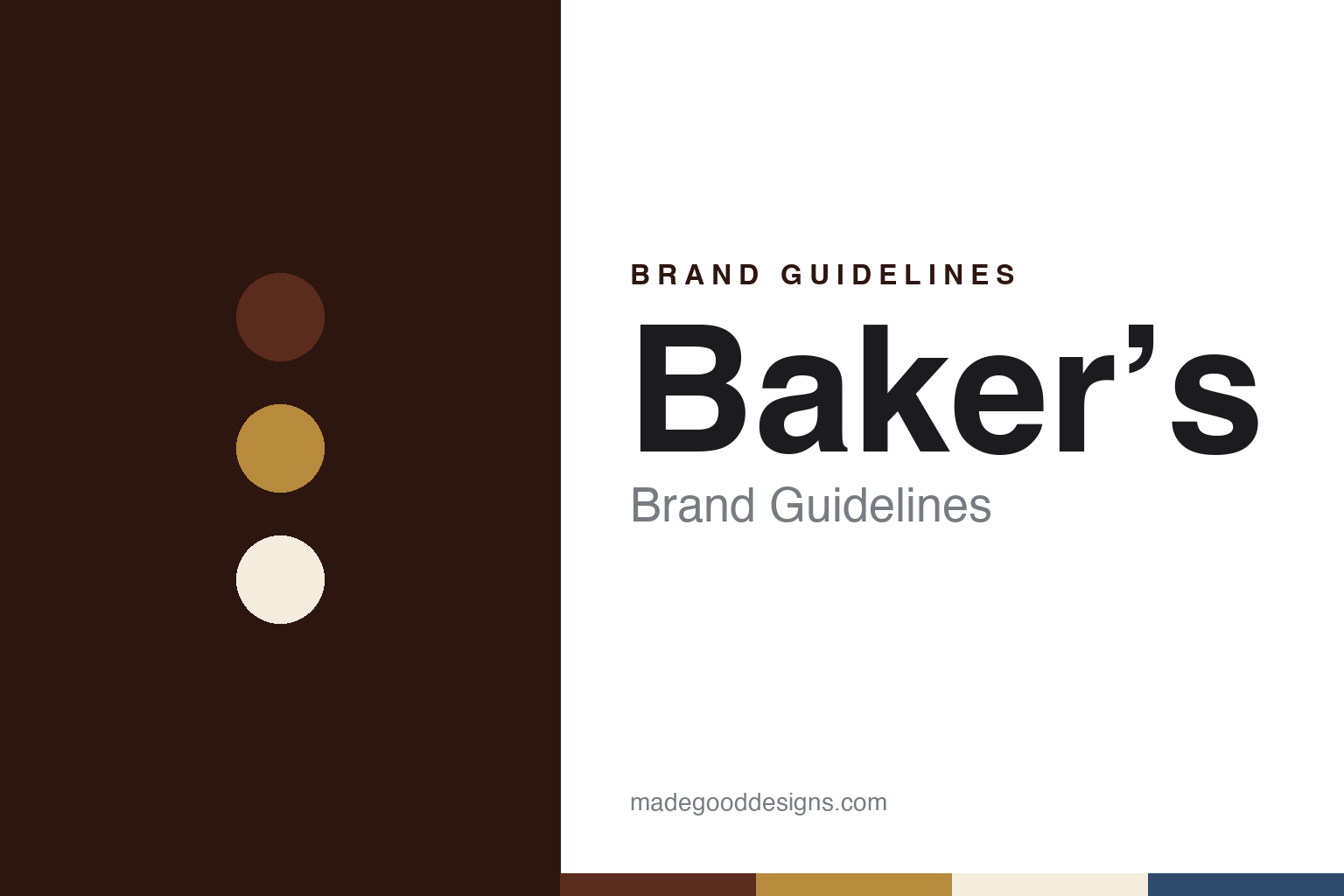
For a design guide, Baker’s shows how a borrowed work of art, adopted as a trademark, can give an industrial ingredient a sense of ceremony that lasts longer than the mills that made it. Compare it with Hershey’s, another American chocolate name, and Nestlé Toll House, another Massachusetts story in the baking aisle. For this guide we use chocolate brown, tray gold, pastel cream and river blue with a serif, an unofficial interpretation; no product or logo is reproduced.
Explore & save
Keep Baker’s’s identity on hand — save it to a board in the Made Good inspiration library.
Baker’s identity set
Pin the Baker’s chocolate brown, tray gold and pastel cream palette and the old-style serif register to your own board.