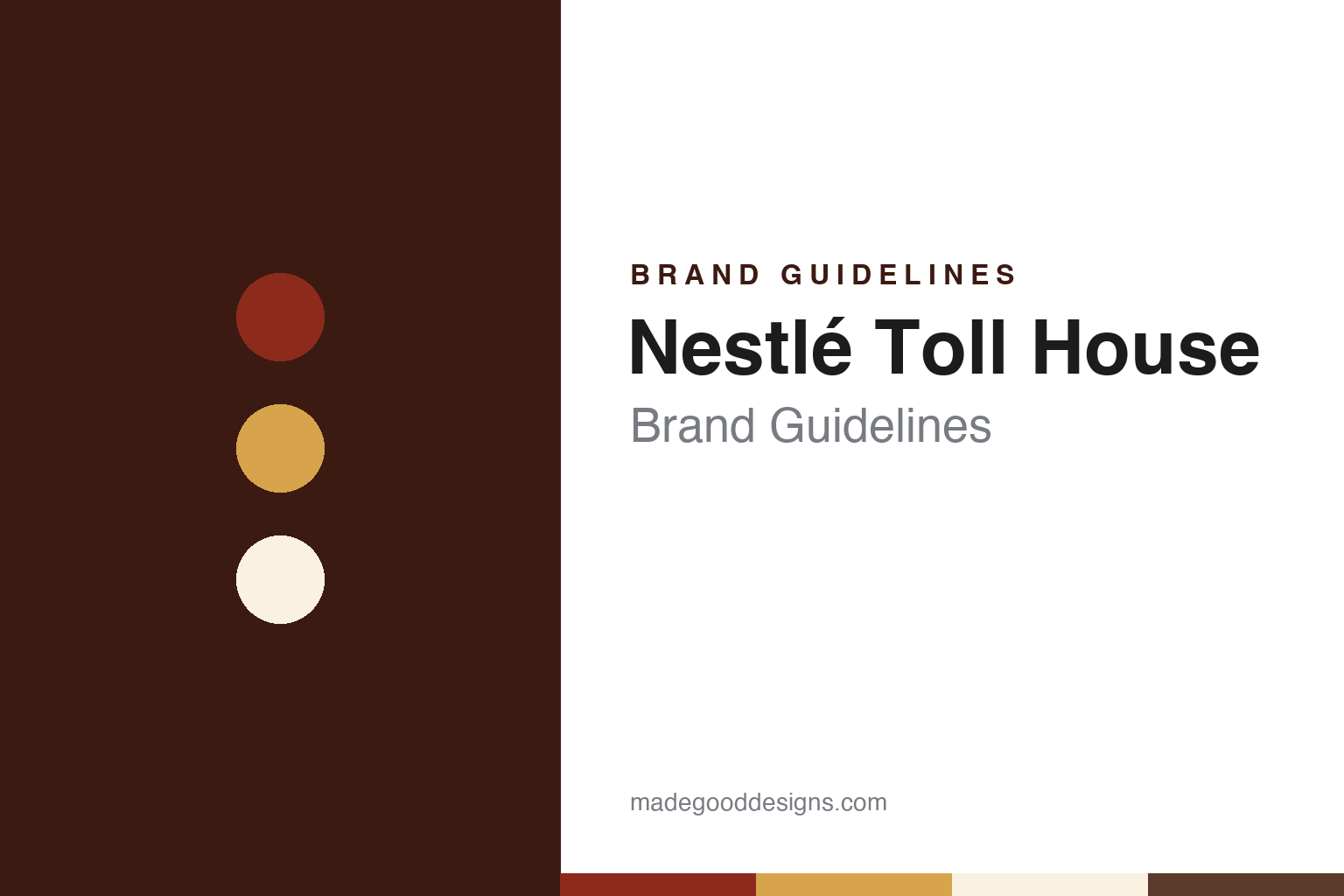
Nestlé Toll House Brand Guidelines
A roadside inn, a cookbook recipe and the words printed on the back of the bag.
Aa
Two constants: an inn-sign red, brown-sugar gold and cookie-dough cream palette and a bracketed display serif register. Abstract homage — not a Nestlé Toll House product or mark; no package, sign or logo is reproduced.
An inn on the road to New Bedford
A home economics teacher, a building on a busy road and a cookbook.
Nestlé Toll House is the American baking brand under which Nestlé sells chocolate morsels and other products for home bakers. Its name does not come from Nestlé. It comes from the Toll House Inn, a restaurant and lodge in Whitman, Massachusetts, run by Ruth Graves Wakefield and her husband Kenneth. English Wikipedia says the couple bought the building in 1930 and turned it into the Toll House Inn. Yankee magazine’s New England Today, in an article by Aimee Tucker updated in October 2021, said the location suited a business because it sat between Boston and New Bedford.
The name itself was a piece of salesmanship. English Wikipedia’s article on the inn says the site was never a toll house and that the building dated from 1817, and that the words “toll house” and the date “1709” on the inn’s sign were a marketing strategy. The sign outlived the building, the same article says, and still stands.
Wakefield came to the inn with training. The Taunton Daily Gazette, in a January 2021 article by Kristina Fontes, described her as an Easton native. English Wikipedia says she attended the Framingham State School of Household Arts, graduated in 1924 and taught home economics before the inn opened. Writing in The New Yorker on 19 December 2013, Jon Michaud noted that she had a degree in household arts and a reputation for perfectionism, a point he drew from the food writer Carolyn Wyman’s Great American Chocolate Chip Cookie Book.
The recipe that gave the brand its name came out of the inn’s dining room. Michaud wrote that Wakefield, who ran the Toll House restaurant with her husband from 1930, brought the Toll House Chocolate Crunch Cookie into being in the late 1930s, as an accompaniment to ice cream. The recipe appeared in print in the 1938 edition of her cookbook, Toll House Tried and True Recipes. The Gazette quoted Wakefield, via Wyman’s book, explaining that the inn had been serving a thin butterscotch nut cookie with ice cream and that she wanted to give guests something different. English Wikipedia says she broke up a Nestlé semi-sweet chocolate bar and added the pieces to a brown sugar dough, and names her pastry chef Sue Brides as her assistant.
Accounts of how the cookie began have long been embroidered. Michaud listed tales of a cook who ran out of nuts or baking chocolate and of chocolate shaken off a shelf into the mixer, and wrote that none of them appeared to be true. The Gazette noted that the plaque at the Whitman site repeats the story about the nuts, while Wakefield herself said the cookie was no accident.
Colour
A Boston radio show, a 1939 agreement and a bag of morsels.
The recipe travelled before Nestlé was involved. The New Yorker reported that the cookie became celebrated quickly enough for Marjorie Husted, the home economist behind General Mills’s Betty Crocker, to feature it on her radio programme. English Wikipedia says Wakefield had been handing printed copies of the recipe to guests who asked, and that Boston newspapers carried it under several names, including, by February 1939, “chocolate chip cookies.”
Nestlé came in through the chocolate. The New Yorker dated the deal to 20 March 1939, when, it said, Wakefield gave Nestlé the right to use her cookie recipe and the Toll House name; she was reportedly given chocolate for life and was paid by Nestlé for work as a consultant. English Wikipedia describes two stages: a March 1939 agreement with a New York licensed manufacturer of Nestlé chocolate to print the recipe on its wrappers, and a year later a wider agreement with Nestlé itself covering its chocolate packaging and its advertising across the country. The Gazette said the plaque in Whitman describes the bargain as the recipe on the wrapper in exchange for a lifetime supply of chocolate.
The product then changed shape. English Wikipedia says that by late 1939 Nestlé was selling chocolate bars scored into small segments for breaking, and that the following year it began selling small, tear-shaped pieces of chocolate under the name morsels. Yankee dated the bagged morsels to 1939. Both sources say the recipe stayed on the pack: Wikipedia says Nestlé still publishes Wakefield’s recipe on the back of each package of Toll House Morsels, and Yankee said it is printed on each bag today.
The war spread the recipe further. The New Yorker wrote that Toll House cookies were a common part of care packages sent to American soldiers overseas, that a Nestlé advertisement urged women to bake for “that soldier boy of yours,” and that the restaurant’s gift shop sent cookies to servicemen abroad. Michaud quoted Wyman’s view that the cookies had been a largely East Coast fad before the war and a national one after it.
The Wakefields eventually left the inn. The New Yorker said they sold the restaurant in 1967; English Wikipedia’s article on Ruth Wakefield dates her retirement and the sale to 1966. Michaud recorded that Wakefield died in 1977, and that the restaurant burned down on New Year’s Eve 1984. English Wikipedia says the agreement to carry her recipe on Nestlé packaging ended in 1979, after which the company adjusted the instructions for modern kitchens.
The brand stayed with Nestlé when the company reorganised its American sweets business. English Wikipedia’s article on Ferrero says that in January 2018 Ferrero agreed to buy Nestlé’s US confectionery business, including Butterfinger and Baby Ruth, and that the deal did not include the Toll House baking line. Nestlé USA’s brands page, as archived in March 2026, still listed Toll House products.
Typography
Design and documentation.
The baking shelf of a grocery store holds a particular kind of product: condensed and evaporated milk in small cans, chocolate chips and baking chocolate in bags and bars, corn starch in a box and baking powder in a tin. They are ingredients rather than finished foods, bought to be measured into something else, and a single can or tin may sit in a kitchen cupboard for months between uses.
That shapes how their packaging works. A name, a colour and a simple device have to be recognised on a crowded shelf, and then again in a cupboard, often by someone following a recipe that names the product. Directions, measurements and recipes printed on the pack are part of the design as well, read in the kitchen with flour on the counter and the oven already warming.
Each guide separates what independent sources record from what the company says about itself — who started the brand, who owns it now, where it is made and how its labels have changed — and marks plainly what rests only on the company’s own word.
Aa
A bracketed, high-contrast display serif — the inn-sign and cookbook-cover register of an old New England recipe. (Specimen set in Playfair Display, a serif STAND-IN; NOT the Nestlé Toll House logo.)
A recipe on the back
An inn name, a printed recipe and a sign that outlived its building.
A lasting piece of the brand’s design is a block of text. English Wikipedia says that from 1939 the Toll House recipe was printed on Nestlé chocolate wrappers, and that Nestlé still prints it on the back of each package of morsels. The same encyclopedia notes that, as of 2014, Nestlé printed the recipe on the side of its chocolate chips in English alone, to keep the cookie’s American association.
The name on the front carries a place. The words Toll House come from a roadside inn that, according to Wikipedia, was never a toll house at all, and whose sign carried the date 1709.
The place itself is still marked. The New Yorker reported in 2013 that the site of the restaurant was occupied by a Wendy’s, and that the authorities in Whitman required the fast-food restaurant to include a small museum to Wakefield and the Toll House. The Taunton Daily Gazette described the site in 2021 as marked by a sign and plaque on Route 18. English Wikipedia says Massachusetts designated the chocolate chip cookie its official state cookie in 1997, in reference to the Wakefield story.
The cookbook mattered too. Yankee reproduced a 1945 edition of Toll House Tried and True Recipes and pointed out the clipped way the recipe was written, with a word or two after each ingredient.
For a design guide, Nestlé Toll House shows how a borrowed place name and a printed recipe can become the identity of a commodity ingredient, so that the pack sells a method as much as a product. Compare it with Hershey’s, another American chocolate name sold in the baking aisle, and Baker’s, the Massachusetts baking chocolate. The parent company has its own guide at Nestlé. For this guide we use inn-sign red, brown-sugar gold, cookie-dough cream and morsel brown with a serif, an unofficial interpretation; no product or logo is reproduced.
Explore & save
Keep Nestlé Toll House’s identity on hand — save it to a board in the Made Good inspiration library.
Nestlé Toll House identity set
Pin the Nestlé Toll House inn-sign red, brown-sugar gold and cookie-dough cream palette and the bracketed display serif register to your own board.