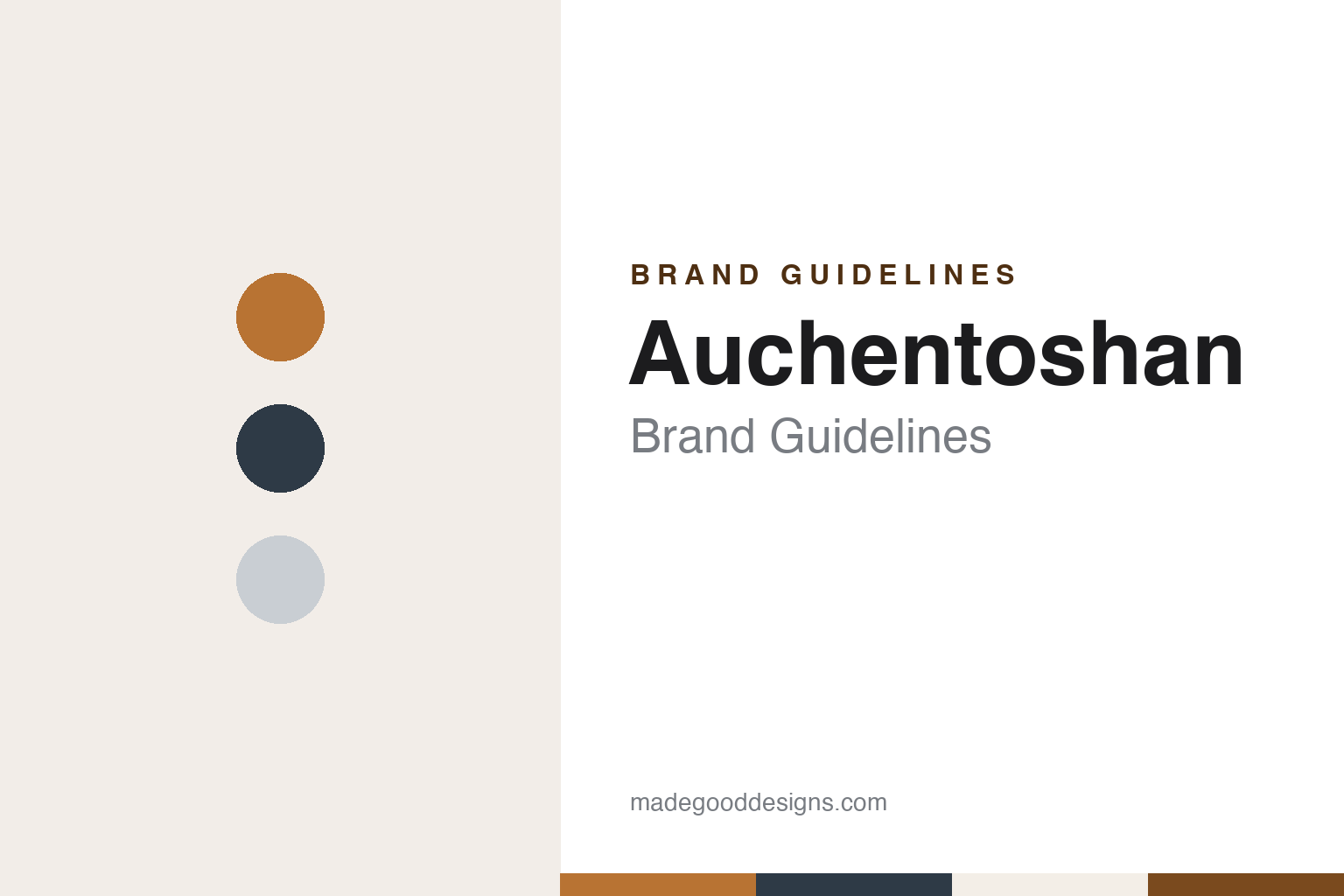
Auchentoshan Brand Guidelines
The triple-distilled Lowland malt from the edge of Glasgow, since 1823.
Aa
Two constants: a still copper, bronze and city slate palette and a condensed urban sans register. Abstract homage — not an Auchentoshan product or mark; no label, logo or bottle is reproduced.
A corner field below the Kilpatrick Hills
Two centuries of owners, and one Glasgow suburb.
Auchentoshan is a Lowland single malt Scotch whisky made at a distillery in Dalmuir, at the foot of the Kilpatrick Hills on the outskirts of Clydebank in West Dunbartonshire, close to the Erskine Bridge. English Wikipedia says the name comes from the Gaelic Achadh an Oisein, “corner field,” and that the distillery’s closeness to the city has earned it the nickname “Glasgow’s Malt Whisky.” The brand leans into that: its own website describes the whisky as “Crafted in Glasgow.”
The distillery gives 1823 as its founding year, and English Wikipedia, citing the distillery’s own history timeline, says it was built that year by John Bulloch, a corn merchant who ran it with his son. Bulloch went bankrupt in 1834. According to the same article, the local farmer Alexander Filshie then bought it, and his family kept control until 1877, when a poor harvest led to a sale; the Glasgow distillers John and George MacLachlan took it on that year.
English Wikipedia says the nearby main road was used as a decoy during the Second World War, and that several of the distillery’s warehouses were hit by the Luftwaffe during the Clydebank Blitz; a bomb crater behind the distillery is now used as a cooling-water pond. In 1969 Eadie Cairns bought the distillery and rebuilt it completely, and in 1984 Cairns sold it to Stanley P. Morrison, the company that became Morrison Bowmore Distillers.
Japan entered the story next. English Wikipedia says Suntory invested in Morrison Bowmore in 1989 and took full ownership of the business, Auchentoshan included, in 1994. When Suntory bought the American spirits company Beam Inc. in 2014, the combined spirits business became Beam Suntory, and on 30 April 2024 it was renamed Suntory Global Spirits, Shanken News Daily and Drinks International reported. The distillery’s water comes from Loch Katrine, according to English Wikipedia, and a visitor centre opened in 2005.
Colour
Three stills, three copper shapes on the pack, and a skyline.
Auchentoshan’s defining method is that it distils three times, using a wash still, an intermediate still and a spirit still. English Wikipedia says the third still helps bring the new spirit off at about 81 per cent alcohol by volume, and notes that triple distillation is unusual in Scotland. The company makes the point in plain words on its website, saying every drop is triple distilled, and pairs it with a self-aware line about its hard-to-pronounce name: “Challenging to say, easy to drink.”
The packaging has been rebuilt several times around that idea. In August 2008 The Drum reported that Morrison Bowmore had relaunched the brand with packaging by the agency Breeze Creative, a radical redesign of a range that had looked much the same for about twelve years. The new look was described as sleeker and more urban, with glass embellishment, embossed textured papers and boards, pearlised packs, a distinctive bottle shape and a tonal use of colour, and it was aimed at younger malt drinkers without losing existing ones.
In June 2013 the trade paper SLTN reported new packs for the core Three Wood and 12 Year Old. They kept the existing bottle shape but added illustrations, set the founding year 1823 prominently, and used bronze foiling to pick out the distillery’s three copper stills; brand manager Jennifer Meenan told the paper that on-pack illustrations were new for Auchentoshan.
The biggest shift came in October 2019. The Spirits Business reported that Beam Suntory had given the whisky bold new packaging, to be rolled out globally, carrying a city skyline, clear tasting notes and an emphasis on the brand’s “urban heritage,” framed around the idea of a whisky “born and raised in the city” of Glasgow. Eileen Livingston, Beam Suntory’s senior director of Scotch whisky, described the brand as “honest, innovative, disruptive and fun to be around,” and said the packaging was meant for a younger generation looking for a more approachable take on single malt.
Typography
Design and documentation.
The seven brands in this group are all Scotch whisky names: Monkey Shoulder, Whyte & Mackay, Auchentoshan, Old Pulteney, Glengoyne, Bunnahabhain and Caol Ila. Scotch whisky brands in general sit at many different points in the trade, from distilleries that still carry the name of the place where they stand to labels that now belong to much larger drinks groups, and a single brand can be sold everywhere from a corner shop to a hotel bar.
A whisky brand’s identity is usually carried less by a single bottle than by a label, a name and the place it promises, because the company behind the name may have changed hands, rebuilt its distillery or grown far beyond the place where it started. That makes the questions behind each name worth asking plainly: who started it, who owns it now, and where its whisky is actually distilled, matured and bottled.
Each guide separates what independent sources record from what the company says about itself — its founding story, its owners over time, where its whisky is made and how its labels have changed — and marks plainly what rests only on the company’s own word.
Aa
A condensed sans for a city-minded single malt. (Specimen set in Barlow Condensed, a sans-serif STAND-IN; NOT the Auchentoshan logo.)
Auchentoshan
A Lowland malt inside a Japanese drinks group.
The range is built on wood as much as on the stills. English Wikipedia says the distillery matures mainly in ex-bourbon barrels and ex-sherry butts, with some French wine casks. Three Wood, the best-known expression, spends its first years in American bourbon casks before finishes in Oloroso and then Pedro Ximénez sherry casks. The current core range on the company’s website runs from American Oak through Three Wood and a 12 Year Old Double Cask to an 18 Year Old, with Dark Oak and Blood Oak sold as travel-retail exclusives. Older releases have included a 50-year-old whisky distilled in 1957 and bottled in 2008, English Wikipedia says.
Through Suntory Global Spirits it sits in the same group as the Suntory whiskies of Japan and the American bourbon Jim Beam. English Wikipedia records double gold medals at the San Francisco World Spirits Competition in 2008 for two of its older expressions.
For a design guide, Auchentoshan shows how a whisky can turn a production quirk — a third copper still — and an unglamorous suburban address into a brand story, moving from pearlised packs in 2008 to bronze-foiled stills in 2013 and a city skyline in 2019. Compare Glenfiddich, the Dufftown single malt, and its Scotch sibling in this series Old Pulteney, the maritime malt from Wick. For this guide we use still copper, bronze and city slate with a condensed sans, an unofficial interpretation; no product or logo is reproduced.
Explore & save
Keep Auchentoshan’s identity on hand — save it to a board in the Made Good inspiration library.
Auchentoshan identity set
Pin the Auchentoshan still copper, bronze and city slate palette and the condensed urban sans register to your own board.