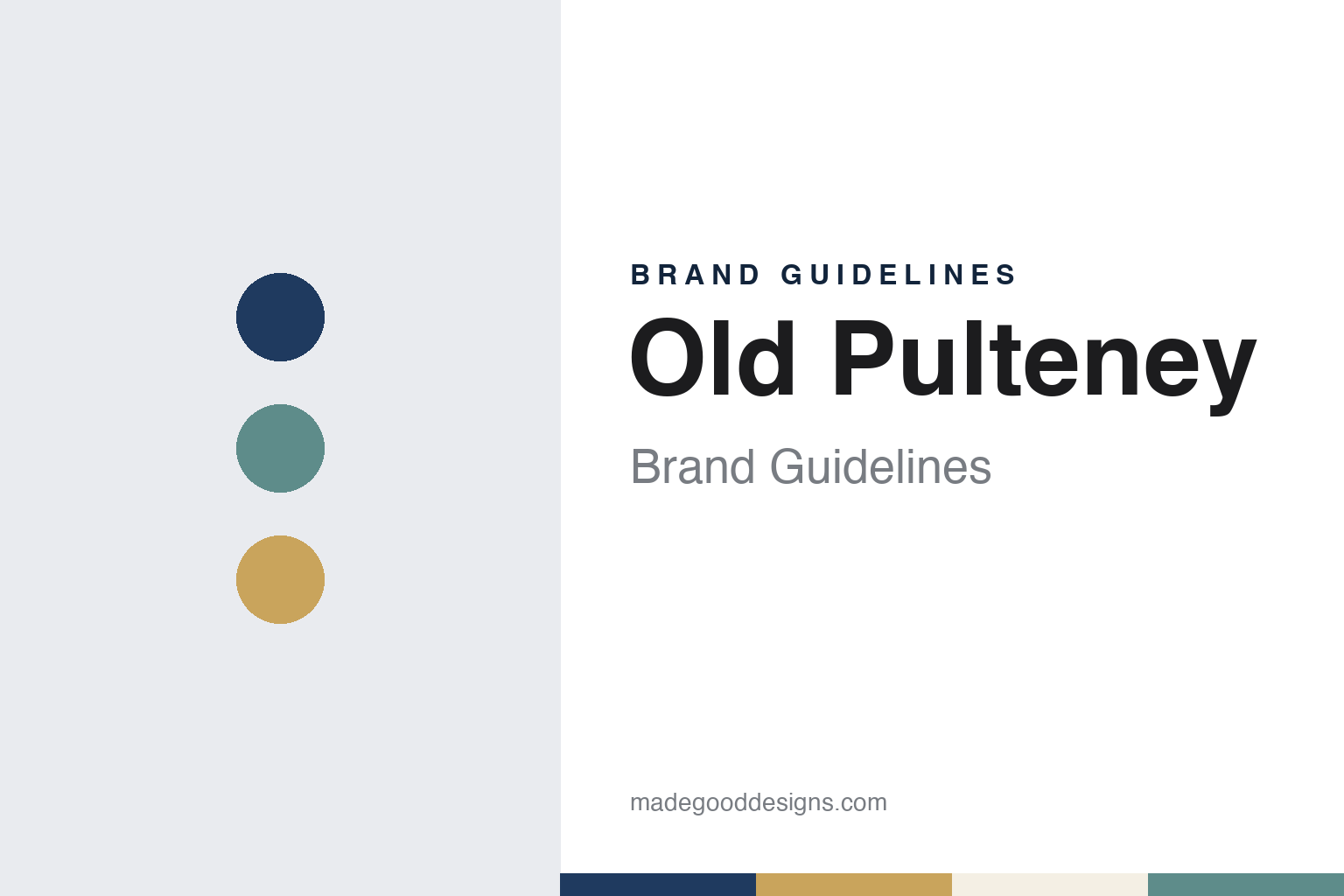
Old Pulteney Brand Guidelines
The maritime malt from the herring port of Wick, since 1826.
Aa
Two constants: a harbour navy, North Sea teal and foil gold palette and a maritime book serif register. Abstract homage — not an Old Pulteney product or mark; no label, logo or bottle is reproduced.
A distillery in a herring town
From a planned fishing settlement to a far-north malt.
Old Pulteney is the single malt of the Pulteney distillery in Wick, a harbour town in Caithness on the far north-east coast of mainland Scotland. The distillery was founded in 1826 by James Henderson, the company says, and the industry site scotchwhisky.com adds that Henderson had previously distilled at Stemster, inland from the town. It took its name from Pulteneytown, the then newly built district of Wick, which, like the distillery, was named after Sir William Pulteney, English Wikipedia says. For many years it was described as the most northerly distillery on the Scottish mainland, a title now claimed by Wolfburn in Thurso.
The town shaped the whisky’s identity. The company describes Wick as having been the “herring capital of the world,” with the distillery and the fishing industry growing up side by side, and English Wikipedia notes that the distillery was for a long time reachable mainly by sea. Its water comes from Loch Hempriggs along a mill lade attributed to the engineer Thomas Telford.
The ownership record runs through most of the big names in Scotch. According to scotchwhisky.com, the Henderson family’s distillery was acquired in 1920 by the Dundee blender James Watson & Co, which John Dewar & Sons bought in 1924; Dewar’s joined the Distillers Company the following year. Production stopped in 1930, after Wick voted itself dry under local prohibition, and the town stayed dry until 1947. The distillery reopened in 1951 under the lawyer Bertie Cumming, who also owned Balblair, and passed in the mid-1950s to Hiram Walker & Sons (English Wikipedia gives 1954, scotchwhisky.com 1955), which substantially rebuilt it at the end of the decade. Allied Breweries, later Allied Domecq, owned it from 1961.
In 1995 the distillery was bought by Inver House Distillers, an Airdrie-based company that also owns Balblair, Balmenach, Knockdhu and Speyburn. English Wikipedia, citing a ThaiBev release of 30 October 2006, says Inver House became a wholly owned subsidiary of International Beverage Holdings, the international arm of Thai Beverage, that year.
Colour
A flat-topped still, a herring drifter and the sea.
Old Pulteney’s visual identity is built from the distillery and the harbour. The first element is the still. scotchwhisky.com describes a wash still with a large boil ball and a flat-topped, truncated shape, with condensing in stainless-steel worm tubs. The company says only two other Scottish distilleries use this design, and that the still’s shape gives the spirit its character and lends the Old Pulteney bottle its “iconic shape.”
The second element is the boat. The brand uses a herring drifter from Wick as its symbol, and several bottlings have been named after real drifters. In November 2011 Packaging Insights reported new packs for the 12, 17 and 21 Year Old in both domestic and travel-retail markets: a new logo carrying the founding year, 1826, and the Wick location, greater use of foil, bolder lettering and a redrawn herring drifter. Margaret Mary Clarke, the brand’s senior brand manager, called the new look “a modern evolution for the brand.”
In October 2011 the BBC reported that Old Pulteney 21 Year Old had been named World Whisky of the Year in Jim Murray’s Whisky Bible 2012, and Packaging Insights noted that the redesign followed that award.
A further relaunch came in August 2018. The trade paper SLTN reported that Inver House had overhauled the core range as a 12 Year Old, the peated Huddart, a 15 Year Old and an 18 Year Old, keeping the established bottle while refreshing labels and packaging. The brand’s slogan throughout has been the sea: it calls itself “The Maritime Malt,” saying sea air reaches the casks through its warehouses, and also uses the line “Made in Wick, shaped by Wick.”
Typography
Design and documentation.
The seven brands in this group are all Scotch whisky names: Monkey Shoulder, Whyte & Mackay, Auchentoshan, Old Pulteney, Glengoyne, Bunnahabhain and Caol Ila. Scotch whisky brands in general sit at many different points in the trade, from distilleries that still carry the name of the place where they stand to labels that now belong to much larger drinks groups, and a single brand can be sold everywhere from a corner shop to a hotel bar.
A whisky brand’s identity is usually carried less by a single bottle than by a label, a name and the place it promises, because the company behind the name may have changed hands, rebuilt its distillery or grown far beyond the place where it started. That makes the questions behind each name worth asking plainly: who started it, who owns it now, and where its whisky is actually distilled, matured and bottled.
Each guide separates what independent sources record from what the company says about itself — its founding story, its owners over time, where its whisky is made and how its labels have changed — and marks plainly what rests only on the company’s own word.
Aa
A sturdy book serif for a harbour-town malt with an 1826 date on the pack. (Specimen set in Libre Caslon Text, a serif STAND-IN; NOT the Old Pulteney logo.)
Old Pulteney
A Caithness malt inside a Thai drinks group.
scotchwhisky.com says the 12 Year Old, the best-seller, was launched in 1997, two years after Inver House took over, followed by a 17 Year Old in 2004 and a 21 Year Old in 2005, and that most of the whisky set aside for single malt is filled into ex-bourbon casks and stored in warehouses on site. Vintage bottlings have also drawn attention: English Wikipedia records that Old Pulteney 1989 was named world’s best single malt at the World Whiskies Awards in 2016, and that in July 2023 the distillery released a 45-year-old called Bow Wave, its oldest whisky to date.
Inver House’s parent, Thai Beverage, is also the company behind the Thai lager Chang, and within Scotland Inver House runs its five malt distilleries from a base in Airdrie. In 2026 the distillery marks 200 years since its founding, and its website offers a 200 Year Distillery Exclusive bottling for the anniversary.
For a design guide, Old Pulteney shows how a whisky can draw its whole identity from a single place — a still with its top cut short, a fishing boat redrawn for each new pack, and a founding date set into the logo — and keep that story steady through two redesigns. Compare Glenfiddich, the Dufftown single malt, and its Scotch sibling in this series Auchentoshan, the triple-distilled Lowland malt. For this guide we use harbour navy, North Sea teal and foil gold with a serif, an unofficial interpretation; no product or logo is reproduced.
Explore & save
Keep Old Pulteney’s identity on hand — save it to a board in the Made Good inspiration library.
Old Pulteney identity set
Pin the Old Pulteney harbour navy, North Sea teal and foil gold palette and the maritime book serif register to your own board.