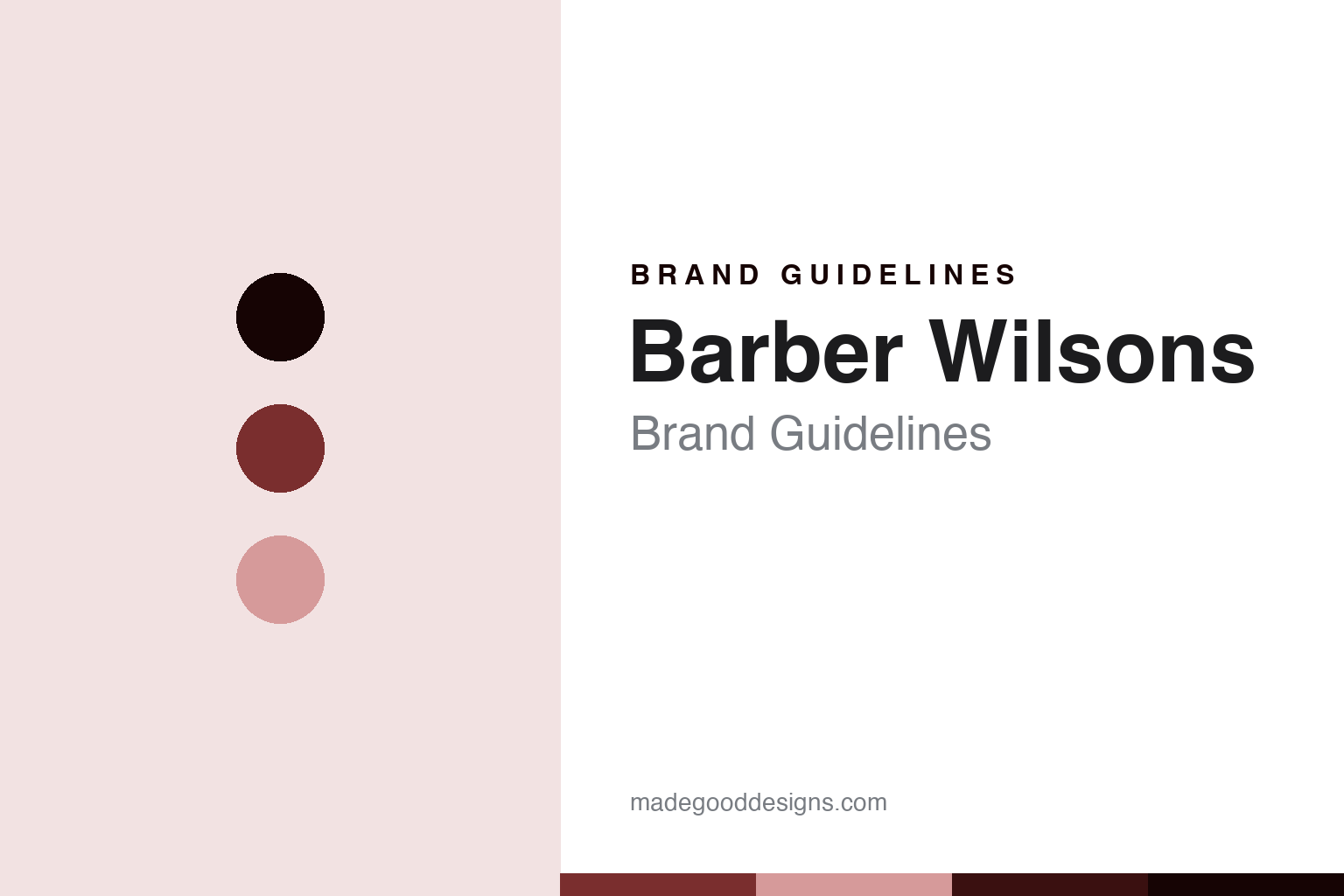
Barber Wilsons Brand Guidelines
English brass since 1905.
Aa
Two constants: an oxblood palette and a warrant-sans register. Abstract homage — not a Barber Wilsons product or mark.
English brass since 1905
Barber Wilsons is the London brassware house of 1905, a family-run maker of traditional English taps at its Wood Green works.
Barber Wilsons is the round’s London brass — a family-run house making traditional and contemporary taps in the same city for over a century. Barber Wilsons makes brass bathroom and kitchen taps, mixers, showers and accessories, in period and modern ranges. Its answer to how a maker becomes a name is a London works plus a long clientele: make traditional English brassware at its Wood Green factory, and keep the specialist ranges going for generations. A tap, made in London.
Its identity is English brass since 1905. Barber Wilsons’ traditional taps, its London making and its family operation are the work it is known for. A tap, made in London. English brass since 1905.
(Honest notes, so the story stays precise. Barber Wilsons & Co — at barberwilsons.com — makes traditional and contemporary brass taps, mixers, showers, kitchen taps and accessories, with heritage ranges such as Mastercraft, designed in the 1930s, and Regent. It was born in 1905, at Crawley Road, London, when brothers Walter and William Wilson joined with Edward Barber. On where it is made — the point of this round — Barber Wilsons is a London manufacturer at its Wood Green works; because its site does not print a blunt “made in England” line, we say made in London, at Wood Green, rather than an absolute national claim, and note the location is Wood Green, not Enfield. On ownership, it is independent and family-operated, described as involving four generations. It has held a Royal Warrant, granted under Queen Elizabeth II; we describe that heritage but do not reproduce the warrant or the royal arms, which are protected. Its name and marks are IP, described but never reproduced, and there is no official brand hex; these tones are an unofficial interpretation. This is design commentary and does not promote any product.)
Colour
Barber Wilsons lives in an oxblood palette. Click a swatch to copy the hex.
Barber Wilsons’ identity is traditional, made and English — an oxblood, an ink, a rose, a deep claret, and a paper. The palette leans oxblood and rose: a deep, traditional register with a hint of the ceremonial. It signals a heritage English brassware house. The honest caveat: with no published brand hex, these values are an original, unofficial interpretation, not first-party colours.
The lesson is an oxblood palette signals a traditional, made-in-London identity. Barber Wilsons’ world is a traditional, made object. For designers, it is a reminder that a deep oxblood and a soft rose can carry a brassware house — the register of a long-established London maker. Because these tones can fail as small text, keep type dark and let the colour live in the accents, palette and band. The takeaways: keep the specialist ranges; make it in the city; describe a make and a warrant honestly; and treat any single hex as unofficial.
Typography
The register is a warrant sans — traditional, solid, made.
Barber Wilsons’ identity carries a traditional, solid, made spirit — a century-old London house, not a newcomer. A warrant sans captures the mood: dependable, formal and English, the register of a maker with a long and grand clientele. Set in an oxblood palette, the warrant sans feels traditional and solid — exactly the personality Barber Wilsons carries. It is a London works rather than a logo, mirroring a cast-brass tap made for generations. (Barber Wilsons’ real wordmark, and any royal warrant or arms, are things we describe but do not reproduce, and the exact typeface is not ours to use.) Because it is not ours to use, the honest description is “a warrant-sans spirit,” shown here in a stand-in. The type behaves like the tap: traditional, solid and made.
Aa
A warrant-sans spirit — traditional and made. (Specimen set in Space Grotesk, a warrant-sans STAND-IN; NOT the Barber Wilsons logo or any royal warrant.)
The tap makers
Barber Wilsons stands for English brass since 1905.
Barber Wilsons is a lesson in how a London works can be an identity. An oxblood palette, a warrant sans and a cast-brass tap make one thing — English brass since 1905 — the whole identity: traditional, made and English. The London manufacture is the differentiator, and the century of specialist ranges is the meaning. The point is a family house that has made traditional English brassware in the same city since 1905.
Put to work, the identity is a London works, told straight, as design. A maker in this spirit would keep the specialist ranges and make them in the city — brassware, at Wood Green. A reader in this spirit would keep the honest limits: the site does not print a blunt made-in-England line, so it is safer to say made in London at Wood Green; the location is Wood Green, not Enfield; and the Royal Warrant, granted under Queen Elizabeth II, is described but never reproduced. Barber Wilsons holds the round’s heritage thread from 1905, its where-made thread at the made-at-home end this round shares, and its differentiator thread with its Royal Warrant heritage. The honest editorial moves are to say made in London, to place the works at Wood Green, and to describe the warrant without rendering it. The lesson Barber Wilsons teaches is that a London works can hold an identity: the city making gives it substance, and the century of ranges keeps it credible.
For designers and brand-builders, Barber Wilsons holds a Britain pole in the tap makers: keep the ranges — and make them in the city. The lessons: hold your specialities; make in-country; state a make only as far as it is stated; never render a protected warrant; and never reproduce a logo. It is also a reminder to stay precise: Barber Wilsons is the London brassware house of 1905, a family-run maker of traditional English taps at its Wood Green works — with the palette here an unofficial interpretation. Read that way, Barber Wilsons is less a tap than a London persistence: a family that has made the same specialist brassware in the same city for over a hundred years. Barber Wilsons made English-brass-since-1905 the identity — proof that a tap, honestly made, can be the difference.
Explore & save
Keep Barber Wilsons’s identity on hand — save it to a board in the Made Good inspiration library.
Barber Wilsons identity set
Pin the oxblood palette and the warrant-sans register to your own board.