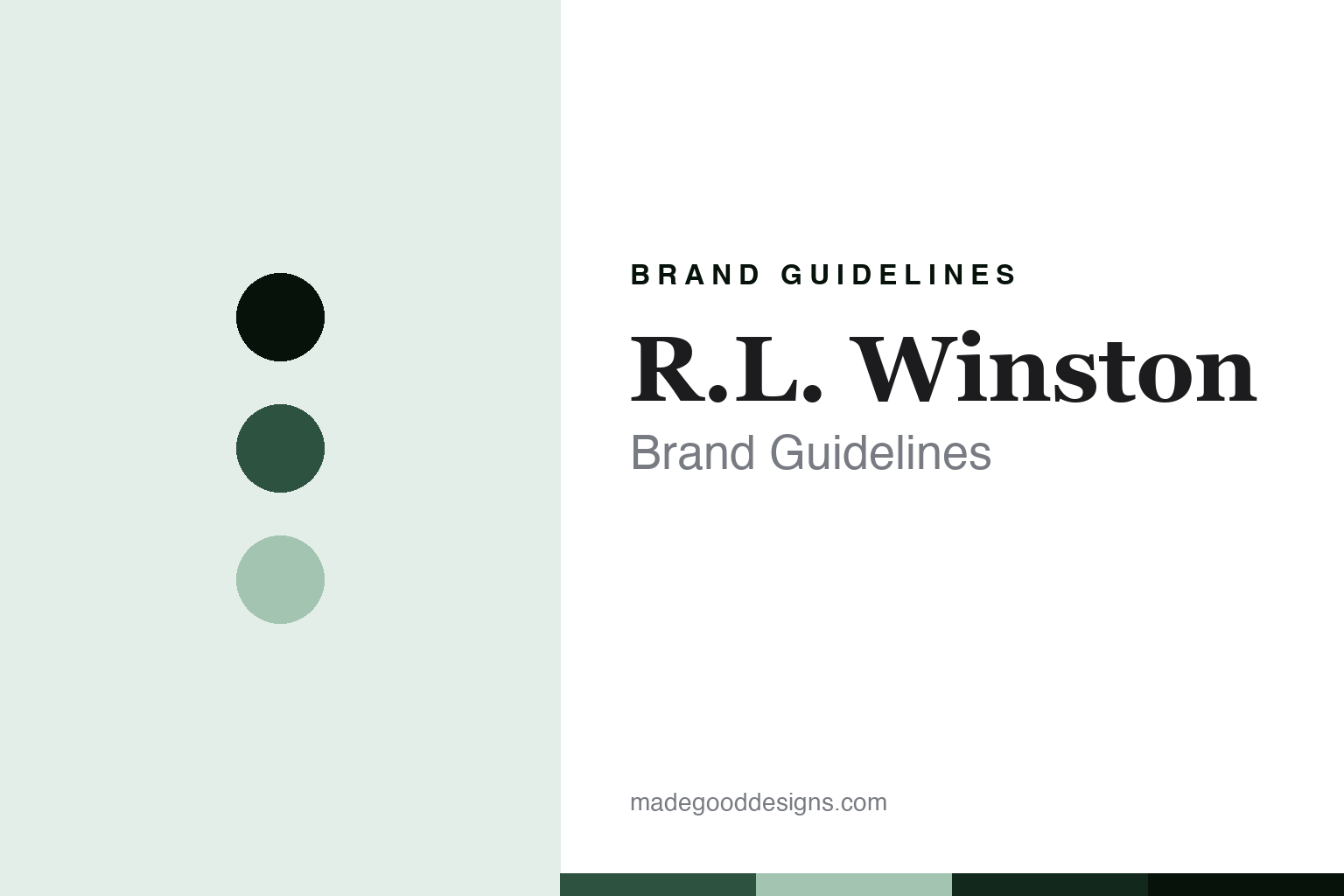
R.L. Winston Brand Guidelines
The bamboo-and-graphite house.
Aa
Two constants: a river-green palette and a heritage-serif register. Abstract homage — not an R.L. Winston product or mark.
The bamboo-and-graphite house
R.L. Winston is the American fly-rod house of 1929 — split-cane bamboo and graphite, handcrafted in Twin Bridges, Montana.
R.L. Winston opens the round as the elder — the fly-rod house that carries split-cane bamboo and modern graphite under one roof, handcrafted in a Montana river town. Winston makes fly rods, and its answer to how a maker becomes a name is longevity married to place: build a rod worth handing down, and build it where the water is. A rod, made in Montana.
Its identity is the bamboo-and-graphite house. Winston’s split-cane heritage, its graphite present and its Twin Bridges bench are the work it is known for. A rod, handcrafted in the USA. The bamboo-and-graphite house.
(Honest notes, so the story stays precise. R.L. Winston — at winstonrods.com — makes fly rods in both split-cane bamboo and graphite, a rare house that keeps the old craft and the new material side by side. It was founded in 1929 in San Francisco; the founder’s name is Robert Winther, not Winston, working with Lew Stoner, and the brand name is the anglicised trace of Winther. The company moved to Twin Bridges, Montana in 1976, with its present facility dating to the 1990s, and its rods — bamboo and graphite alike — are handcrafted there. On ownership — a theme of this round — Winston changed hands in 2026: David Ondaatje, who owned it from 1991, sold it to Lance Robertson, with staff and manufacturing continuity kept in Twin Bridges. There is a well-loved heritage colour associated with Winston rods; out of respect for the mark we describe the river-green mood but do not reproduce any official hex. Its name and marks are IP, described but never reproduced; these tones are an unofficial interpretation. This is design commentary and does not promote any product.)
Colour
Winston lives in a river green. Click a swatch to copy the hex.
Winston’s identity is handcrafted, made and lasting — a green, an ink, a sage, a deep green, and a paper. The palette leans river green and sage: a quiet register that nods to Montana water and the green long associated with the house, held here as an original interpretation rather than a copy. It signals a heritage rod-builder that still cuts cane by hand. The honest caveat: out of respect for the real Winston colour, these values are an original, unofficial interpretation, not first-party colours.
The lesson is a river green signals a handcrafted, made-in-Montana identity. Winston’s world is a handcrafted, lasting object. For designers, it is a reminder that a soft green and a river sage can carry a rod maker — the tone of clear water and bamboo. Because these tones can fail as small text, keep type dark and let the colour live in the accents, palette and band. The takeaways: build to be handed down; build where the water is; keep the old craft alive beside the new; and treat any single hex as unofficial.
Typography
The register is a heritage serif — handcrafted, patient, made.
Winston’s identity carries a handcrafted, patient, made spirit — a house nearly a century old, not a fashion. A heritage serif captures the mood: warm, classic and unhurried, the register of a rod planed and wrapped by hand in a Montana shop. Set in a river-green palette, the heritage serif feels handcrafted and lasting — exactly the personality Winston carries. It is craft rather than a logo, mirroring split cane and cork. (Winston’s real wordmark is something we describe but do not reproduce, and the exact typeface is not ours to use.) Because it is not ours to use, the honest description is “a heritage-serif spirit,” shown here in a stand-in. The type behaves like the rod: handcrafted, patient and made.
Aa
A heritage-serif spirit — handcrafted and patient. (Specimen set in Playfair Display, a heritage-serif STAND-IN; NOT the R.L. Winston logo.)
The rod builders
R.L. Winston stands for the bamboo-and-graphite house.
Winston opens the round as the elder. A river-green palette, a heritage serif and a handcrafted rod make one thing — the bamboo-and-graphite house — the whole identity: handcrafted, made and lasting. The Montana bench is the differentiator, and the split-cane-and-graphite craft is the meaning. The point is a house from 1929 that still planes bamboo by hand while building graphite for the modern angler.
Put to work, the identity is a heritage craft told straight, as design. A maker in this spirit would keep the old skill alive beside the new material and build both where the water is — rods, in Twin Bridges. A reader in this spirit would keep the facts right: it began in San Francisco in 1929 under Robert Winther, not a man named Winston; it moved to Montana in 1976; and it changed hands in 2026, from David Ondaatje to Lance Robertson, with the bench kept intact. Winston opens the round’s where-made thread at the home-built end that St.Croix, Thomas & Thomas, Scott and G.Loomis share, and it echoes the bamboo heritage of Orvis and Hardy from the first fishing round. The honest editorial moves are to credit Winther, to place the making in Twin Bridges, to note the 2026 sale plainly, and to leave the beloved house colour undescribed as a hex. The lesson Winston teaches is that a house can hold an identity across a century: the bamboo keeps it rooted, and the graphite keeps it current.
For designers and brand-builders, Winston opens the rod builders: build something worth handing down — and build it where the water is. The lessons: keep the old craft alive; make in-country; treat an ownership change as continuity, not rupture; get a founder’s name right; and never reproduce a logo or a beloved colour. It is also a reminder to stay precise: R.L. Winston is the American fly-rod house of 1929, split-cane and graphite handcrafted in Twin Bridges, Montana — with the palette here an unofficial interpretation. Read that way, Winston is less a rod than a promise: that a thing made by hand, in a river town, will outlast the angler who buys it. The lesson for a brand is that patience and place can be an identity all their own, because a rod planed from cane in Montana carries a meaning no material spec can print. Winston made the-bamboo-and-graphite-house the identity — proof that a rod, handcrafted where the water runs, can be an heirloom.
Explore & save
Keep R.L. Winston’s identity on hand — save it to a board in the Made Good inspiration library.
R.L. Winston identity set
Pin the river-green palette and the heritage-serif register to your own board.