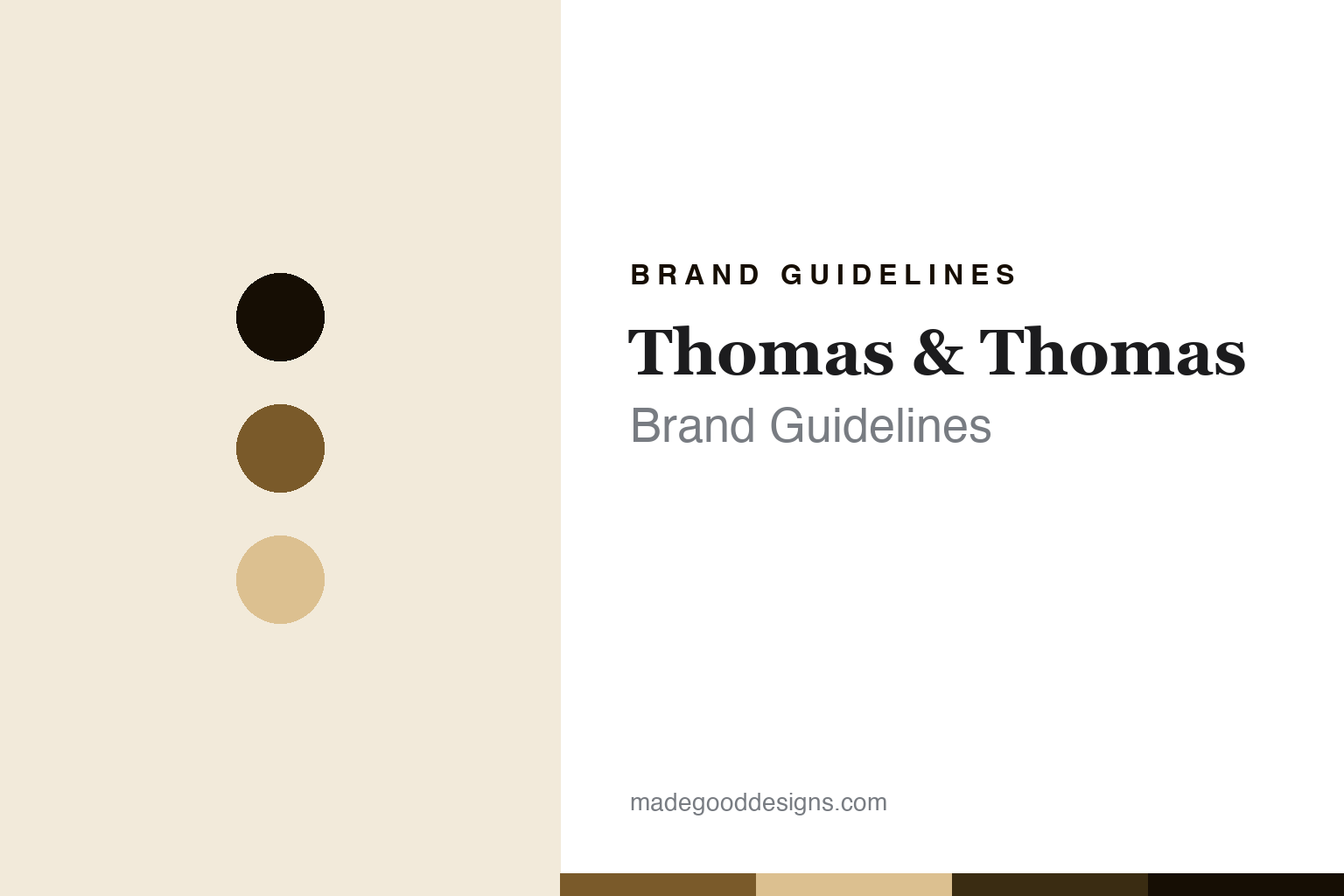
Thomas & Thomas Brand Guidelines
The cane-and-graphite house.
Aa
Two constants: a cane palette and a cane-serif register. Abstract homage — not a Thomas & Thomas product or mark.
The cane-and-graphite house
Thomas & Thomas is the American fly-rod house of 1969 — bamboo and graphite, handcrafted in western Massachusetts.
Thomas & Thomas answers Winston as the other bamboo house — the New England maker whose name is two Toms, and whose bench keeps split cane alive beside modern graphite. Thomas & Thomas makes fly rods, and its answer to how a maker becomes a name is craft kept deliberately small: handcraft every rod, and never let the cane die out. A rod, made in Massachusetts.
Its identity is the cane-and-graphite house. Its bamboo craft, its graphite present and its western-Massachusetts bench are the work it is known for. A rod, handcrafted in the USA. The cane-and-graphite house.
(Honest notes, so the story stays precise. Thomas & Thomas — at thomasandthomas.com — makes handcrafted fly rods in both bamboo and graphite, one of the few houses that still builds split cane at scale. It was founded in 1969 by Tom Dorsey and Tom Maxwell — the two Toms behind the name. On where it is made — a theme of this round — its rods are handcrafted in the USA, in western Massachusetts; we say western Massachusetts rather than a single street address. On ownership, the company has been led by chief executive Neville Orsmond since 2014. Its name and marks are IP, described but never reproduced, and there is no official brand hex; these tones are an unofficial interpretation. This is design commentary and does not promote any product.)
Colour
Thomas & Thomas lives in a cane palette. Click a swatch to copy the hex.
Its identity is handcrafted, warm and made — a cane, an ink, a straw, a deep cane, and a paper. The palette leans cane and straw: a warm register that nods to split bamboo, cork grips and the amber of a finished blank. It signals a heritage rod-builder that still planes cane by hand. The honest caveat: with no published brand hex, these values are an original, unofficial interpretation, not first-party colours.
The lesson is a cane palette signals a handcrafted, made-in-USA identity. The house’s world is a handcrafted, warm object. For designers, it is a reminder that a warm cane and a soft straw can carry a rod maker — the tone of bamboo and cork. Because these tones can fail as small text, keep type dark and let the colour live in the accents, palette and band. The takeaways: keep the craft small; keep the cane alive; make it by hand; and treat any single hex as unofficial.
Typography
The register is a cane serif — handcrafted, warm, made.
Its identity carries a handcrafted, warm, made spirit — a small bench, not a factory floor. A cane serif captures the mood: fine, classic and warm, the register of split bamboo planed and glued by hand. Set in a cane palette, the cane serif feels handcrafted and warm — exactly the personality Thomas & Thomas carries. It is craft rather than a logo, mirroring cane, cork and nickel silver. (The real wordmark is something we describe but do not reproduce, and the exact typeface is not ours to use.) Because it is not ours to use, the honest description is “a cane-serif spirit,” shown here in a stand-in. The type behaves like the rod: handcrafted, warm and made.
Aa
A cane-serif spirit — handcrafted and warm. (Specimen set in Cormorant Garamond, a cane-serif STAND-IN; NOT the Thomas & Thomas logo.)
The rod builders
Thomas & Thomas stands for the cane-and-graphite house.
Thomas & Thomas pairs with Winston as the round’s second bamboo house. A cane palette, a cane serif and a handcrafted rod make one thing — the cane-and-graphite house — the whole identity: handcrafted, warm and made. The western-Massachusetts bench is the differentiator, and the two-Toms craft is the meaning. The point is a small New England house from 1969 that kept split cane alive when the industry moved wholesale to graphite.
Put to work, the identity is a small craft told straight, as design. A maker in this spirit would keep the bench small, keep the cane alive, and handcraft every rod — rods, in western Massachusetts. A reader in this spirit would keep the facts right: it was founded in 1969 by Tom Dorsey and Tom Maxwell, the two Toms; it is led by Neville Orsmond since 2014; and it is handcrafted in western Massachusetts. Thomas & Thomas sits in the round’s where-made thread at the home-built end with Winston, St.Croix, Scott and G.Loomis, and it echoes the bamboo heritage of Orvis and Hardy from the first fishing round. The honest editorial moves are to credit both Toms, to name western Massachusetts, and to keep the living chief executive to public facts. The lesson Thomas & Thomas teaches is that a house can stay small and still hold an identity: the cane keeps it rare, and the handcraft keeps it honest.
For designers and brand-builders, Thomas & Thomas continues the rod builders: keep the craft small — and keep the cane alive. The lessons: refuse to scale past the craft; keep an old material when it is worth keeping; make by hand; get the founders right; and never reproduce a logo. It is also a reminder to stay precise: Thomas & Thomas is the American fly-rod house of 1969, bamboo and graphite handcrafted in western Massachusetts — with the palette here an unofficial interpretation. Read that way, the house is less a brand than a bench: two Toms who decided a rod was worth planing by hand, and a company that still does. The lesson for a brand is that scarcity earned by craft is more durable than scarcity manufactured by marketing, because a hand-planed cane rod is genuinely rare and cannot be faked. Thomas & Thomas made the-cane-and-graphite-house the identity — proof that a rod, kept small and made by hand, can be a quiet standard. The house’s refusal to outgrow its bench is not nostalgia but strategy: every rod that leaves western Massachusetts carries the fact that a person planed and wrapped it, and that provenance is exactly what a mass-moulded blank can never claim, which is why the two Toms’ decision in 1969 still reads as modern rather than quaint today.
Explore & save
Keep Thomas & Thomas’s identity on hand — save it to a board in the Made Good inspiration library.
Thomas & Thomas identity set
Pin the cane palette and the cane-serif register to your own board.