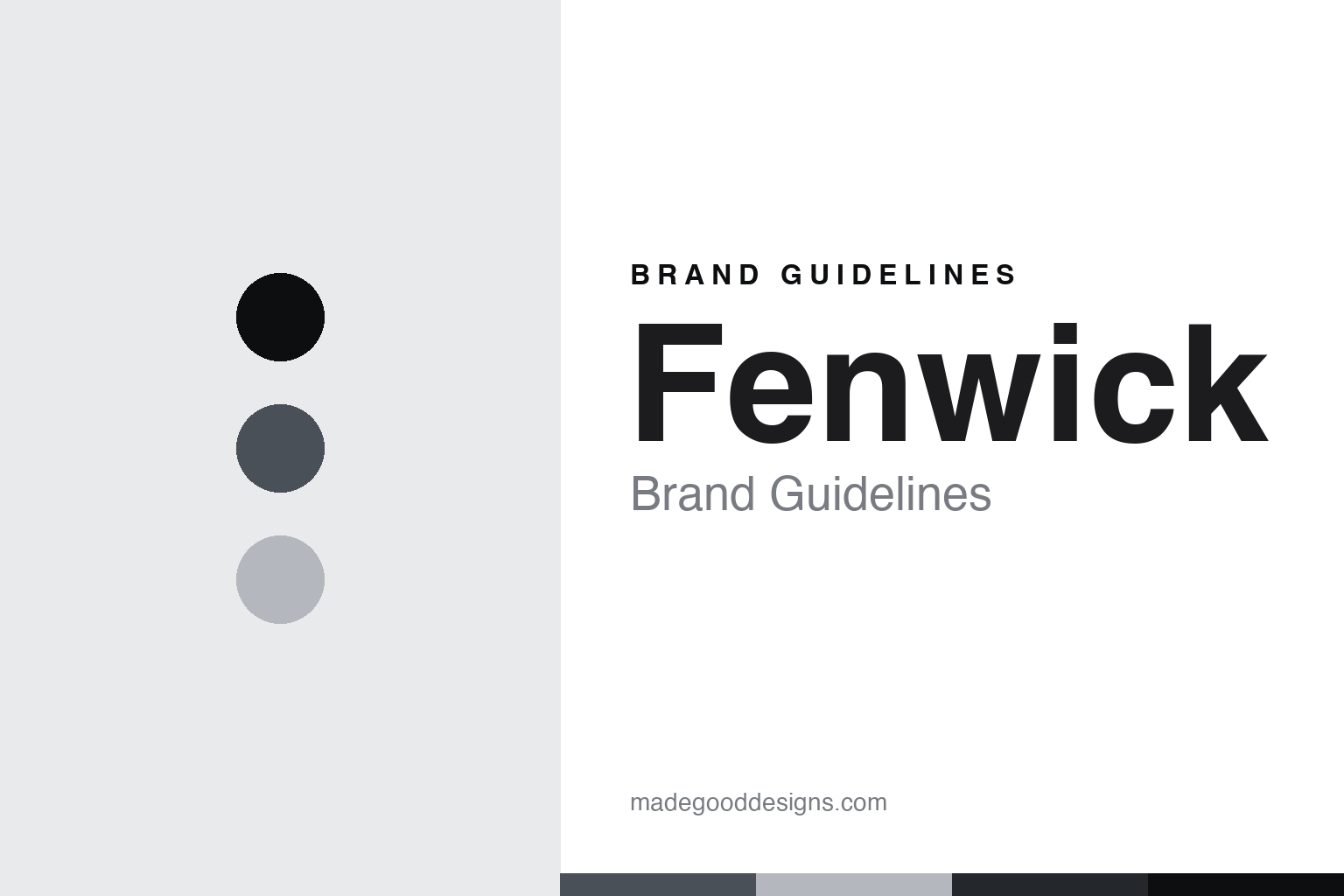
Fenwick Brand Guidelines
The graphite rod, American-owned.
Aa
Two constants: a graphite palette and a graphite-sans register. Abstract homage — not a Fenwick product or mark.
The graphite rod, American-owned
Fenwick is the American rod maker of the early 1950s — the graphite pioneer of the HMG, near Lake Fenwick in Washington, now a Pure Fishing brand.
Fenwick follows Berkley as the rod pioneer — the Washington maker credited with one of the first commercially successful graphite rods, whose name most anglers know without knowing it shares an owner with Penn and Abu Garcia. Fenwick makes fishing rods, and its answer to who owns your tackle is a genuine technical first that ended up inside a private-equity portfolio. A rod, graphite by heritage.
Its identity is the graphite rod, American-owned. Fenwick’s HMG heritage, its Feralite ferrule and its place under Pure Fishing are what this round is about. A rod, from near Lake Fenwick. The graphite rod, American-owned.
(Honest notes, so the story stays precise. Fenwick — at fenwickfishing.com — makes fishing rods, with the HMG line and the Feralite glass ferrule as its heritage hallmarks. It began in the early 1950s near Lake Fenwick in Kent, Washington; sources differ on the exact year (Wikipedia says 1952, Fenwick’s own site says “since 1954”), so we say early 1950s. Phil Clock bought the company in 1968 and moved it to California. On the graphite claim — Fenwick is credited with one of the first commercially successful graphite rods, the HMG, around 1973; we say “one of the first,” not the absolute first, which is contested. On where it is made — a theme of this round — the heritage rods were USA-made, but production under Pure Fishing is now largely overseas; we treat that as reported rather than company-confirmed. On ownership — the heart of this round — Fenwick is a Pure Fishing brand, sister to Abu Garcia, Penn and Berkley, and Pure Fishing has been owned by Sycamore Partners since a deal that closed in January 2019. Its marks are IP we describe but do not reproduce, and there is no official brand hex; these tones are an unofficial interpretation. This is design commentary and does not promote any product.)
Colour
Fenwick lives in a graphite grey. Click a swatch to copy the hex.
Fenwick’s identity is engineered, made and owned — a graphite, an ink, an ash, a deep graphite, and a paper. The palette leans graphite and ash: a technical register that nods to the carbon material Fenwick helped bring to fishing. It signals a rod pioneer inside a modern portfolio. The honest caveat: with no published brand hex, these values are an original, unofficial interpretation, not first-party colours.
The lesson is a graphite grey signals an engineered, pioneering identity. Fenwick’s world is an engineered object with a corporate present. For designers, it is a reminder that a cool graphite and a soft ash can carry a rod maker — the tone of carbon fibre. Because these tones can fail as small text, keep type dark and let the colour live in the accents, palette and band. The takeaways: honour a genuine first without overclaiming it; keep where-made honest; name the owner; and treat any single hex as unofficial.
Typography
The register is a graphite sans — technical, plain, owned.
Fenwick’s identity carries a technical, plain, owned spirit — an engineered object, not a fashion. A graphite sans captures the mood: exact, modern and matter-of-fact, the register of a rod that helped introduce carbon to the sport. Set in a graphite palette, the graphite sans feels technical and plain — exactly the personality Fenwick carries. It is engineering rather than a logo, mirroring a carbon blank. (Fenwick’s real wordmark, and the HMG and Feralite names, are things we describe but do not reproduce, and the exact typeface is not ours to use.) Because it is not ours to use, the honest description is “a graphite-sans spirit,” shown here in a stand-in. The type behaves like the rod: technical, plain and owned.
Aa
A graphite-sans spirit — technical and plain. (Specimen set in Libre Franklin, a graphite-sans STAND-IN; NOT the Fenwick logo.)
Who owns your tackle
Fenwick stands for the graphite rod, American-owned.
Fenwick follows Berkley as the rod pioneer. A graphite palette, a graphite sans and an engineered rod make one thing — the graphite rod, American-owned — the whole identity: engineered, made and owned. The HMG heritage is the differentiator, and the Pure Fishing parentage is the meaning. The point is a Washington maker that helped bring graphite to fishing and now shares a portfolio with a Swedish baitcaster and an Iowa line.
Put to work, the identity is a technical first told straight, as design. A maker in this spirit would keep a genuine innovation truthful while a portfolio owner runs the factory — a rod American by heritage. A reader in this spirit would keep the facts right: it began near Lake Fenwick in the early 1950s (sources differ on 1952 versus 1954); Phil Clock moved it to California in 1968; the HMG is credited as one of the first commercially successful graphite rods around 1973, not the outright first; the heritage was USA-made but production is now largely overseas; and the owner is Pure Fishing, held by Sycamore Partners since 2019. Fenwick sits in the round’s parent thread at the Pure-Fishing end with Abu Garcia, Penn and Berkley, and it ties across to the rod builders of the third fishing round — Winston, Scott and G.Loomis — as the mass-market, portfolio-owned counterpart to those home-built houses. The honest editorial moves are to hedge the founding year, to say “one of the first” graphite rods, to keep where-made reported, and to name the owner. The lesson Fenwick teaches is that a real technical first can still become a portfolio line, and precision about the claim matters as much as the claim itself.
For designers and brand-builders, Fenwick continues who owns your tackle: honour a real first — but do not overclaim it, and name the owner. The lessons: hedge a contested date; say “one of the first,” not “the first”; keep where-made honest; never reproduce a logo; and treat any single hex as unofficial. It is also a reminder to stay precise: Fenwick is the American rod maker of the early 1950s, the graphite pioneer of the HMG, now a Pure Fishing brand — with the palette here an unofficial interpretation. Read that way, Fenwick is less a rod than a discipline of claims: a genuine innovation, stated carefully, inside a corporate present that is stated plainly. The lesson for a brand is that a true first is only as strong as the honesty around it, and “one of the first, now portfolio-owned” is more durable than a boast that a fact-check can dent. Fenwick made the-graphite-rod-American-owned the identity — proof that a real innovation and a corporate owner are not a contradiction when both are told straight.
Explore & save
Keep Fenwick’s identity on hand — save it to a board in the Made Good inspiration library.
Fenwick identity set
Pin the graphite palette and the graphite-sans register to your own board.