Blanton’s Brand Guidelines
Elmer T. Lee’s 1984 single barrel and its racehorse stoppers.
Aa
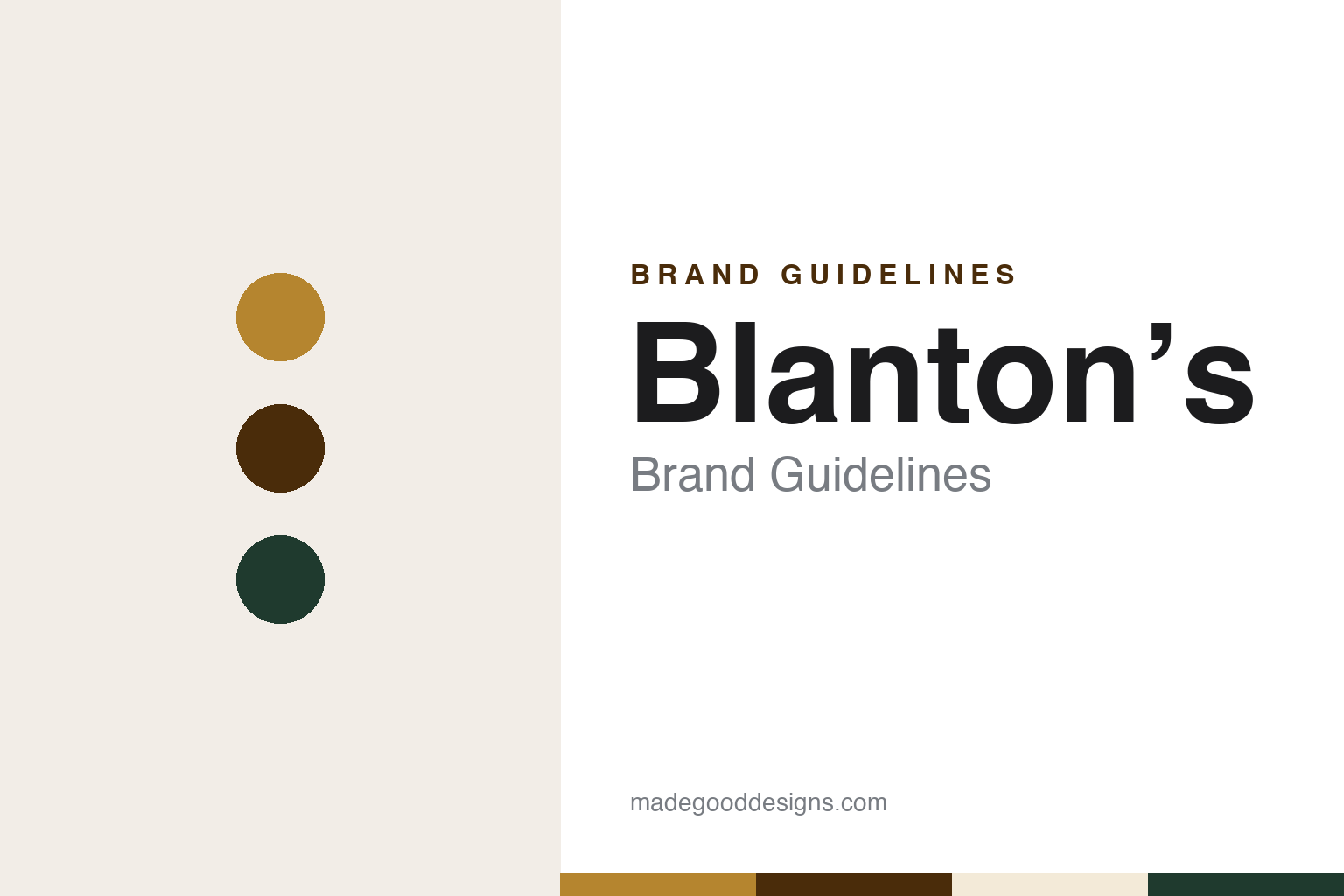
Two constants: a barrel amber, charred oak and paddock green palette and a high-contrast display serif register. Abstract homage — not a Blanton’s product or mark; no bottle, stopper, label or logo is reproduced.
Honey barrels from Warehouse H
A master distiller near retirement and a colonel’s old habit.
Blanton’s was introduced in 1984 by Elmer T. Lee, then master distiller at the distillery in Frankfort, Kentucky, that is now called Buffalo Trace. English Wikipedia, citing The New York Times in 2013, describes it as the first modern bourbon marketed as a single barrel, and its first name was Blanton’s Single Barrel Bourbon. Lee brought it out the year before he retired in 1985, and he stayed on afterwards as master distiller emeritus; he died in July 2013, English Wikipedia records, citing Business Lexington.
The name honours Colonel Albert B. Blanton, who ran the distillery for decades. English Wikipedia says he joined it in 1897 as a 16-year-old office boy, when it was called the O.F.C. Distillery, became superintendent in 1912, the year it was renamed the George T. Stagg Distillery, and became president in 1921. “Colonel” was an honorific: he held the title of Kentucky Colonel. English Wikipedia says Blanton hired Lee in 1949; the company’s own history puts it in the late 1940s and says Lee started as a maintenance engineer, after Blanton at first turned him away.
The company tells the origin as a revival. It says that Blanton, when entertaining dignitaries and other important guests, would hand-pick what it calls “honey barrels” from the centre of Warehouse H and have that bourbon bottled one barrel at a time, and that Lee, asked to create a bourbon of exceptionally high quality, named the new single barrel after him as a tribute to that habit. Warehouse H itself is part of the story: English Wikipedia says it is the only metal-clad warehouse at Buffalo Trace, commissioned by Blanton shortly after Prohibition ended, and the company says the thin metal walls let the temperature inside follow the weather outside more closely, so the bourbon ages differently. The company says Warehouse H became the home of Blanton’s in 1984 and that barrels for it still age there.
The ownership is split in an unusual way. English Wikipedia, citing a trademark record, says the brand is owned by Age International, while the Sazerac Company, owner of Buffalo Trace, holds exclusive rights to distil it and produces and markets it; Sazerac bought the distillery in 1992. Age International, English Wikipedia notes, is a former owner of the distillery and is now part of the Japanese group Takara. Takara’s own company history says Takara Shuzo, which had a partnership importing and selling bourbon such as Blanton’s, bought a stake in Age International’s parent company in 1991 and all of its shares the following year, calling itself the first Japanese company to take part in managing a bourbon maker. Takara Shuzo still sells Blanton’s in Japan, where Japanese Wikipedia lists it among the company’s whiskies.
Colour
Eight horses, eight letters and one barrel at a time.
The most collected part of a Blanton’s bottle is the stopper. English Wikipedia describes eight stopper designs, each topped by a small figure of a racehorse and jockey and each carrying a letter; set in order, the letters spell B-L-A-N-T-O-N-S and the figures follow a race from the starting gate to the finish line. The company’s own answers to collectors fill in the details: there are two different N stoppers, with different horses, and the second is followed by a very small colon, so that the eighth letter reads “N:” rather than an S; all eight letters are produced in equal amounts; and the miniature bottles carry no letters at all. The company sells displays for the stoppers in its online store.
The label carries information as well as a name. The company says the dump date, the day the bourbon leaves the barrel, is written on the label because that is the day barrel ageing stops, and that the distillery generally dumps barrels for Blanton’s on weekdays. Each bottle comes from a single barrel, which is the idea the brand was built on; the company describes the Original as taken from the centre-cut sections of Warehouse H and says it was once reserved for ambassadors, dignitaries and the colonel’s family and friends.
The range has grown in stages. For decades the 93-proof Original was the only version sold in the United States; English Wikipedia, citing the writer Fred Minnick, says Sazerac announced limited annual US releases of a Gold edition and a cask-strength Straight From the Barrel in 2020. Other bottlings have been made for particular markets, including a Green Label for export and, in Japan, a Black Label and Takara Red and Takara Gold editions, and since 2006 an annual bottling has been made with the French whisky retailer La Maison du Whisky.
Demand has been the brand’s recurring public issue: the company’s own frequently asked questions acknowledge that demand for Blanton’s is outpacing supply and that bottles may be missing from shelves while more bourbon ages.
Typography
Design and documentation.
The seven brands in this group are all bourbon names: Elijah Craig, Eagle Rare, Blanton’s, Angel’s Envy, Old Forester, Michter’s and Basil Hayden. Bourbon brands in general sit at many different points in the trade, from family distillers that still carry a founder’s name to labels that now belong to much larger drinks groups, and a single brand can be sold everywhere from a corner shop to a hotel bar.
A bourbon brand’s identity is usually carried less by the whiskey itself than by a bottle, a label and a name, because the company behind the name may have changed hands, moved its distilling or grown far beyond the place where it started. That makes the questions behind each name worth asking plainly: who started it, who owns it now, and where its whiskey is actually distilled, aged and bottled.
Each guide separates what independent sources record from what the company says about itself — its founding story, its owners over time, where its whiskey is made and how its bottles and labels have changed — and marks plainly what rests only on the company’s own word.
Aa
A high-contrast display serif for a name taken from a Kentucky colonel. (Specimen set in Playfair Display, a serif STAND-IN; NOT the Blanton’s logo.)
Blanton’s
A Japanese-owned brand made in a Kentucky landmark.
Blanton’s is made at one of the best-documented distilleries in Kentucky. The site in Frankfort was designated a National Historic Landmark in March 2013 under its old name, the George T. Stagg Distillery, according to a US Department of the Interior announcement cited by English Wikipedia, and it was added to the National Register of Historic Places in 2001. The distillery’s bottling hall, part of the Buffalo Trace tour, carries Colonel Blanton’s name.
Elmer T. Lee’s name also lives on in the same place. English Wikipedia lists a single-barrel bourbon called Elmer T. Lee among the whiskeys produced at Buffalo Trace in partnership with Age International, alongside Blanton’s and Ancient Age, the brand Age International bought from Schenley in 1983. The company says Lee was inducted into the Kentucky Bourbon Hall of Fame in 2001.
The official site is blantonsbourbon.com, with merchandise sold through a separate shop site; the company notes that the law does not allow it to sell the bourbon directly to consumers.
For a design guide, Blanton’s shows how a single idea — one barrel, one bottle — can be carried by a colonel’s name, a handwritten date and a set of eight collectable racehorses that together spell the brand. Compare Eagle Rare, another bourbon from Buffalo Trace, and Maker’s Mark, the Loretto bourbon known for its red wax. For this guide we use barrel amber, charred oak and paddock green with a high-contrast serif, an unofficial interpretation; no product or logo is reproduced.
Explore & save
Keep Blanton’s’s identity on hand — save it to a board in the Made Good inspiration library.
Blanton’s identity set
Pin the Blanton’s barrel amber, charred oak and paddock green palette and the high-contrast display serif register to your own board.