Blurb Brand Guidelines
A book of your own, printed one at a time.
Aa
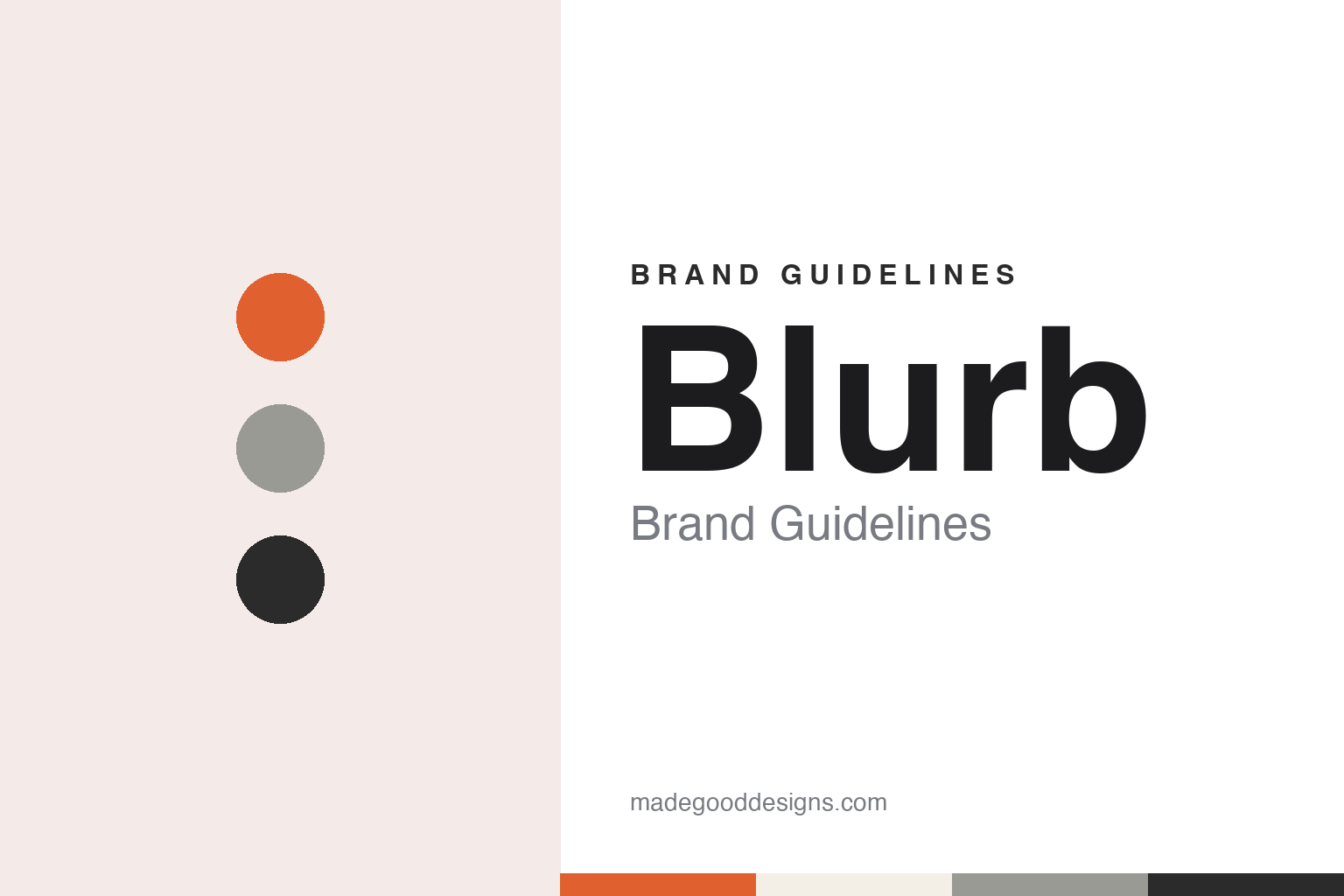
Two constants: a cover orange, photo grey and charcoal palette and a geometric sans register. Abstract homage — not a Blurb asset or mark; no logo, icon or wordmark is reproduced.
A photographer’s book problem
San Francisco, 2005 to 2006.
Blurb began with one book its founder wanted to make. The company says that in 2005 Eileen Gittins set out to turn her own photography into a book and found that, while it could be done, the cost and the effort were out of proportion to a handful of copies. Blurb, it says, was her answer: a way for anyone to design, print and publish a small run of their own books, down to a single copy. The company dates its public launch to 2006.
Wikipedia gives the same founding year, 2005, and names Gittins as founder. It says the company was funded by the venture firms Canaan Partners and Anthem Venture Partners and that its headquarters are in San Francisco, California. Fortune, writing in May 2014, also described Blurb as a San Francisco-based book-printing service, with Gittins as its chief executive.
Photography shaped the early business. Fortune reported that Blurb had initially concentrated on printing image-driven books for designers and photographers, partly because Gittins’s own background was in photography. That focus explains much of what the company built: layout tools aimed at pictures, and book formats meant to show pictures well.
The early tools were already part of the pitch. A Time magazine round-up of websites in 2006, preserved in the Internet Archive, described Blurb’s “slurper”, a tool that pulled in the contents of a blog and reformatted it as a printed book. The user chose the design and layout, Blurb printed and shipped the finished volume, and the book could then be offered on Blurb’s site for others to buy. Time said the company’s BookSmart software could already be used to make other kinds of books, naming cookbooks, baby books and poetry books.
Behind the screen there was a printer. The trade site The Dead Pixels Society reported in 2020 that Blurb’s business relationship with Reischling Press, Inc., known as RPI, a digital printing company based in Seattle, began in 2005, the year Blurb was founded.
Colour
BookWright, Amazon, MagCloud and Lightroom.
Blurb’s software moved on from BookSmart. Fortune reported on 6 May 2014 that the company had announced BookWright the previous month, a free product that let authors lay out their work themselves. Blurb now calls BookWright its flagship tool, and says it can be used to design books, magazines and ebooks.
The same spring brought a retail link. Wikipedia says Blurb announced a partnership with Amazon in April 2014, allowing books designed with Blurb to be sold and distributed through Amazon. Fortune described the arrangement as letting Blurb-designed books be self-published on Amazon with the click of a button. Gittins, it reported, had held back from ebooks until the reading platforms were ready, pointing to the opening of the iPad to book publishing two years earlier.
Magazines followed books. Fortune reported that on 5 May 2014 Blurb acquired MagCloud, a self-publishing platform for magazines, under a licensing agreement from HP. Blurb took over MagCloud’s technology and operations. Gittins told Fortune that MagCloud had always existed as something of a rogue project inside HP, and that Blurb would offer warehousing and fulfilment to its customers, as it did for books. Wikipedia gives the same month and describes the same licensing arrangement.
Blurb also placed itself inside other people’s design software. Fortune noted that Blurb was built into Adobe’s Lightroom tools through a “Send book to Blurb” button. The company now says it offers integration with Adobe InDesign and Lightroom, alongside an online tool that makes books from Instagram and Facebook feeds.
Gittins described the business to Fortune as a “YouTube for books”, a service for independent publishers working on niche subjects. She gave two examples of what Blurb’s customers made: books about women’s roller derby teams, and tattoo books.
The leadership changed after Gittins. By the time of the 2020 sale, The Dead Pixels Society reported, Blurb’s chief executive was Rix Kramlich.
Typography
A book-making service owned by its printer.
For a print-service brand, the identity is not confined to a logo on a homepage. It is carried through a sequence of moments that a customer passes through, often without noticing that each one has been designed. The order flow is the first of these: the upload screen, the template picker, the preview window and the progress bar all speak in the brand’s type, colour and tone of voice, and they set expectations long before anything is printed.
The proof is the second moment. A digital proof, a soft-proof warning about low-resolution images or a printed sample sent ahead of a larger run is where the service shows how carefully it handles someone else’s work, and the language around it matters as much as the layout.
Paper samples and swatch packs make the brand tangible. Stock names, finish labels and the small card that explains weight and coating turn technical choices into something a customer can hold and compare.
Finally there is delivery. The shipping box, the tape, the protective sleeve, the packing slip and any insert card are often the only physical contact a customer has with an online printer, so they become the most direct expression of the identity. Designers studying the category should look at these surfaces together, as one continuous system rather than as separate pieces.
Aa
A geometric sans — after the clean, picture-led pages Blurb was built to print. (Specimen set in DM Sans, a sans STAND-IN; NOT the Blurb logo or any Blurb typeface.)
Blurb
From partner to parent: RPI in 2020.
Reischling Press, Inc. (RPI) has owned Blurb since August 2020. The Dead Pixels Society, a trade news site for the imaging and photo industry, reported on 3 August 2020 that the Seattle-based digital printing company had acquired Blurb, which it described as an e-commerce platform for print-on-demand books, magazines and other services for self-publishers and creative professionals. Other terms of the deal were not disclosed. Wikipedia also dates the acquisition to August 2020 and describes RPI as Blurb’s print fulfilment partner.
The deal closed a long working relationship. Rick Bellamy, RPI’s chief executive, said the acquisition “culminates the long-term partnership between our two companies”, according to The Dead Pixels Society. The site reported that Blurb had been the customer that made possible RPI’s purchase of Paro, a printer in Eindhoven, the Netherlands, in 2011, and quoted Bellamy saying RPI had produced Blurb’s books for years.
Blurb kept its name and its offices. The Dead Pixels Society said Blurb would continue to maintain offices in San Francisco and the United Kingdom, and that Rix Kramlich, then Blurb’s chief executive, would become general manager of a new eCommerce division within RPI. Kramlich said becoming part of RPI was a natural next step, letting Blurb concentrate on its creation tools and on the printed products themselves. The site added that RPI, which marked forty years in business in 2019, had production facilities in Kennesaw, Georgia, Rochester, New York, and Eindhoven.
The company still frames its story around the original book. Blurb’s own account begins with Gittins and her photographs, and its tools are still named for books: BookWright for layout, and a bookstore where authors can list what they make.
For a design guide, Blurb shows how a service built around one photographer’s book became a set of tools for pictures, magazines and small runs, and then joined the printer it had worked with since 2005. Compare Shutterfly, another American photo-printing brand, and Lulu, the print-on-demand book service Bob Young founded in North Carolina. For this guide we use cover orange, photo grey and charcoal with a sans, an unofficial interpretation; no product or logo is reproduced.
Explore & save
Keep Blurb’s identity on hand — save it to a board in the Made Good inspiration library.
Blurb identity set
Pin the Blurb cover orange, photo grey and charcoal palette and the geometric sans register to your own board.