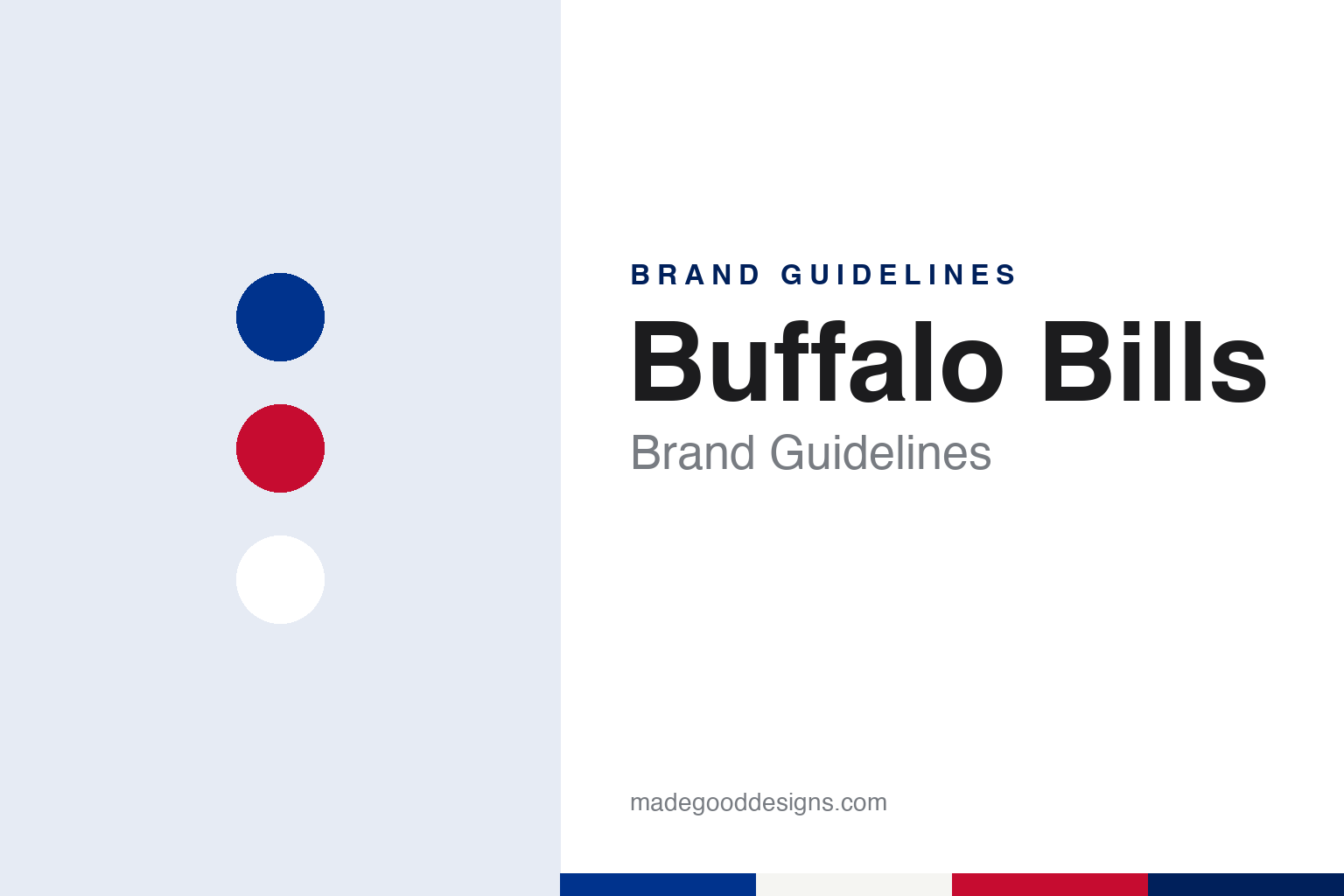
Buffalo Bills Brand Guidelines
A frontier name, a buffalo on the charge, and a red streak drawn at an illustrator’s desk.
Aa
Two constants: a royal blue, streak red and white palette and a condensed athletic sans register. Abstract homage — not a Buffalo Bills product or mark; no helmet, uniform or logo is reproduced.
A name from the frontier
An oilman’s contest, a showman’s nickname and a name borrowed for a new league.
The Buffalo Bills took their name from a team that came before them. In ESPN’s NFL Nation guide to the origins of every league team name, published on 2 February 2022, the Bills reporter Alaina Getzenberg traced it to a Buffalo club founded in 1946 in the All-America Football Conference and originally called the Bisons. After one season its owner, James Breuil, held a contest to rename the team for 1947. The winning entry, by James F. Dyson, was an essay comparing the team to a band of “Buffalo Bills”, a reference to William “Buffalo Bill” Cody, whose touring shows in the 1880s were called “Buffalo Bill’s Wild West”. ESPN said Breuil also owned the Frontier Oil Company and wanted to carry the frontier theme over to his team.
That earlier set of Bills did not last. ESPN said the AAFC folded after the 1949 season, taking the original Bills with it, and that Ralph Wilson chose the name for his new American Football League team in 1959. English Wikipedia says the club was founded that year as a charter member of the AFL, began play in 1960, and joined the National Football League with the AFL–NFL merger in 1970.
The early look came from Detroit. Wikipedia says that for their opening two seasons the Bills wore uniforms based on those of the Detroit Lions, in which Wilson had been a minority owner, and notes that the AAFC Bills had also worn blue and silver. The original colours were Honolulu blue, silver and white; the helmets were silver, with no striping and no logo, carrying the players’ numbers on each side.
The colours changed in 1962. Wikipedia says a standing red bison was designated the logo that year and placed on a white helmet, and the team’s colours became red, white and blue. The jerseys turned blue with red and white shoulder stripes, which Wikipedia likens to those of the city’s Bisons ice hockey team of the period, and a distinctive four-stripe sleeve pattern followed in 1964, with red and blue centre stripes on the helmet by 1965.
Colour
Wilson to the Pegulas, and the stadium in Orchard Park.
For more than five decades the club had one owner. Wilson, who had been a minority partner in the Lions, owned the Bills from the club’s founding in 1959 until 2014. That autumn, an Associated Press and ESPN report published on 8 October 2014 said, NFL owners meeting in New York unanimously approved Terry and Kim Pegula as the new owners of the Bills. The couple already owned the National Hockey League’s Buffalo Sabres, and the report said they were acquiring the franchise from the family of Ralph Wilson, who had died in March that year. The report quoted Terry Pegula: “If you had asked me 10 years ago if I would own the Bills and the Sabres, I’d have called you a liar.” The Pegulas have owned the club since 2014; Wikipedia says a group of private equity investors bought a minority stake in 2024.
The home ground lies south of the city. Wikipedia says the Bills play their home games in Orchard Park, New York, at the stadium now named Highmark Stadium, and that the club planned a new stadium to replace it; Wikipedia describes the 2025 season as the original Highmark Stadium’s final season.
Game day has its own cast. Wikipedia says the official mascot is Billy Buffalo, an eight-foot anthropomorphic blue bison who wears the jersey “number” BB, and that since the end of the 2013 season the club’s designated drumline has been the Stampede Drumline. The team’s long-running anthem, Wikipedia says, is a version of the Isley Brothers’ “Shout” recorded by Scott Kemper and adopted as the official promotional song in 1987.
The uniforms have also moved with the league’s suppliers and programmes. Wikipedia says the Bills’ kit received minor changes when Nike became the league’s uniform maker, unveiled on 3 April 2012, and that in November 2015 the Bills wore an all-red combination for the NFL’s Color Rush initiative in a game against the New York Jets. From 2021, the team switched to white facemasks.
Typography
Design and documentation.
A professional football identity is built from a small set of parts that have to work together at very different sizes. The helmet decal is a compressed version of the identity: a mark that sits on a curved shell, is seen from the side at a distance and has to read in a single colour against a painted surface. Many clubs keep the helmet mark separate from the primary logo used on print and screens, and the two are often redrawn on different schedules.
Colour names are part of the system. Clubs and their uniform suppliers give their tones proper names, and those names travel from style guides onto merchandise labels and broadcast graphics, which helps keep a shade consistent across fabric, paint and pixels.
Throwback uniforms let a club revisit an earlier set without retiring the current one, so an older wordmark, numeral style or helmet colour can return for a single season or a few games. Stadium naming adds another layer: when naming rights change, the building’s signage, tickets and wayfinding are rebranded while the team’s own marks stay the same.
Aa
A condensed athletic sans — the register of a sideline number and a stadium concourse sign. (Specimen set in Barlow Condensed, a sans-serif STAND-IN; NOT the Buffalo Bills logo or wordmark.)
A standing bison, then a charging one
An aerospace illustrator, a general manager’s letter and a stripe from the horn.
The standing bison lasted until 1973. Its replacement was the work of Stevens Wright, a commercial illustrator, according to the ESPN uniform columnist Paul Lukas, writing in his Uni Watch column on 20 September 2013. Lukas reported that Wright’s illustration work in the 1960s and 1970s was largely in the aerospace industry, and that his wife, Jere Wright, was a production manager at NFL Properties, the league’s licensing and branding arm. She brought his work to David Boss, the director of NFL Properties’ creative services division, who gave him the assignment of a new logo for the Bills.
The decision came by letter. Lukas wrote that Wright submitted several designs to the Bills in the summer of 1973, and that the team’s general manager, Robert Lustig, wrote to Boss expressing a strong preference for the one that became the charging buffalo. The finished logo, with the red stripe modified as Lustig had asked, went onto the Bills’ helmet the following season. Wikipedia describes it as a blue charging bison with a red slanting stripe streaming from its horn, and says it remains the franchise’s primary emblem. Lukas also traced to Wright a 1979 New England Patriots logo that fans rejected at a halftime vote and a 1991 San Francisco 49ers helmet design that was withdrawn the day after it was unveiled.
The buffalo stayed while the helmet around it changed. Wikipedia says the shell turned from white to red in 1984, partly to help the quarterback Joe Ferguson pick out receivers against division rivals who also wore white helmets. In 2002, under the general manager Tom Donahoe, the Bills brought in a darker blue, nickel grey accents and red side panels; a new stylised “B” logo built from two bullets with a buffalo head was proposed and appeared on some caps, but fan backlash kept the charging buffalo. The standing bison returned as a throwback from 2005, and in 2011 the Bills went back to white helmets and royal blue in an update of their 1975–83 design. Wikipedia says the red helmet came back as an alternate in 2025.
For a design guide, the Buffalo Bills show how a name inherited from a defunct team can carry a whole frontier story, and how a single logo can stay fixed while helmet colours, blues and stripes change around it. Compare it with New England Patriots, for whom the same illustrator drew a rejected logo in 1979, and NFL, whose Properties arm commissioned the charging buffalo. For this guide we use royal blue, streak red and white with a condensed sans, an unofficial interpretation; no product or logo is reproduced.
Explore & save
Keep Buffalo Bills’s identity on hand — save it to a board in the Made Good inspiration library.
Buffalo Bills identity set
Pin the Buffalo Bills royal blue, streak red and white palette and the condensed athletic sans register to your own board.