Miami Dolphins Brand Guidelines
A dolphin, a sunburst, and the colours of a bay and a sky.
Aa
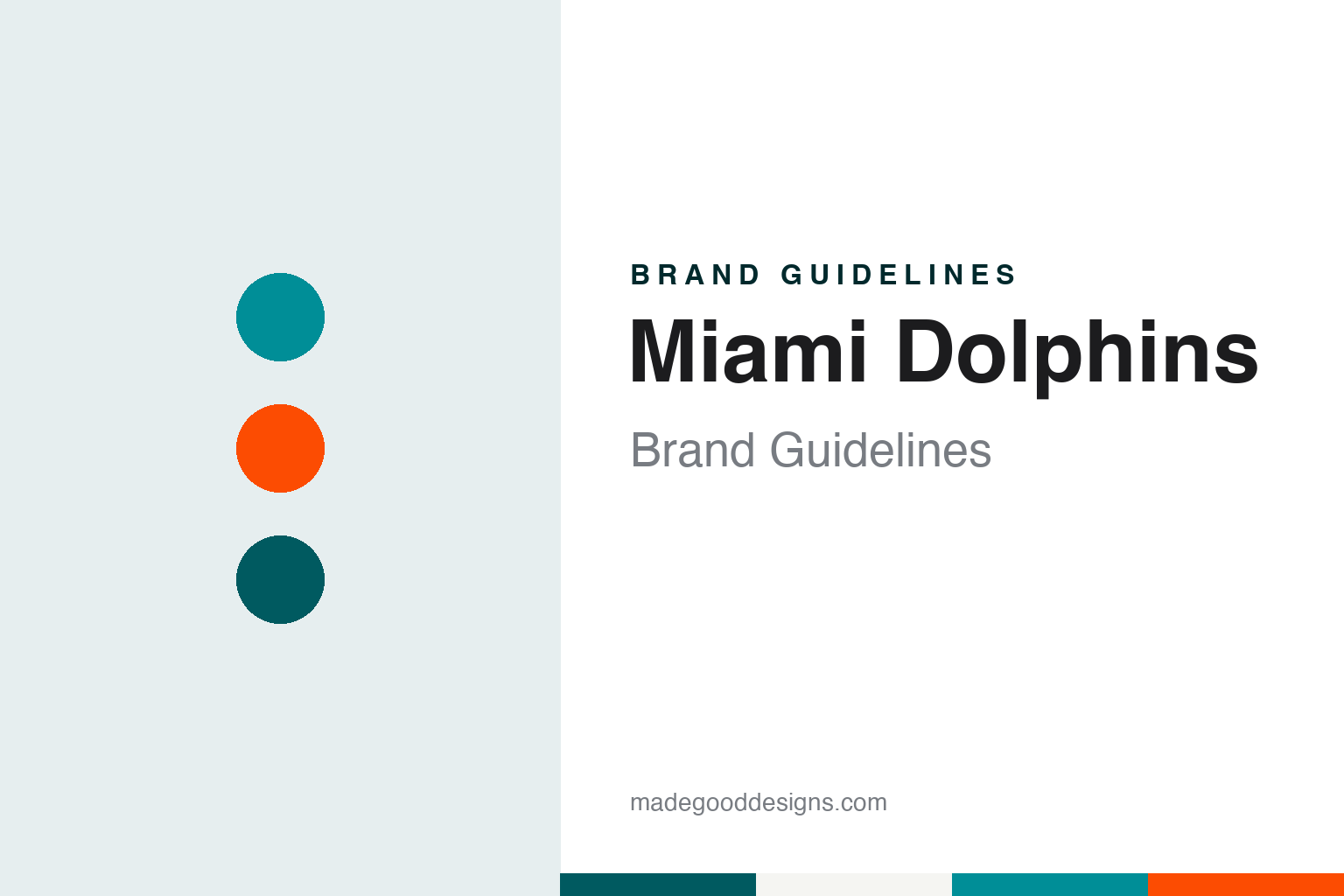
Two constants: a bay aqua, sunburst orange and deep aqua palette and a rounded technical sans register. Abstract homage — not a Miami Dolphins product or mark; no helmet, uniform or logo is reproduced.
A name from the sea
A lawyer, a television star and a name chosen by the public.
The Miami Dolphins were born of the American Football League’s expansion in the mid-1960s. A Pro Football Hall of Fame history of that expansion, published on 2 December 2009, says that in August 1965 the league’s commissioner, Joe Foss, announced that a new franchise would go to a group of investors led by Joe Robbie, a lawyer from Minneapolis, and the television star Danny Thomas. The Hall of Fame piece says the city had tried professional football before, with a team called the Seahawks in the All-America Football Conference in 1946, and that interest in a Miami franchise returned once the AFL looked set to last. English Wikipedia describes Robbie as an attorney and politician and Thomas as an actor and comedian, and says Thomas later sold his stake in the team to Robbie.
The name was put to the public. The Hall of Fame says the owners held a fan contest that produced several thousand votes, with “Dolphins” coming out on top. ESPN’s Marcel Louis-Jacques, in an NFL Nation guide to the origins of every team name published on 2 February 2022, wrote that the contest took place in 1965, that it drew a large public response, and that Robbie was taken with the winning name. Announcing it, Robbie said, according to ESPN, that “the dolphin is one of the fastest and smartest creatures of the sea.”
The team began playing in 1966. Wikipedia says its training camp that summer was at St. Pete Beach, with August practices at a high school in Gulfport, and that for the next few years the club trained at Saint Andrew’s School, a boarding school in Boca Raton. Home games were played at the Orange Bowl in Miami. For part of those early seasons the stadium had a live animal on site: Wikipedia says a dolphin named Flipper lived in a water tank at the open east end of the Orange Bowl from 1966 to 1968, and again in the 1970s, jumping to celebrate scores, and was removed to save costs and later because of stress on the animal. The club joined the National Football League in 1970, when the two leagues merged.
Colour
Robbie, Huizenga, Ross and a stadium of many names.
Joe Robbie remained the club’s owner from 1966 to 1989, Wikipedia says, and he built the team a new home. After the 1986 season the Dolphins left the Orange Bowl for Joe Robbie Stadium, north of the city in what is now Miami Gardens. Since 1996 the ground has carried a series of sponsored names, among them Pro Player Stadium, Dolphin Stadium, LandShark Stadium and Sun Life Stadium, and it has been Hard Rock Stadium since August 2016. Robbie is commemorated there by a life-size bronze statue at the north end, part of an alumni walk established in 2011.
The next owner was Wayne Huizenga. An Associated Press report published on 20 January 2009 said Huizenga had become sole owner of the Dolphins in 1994. The same report said that the New York real-estate developer Stephen Ross had that day become the club’s majority owner, completing a deal agreed with Huizenga the previous February, under which Ross had bought into the franchise, the stadium and the surrounding land, with an agreement that he would later become managing general partner. The AP said the National Football League had approved that second stage in October 2008. Ross has owned the Dolphins since 2009.
The sideline identity grew alongside the uniform. Wikipedia says the club’s cheerleaders made their debut in 1978 as the Dolphins Starbrites, a name taken from a co-sponsor, Starbrite Car Polish, with the choreographer June Taylor in charge of the squad until 1990. The club introduced its costumed mascot on 18 April 1997, a seven-foot dolphin who appeared at the stadium’s draft-day party the next day; the team then ran a “Name the Mascot” contest, and the winning name, T.D., was announced at the club’s awards banquet that June.
Training moved with the team, too. Wikipedia says the Dolphins trained at Biscayne College, later St. Thomas University, in Miami Gardens from 1970 until 1993, then at a facility on the campus of Nova Southeastern University in Davie, and since 2021 at the Baptist Health Training Complex beside Hard Rock Stadium.
Typography
Design and documentation.
An American football club’s identity has to work at very different scales. The helmet logo is the mark people see first: a single shape on a curved shell, read from the upper deck and on a phone screen, so it is usually a bold silhouette with a clear outline and few colours. A wordmark then carries the name on jerseys, sidelines and broadcasts, often in a custom or heavily modified typeface with its own numerals for the back and shoulders of the jersey.
Alternate uniforms give clubs room to play. Throwback sets bring back earlier helmets and stripes for a game or a season, and all-over single-colour “colour rush” style sets push one team colour across helmet, jersey and trousers. Each alternate has to stay recognisable on television next to the opposing side, which is why contrast between home and away kits matters so much.
Sideline apparel — coaches’ jackets, caps, hoodies and staff polos — extends the same marks into retail, away from the field. In the stadium, the palette moves onto end-zone paint, the midfield logo, ribbon boards, wayfinding and concourse signs, where large flat areas of colour and simple type need to read from a distance and in floodlight.
Aa
A rounded technical sans — the register of a jersey number and a beachfront sign. (Specimen set in Exo 2, a sans-serif STAND-IN; NOT the Miami Dolphins logo or wordmark.)
The leaping dolphin and the sunburst
A helmeted dolphin until 2012, then a silhouette.
The original mark put a football player inside a fish’s outline. Wikipedia says the team’s colours were at first aqua and coral, the coral paying tribute to the Miami Seahawks and to the coral reefs of Biscayne Bay, and that a lighter, brighter orange was used in place of the deep coral when the team made its debut in 1966. The original logo was a sunburst with a leaping dolphin wearing a football helmet marked with the letter M. In the 1967 season the dolphin was moved to the centre of the sunburst, and the badge then stayed fairly consistent until 2012.
The 1997 redraw was modest. In 1997, Wikipedia says, the sunburst was simplified and the dolphin was darkened and given a more serious game-face expression; the uniforms kept their layout but took a different block number font and navy drop shadows. On rare prime-time occasions in the 2000s the club wore an orange jersey that swapped the positions of orange and aqua.
The larger change came in 2013. An Associated Press report, carried by Miami’s WSVN, said the Dolphins introduced new uniforms with a lighter and brighter blue and orange at an NFL draft party at their stadium, with the former quarterbacks Dan Marino and Bob Griese among those modelling them, and unveiled a new aqua, orange and blue logo with a sleeker dolphin. The team said South Florida’s sun and water provided the foundation for the design, the AP reported. Wikipedia describes the new logo as a stylised aqua dolphin swimming in front of a heavily modified orange sunburst, more abstract than before and no longer wearing a helmet, and says navy became a featured colour while orange was de-emphasised. In 2018 the shades of orange and aqua were adjusted and navy was removed from the uniforms, remaining only in the logo.
The archive has been worn again since. Wikipedia says the club brought back its 1970s aqua uniforms for select games in 2015 and added a white version from the same era four years later, and that on 28 August 2025 it released a dark blue “Rivalries” uniform with aqua numbers, orange trim and a modified swimming-dolphin logo.
For a design guide, the Miami Dolphins show how a name chosen by the public and a palette drawn from local water and light can carry a club through a full redraw, from a helmeted cartoon dolphin to a silhouette, while the sunburst stays. Compare it with Miami Heat, the city’s basketball club, and New England Patriots, another AFL club named through a public contest. For this guide we use bay aqua, sunburst orange and deep aqua with a rounded sans, an unofficial interpretation; no product or logo is reproduced.
Explore & save
Keep Miami Dolphins’s identity on hand — save it to a board in the Made Good inspiration library.
Miami Dolphins identity set
Pin the Miami Dolphins bay aqua, sunburst orange and deep aqua palette and the rounded technical sans register to your own board.