California Pizza Kitchen Brand Guidelines
A Beverly Hills pizza kitchen run by two lawyers.
Aa
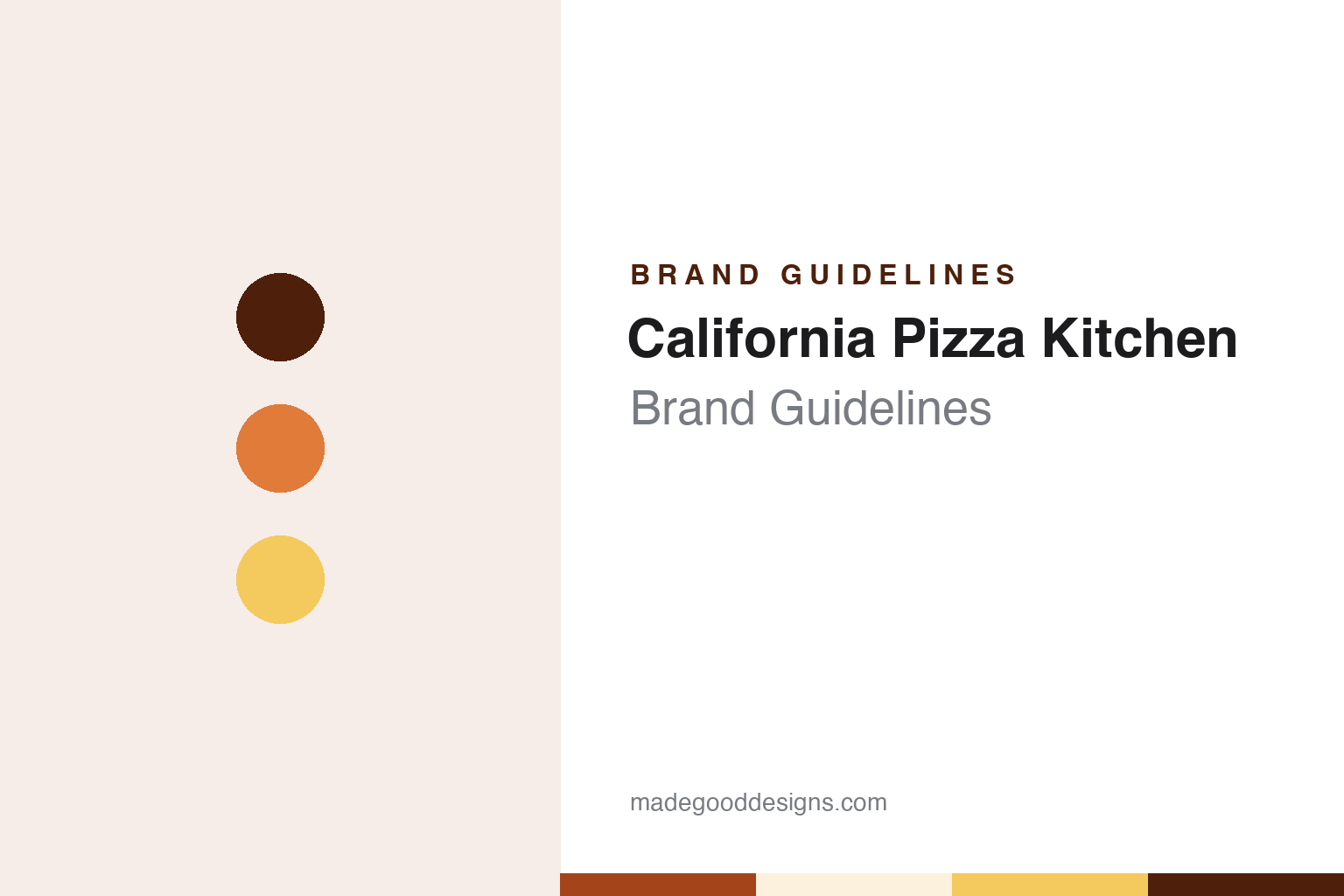
Two constants: a sunset rust, poppy orange and sun yellow palette and a sunny geometric sans register. Abstract homage — not a California Pizza Kitchen product or mark; no pizza, box or logo is reproduced.
Flax and Rosenfield
Two former prosecutors and “Spago for the masses”.
California Pizza Kitchen was started by two lawyers. Eater LA, in a March 2025 history of the chain, says Larry Flax and Rick Rosenfield had been federal prosecutors before leaving government service to open their own law firm, and that both had grown tired of legal work and loved to cook and eat out. Wikipedia likewise describes the founders as attorneys.
The concept took shape in 1984. Rosenfield told Eater that his brother introduced him to a pasta cafeteria idea from Chicago, and that a visit to a similar operation at the Glendale Galleria — where pizza was sold by the slice under a hot lamp — changed the plan. He recalled telling Flax and their friend Bob Mandler: “Let’s do Spago for the masses.” Spago, Wolfgang Puck’s restaurant, was then serving California-style pizzas created by its pizzaiolo Ed LaDou.
The partners signed a lease near South Beverly Drive and Charleville in Beverly Hills, funded with loans, second mortgages and money raised from friends, Eater reports. They opened at 5 p.m. on Wednesday, 27 March 1985; the actress Shirley MacLaine, whose agent had an office upstairs, walked in as the doors opened and ordered a coffee. Suzanne Goin, later a chef and restaurateur, worked as a hostess that summer and recalled to Eater that the restaurant took no reservations.
Three weeks before opening, the founders had made a deal with LaDou, who designed an opening menu modelled on Spago’s. Rosenfield told Eater that the more esoteric toppings did not work for the restaurant’s customers but that the Barbecue Chicken Pizza from that menu caught on immediately; LaDou worked in the kitchen for about a month and was never a partner in the business. Wikipedia also credits LaDou with developing the first menu.
Colour
Malls, a casino, PepsiCo and a string of owners.
A second restaurant opened about a year later in the Beverly Center mall, and Eater says that location came to typify the brand: Rosenfield described the growth plan as asking for prime mall sites next to a department store such as Nordstrom, Neiman Marcus or Saks. The diners there included the hotelier Steve Wynn, who became an early investor and, in 1989, put the first franchised California Pizza Kitchen inside his new Mirage hotel and casino in Las Vegas, next to the sportsbook. The company, Eater adds, became known by its acronym, CPK, almost immediately.
Ownership changed repeatedly from the 1990s. PepsiCo, then the owner of Pizza Hut, KFC and Taco Bell, took a stake in 1992 and pushed rapid expansion; Eater and Wikipedia both describe cost cuts in that period that Flax and Rosenfield later reversed. The Los Angeles Times reported in September 1999 that PepsiCo had sold its stake in 1997 to the New York investment firm Bruckmann, Rosser, Sherrill & Co. The founders stayed on the board while a new chief executive, Fred Hipp, ran the business; after a missed forecast in 2003 they returned as co-chief executives, according to Eater and Wikipedia.
In 2011 Flax and Rosenfield sold the company to the private equity firm Golden Gate Capital, which took it private. CPK filed for Chapter 11 bankruptcy protection in July 2020 and emerged that November through a debt-for-equity transaction, Restaurant Dive reported on 24 November 2020. The chain began franchising in 2021, the same publication later noted.
On 16 December 2025, Restaurant Dive reported that California Pizza Kitchen had agreed to be acquired by Consortium Brand Partners, Eldridge Industries, Aurify Brands and Convive Brands, with Bain Capital backing the transaction. Under the agreement, Convive takes over as global operator and master franchisor, and its chief executive, Jon Weber, becomes chief executive of CPK; Inside Retail reported the same terms the following day.
Typography
Design and documentation.
A themed or full-service restaurant chain carries its identity in more than a logo. The name on the street sign, the lettering on the door, the layout of the dining room, the objects on the walls and the design of the printed menu all work together. For a chain, the same set of cues has to travel from one site to the next, so the brand is often set down as a repeatable kit of signage, colours, fixtures and furniture rather than a single building.
Themed restaurants push that kit further. Their interiors may borrow from a place, a period or a pastime, using collected objects, built scenery, lighting and sound to carry the theme, while full-service chains tend to lean on materials, table settings and menu typography to set a tone. Ownership matters here too, because a restaurant name can pass between companies while the sign above the door stays much the same.
Each guide separates what independent sources record from what the company says about itself — its founding story, its owners over time, and how its name, signage, interiors and menus have changed — and marks plainly what rests only on the company’s own word.
Aa
A sunny geometric sans — the register of a menu board and a frozen-pizza carton. (Specimen set in Montserrat, a sans-serif STAND-IN; NOT the California Pizza Kitchen logo.)
California Pizza Kitchen
Three initials, two founders on camera and a freezer case.
The name puts the state first. Eater reports that “California Pizza Kitchen” became known by its initials, CPK, almost immediately after the 1985 opening, and Wikipedia uses the same initials for the company and its frozen-pizza licence.
For years the founders were the brand’s faces. Eater says that even after PepsiCo and later private equity owners took control, Flax and Rosenfield continued to appear “on the pizza boxes and menus” and to speak for the company. The Los Angeles Times reported in September 1999 that the pair had appeared in a nationwide American Express commercial about five years earlier, and that they would front the launch of CPK’s frozen pizzas, made by Kraft Pizza Co. under licence. That 30-second spot was filmed on the beach in Santa Monica, developed with the Chicago agency Foote, Cone & Belding, and ran under the theme “Cool New Way to Pizza”. A Kraft brand manager told the paper that the restaurant was clearly the founders’ personalities.
The freezer line outlived that owner. Wikipedia says the licence passed to Nestlé when it bought Kraft’s pizza business in 2010, the same deal that took Kraft’s DiGiorno to Nestlé. The restaurants changed too: Wikipedia records “Next Chapter” locations from 2014 with modernised interiors and updated menus, and Restaurant Dive reported in December 2025 that CPK had overhauled its marketing strategy and brought on new agencies in late 2024.
For a design guide, California Pizza Kitchen shows how a descriptive place-name, compressed into three letters and fronted by its founders, can carry a restaurant from a Beverly Hills storefront to a casino floor and a grocery freezer. Compare it with DiGiorno, the Kraft frozen pizza that went to Nestlé in the same 2010 deal, and Domino’s, another pizza brand in this library. For this guide we use sunset rust, poppy orange and sun yellow with a sans, an unofficial interpretation; no product or logo is reproduced.
Explore & save
Keep California Pizza Kitchen’s identity on hand — save it to a board in the Made Good inspiration library.
California Pizza Kitchen identity set
Pin the California Pizza Kitchen sunset rust, poppy orange and sun yellow palette and the sunny geometric sans register to your own board.