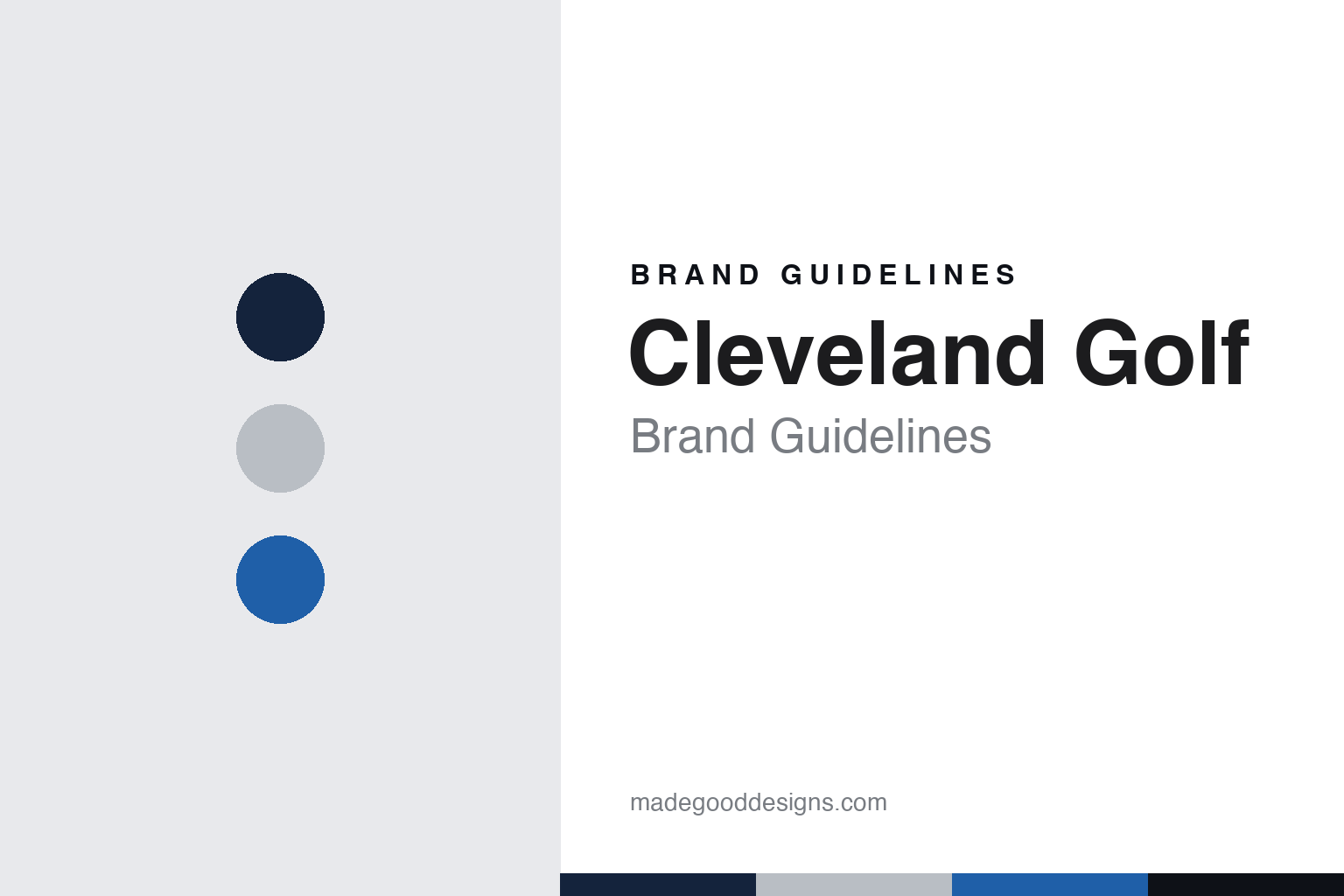
Cleveland Golf Brand Guidelines
Roger Cleveland’s wedge maker, under three owners since 1990.
Aa
Two constants: a navy, satin-steel and blue palette and a grotesque sans register. Abstract homage — not a Cleveland Golf product or mark; no club, logo or badge is reproduced.
Cleveland Classics
A club designer, his surname and three owners.
Cleveland Golf began in 1979 as Cleveland Classics, the company of the club designer Roger Cleveland. English Wikipedia, citing National Club Golfer, says it started by making replicas of classic golf clubs. A 2025 profile by the golf media company Skratch, published in partnership with Srixon and Cleveland Golf, describes the early focus as persimmon woods and says Roger Cleveland used the PGA Tour as a testing ground, handing prototypes to players and refining designs from their feedback.
The name the brand is known by came with a sale. In 1990 the French ski maker Skis Rossignol bought the business and renamed it Cleveland Golf, English Wikipedia says. Roger Cleveland stayed on until 1995 as a senior executive responsible for club design, according to Skratch, and afterwards held senior design roles at other companies, most notably Callaway. The departure was not his choice: he told Global Golf Post in November 2025 that he was shown the door just as his five-year employment contract ran out in late 1995. Callaway named him its chief of golf club design in 1996, according to the Southern California Golf Hall of Fame, which inducted him in 2024 and calls him a “legendary wedge maker”; Global Golf Post says he held the role for 28 years.
Ownership then followed the ski business. In 2005 the US company Quiksilver bought Rossignol and, English Wikipedia says, ran Cleveland Golf until late 2007. On 30 October 2007, a Quiksilver filing with the US Securities and Exchange Commission shows, it signed an agreement to sell Cleveland — formally the Roger Cleveland Golf Company, then a wholly owned Quiksilver subsidiary — to SRI Sports Limited, the sports-equipment arm of Japan’s Sumitomo Rubber Industries. English Wikipedia dates completion to December 2007. The company has kept its founder’s surname through all three changes of owner.
Colour
The 588 and the wedges that followed it.
Cleveland’s reputation rests on wedges. The British site GolfMagic, in a history of the company’s wedges updated in November 2023, dates the first, the Classic Tour Forged, to 1983: a wedge forged from mild carbon steel with a four-way cambered sole. Muscle-back Classic pitching and sand wedges followed in 1984, and the 485 Tour Action, with a solid back and a rounded leading edge, in 1985.
The model that made the name came in 1988: the 588 Tour Action. GolfMagic describes it as made from 8620 soft carbon steel, with a traditional shape, a large face, a high toe and a “V Sole” that narrowed towards the heel, giving bounce on full shots and versatility around the green; it says the 588’s U-shaped grooves let golfers hit higher shots with more spin. The story told by Skratch is that the number stands for the company’s fifth wedge design, released in 1988. Gun-metal, perimeter-weighted and beryllium-copper versions of the 588 followed in 1989, according to GolfMagic.
The number has been reused since. GolfMagic lists the 588 RTX among later models, and Cleveland’s wedge lines have since carried the RTX and RTZ names. Skratch reported in July 2025 that the RTZ line introduced Z-Alloy, which it describes as a softer, less dense, rust-resistant variant of 8620 steel, and English Wikipedia, citing Today’s Golfer in August 2026, reports a second-generation RTZ 2 wedge.
The founder has come back to the brand. In 2025, nearly 30 years after leaving, Roger Cleveland rejoined the company in a founder and advisor role, Skratch reported in July 2025, quoting him calling the return “a special moment for me.” Global Golf Post reported that the company had asked him back in the spring of 2025 and that he now advises its tour and research-and-development teams on new product and design ideas; Mike Jolly, its director of tour operations, told the paper that “Roger has so much knowledge and experience.”
Typography
Clubs, owners and documentation.
The seven brands in this group all make golf clubs: Cobra, Ben Hogan, Cleveland, PXG, Tour Edge, XXIO and Sub 70. A golf club brand has to work inside a narrow set of rules. The R&A and the United States Golf Association set what shapes and physical characteristics of clubs are allowed in competition, and the Rules of Golf limit a player to a maximum of 14 clubs in the bag, English Wikipedia notes — so every maker is designing variations on the same few objects: woods and drivers, irons and wedges, hybrids and putters.
Because the objects are so tightly defined, identity tends to live in the details: the shape of a head seen at address, the finish on a forged or cast iron, the name or number stamped on the sole, the colour of a headcover, and the way a brand sells and fits its clubs. Many modern iron heads are investment-cast from steel alloys, while forged irons remain popular with skilled players, English Wikipedia says, and heads, shafts and grips can be combined and fitted to a player in a great many ways.
The brands here differ in age, in ownership and in how they sell their clubs; two of them, Tour Edge in Batavia and Sub 70 in Sycamore, are Illinois companies, according to their own websites. Each guide separates what independent sources record from what the company says about itself — who founded it, who owns it now, where its clubs are designed, made and assembled, and how its marks have changed — and marks plainly what rests only on the company’s own word.
Aa
A grotesque sans — plain, technical lettering suited to a wedge maker. (Specimen set in Archivo, a sans STAND-IN; NOT the Cleveland Golf logo.)
Cleveland Golf
One of Sumitomo Rubber’s golf brands.
Under Sumitomo Rubber, Cleveland became one of a family of golf brands. On 27 June 2008 SRI Sports announced that the operations of Cleveland and Srixon would be consolidated, English Wikipedia says, citing Golfweek; its article on Sumitomo Rubber adds that Cleveland was to oversee marketing and distribution in North America. Sumitomo Rubber, which began in 1909 as Dunlop Far East, is based in Kobe, Japan, according to the same article.
Sumitomo Rubber has owned Cleveland Golf since 2007. The National Golf Foundation’s directory of the businesses in golf lists the Srixon/Cleveland Golf corporate headquarters in Huntington Beach, California, and describes Dunlop Sports Americas, with offices in Huntington Beach and Greenville, South Carolina, as the North American subsidiary of Sumitomo Rubber Industries, making and selling Srixon, Cleveland Golf, XXIO and Dunlop equipment.
For a design guide, Cleveland Golf shows how a founder’s surname, kept through three changes of owner, can carry a reputation built largely on one kind of club. Compare Srixon, its sister brand under Sumitomo Rubber, and XXIO, another golf brand in the same group. For this guide we use navy, satin steel and a signal blue with a sans, an unofficial interpretation; no product or logo is reproduced.
Explore & save
Keep Cleveland Golf’s identity on hand — save it to a board in the Made Good inspiration library.
Cleveland Golf identity set
Pin the Cleveland Golf navy, satin steel and blue palette and the grotesque sans register to your own board.