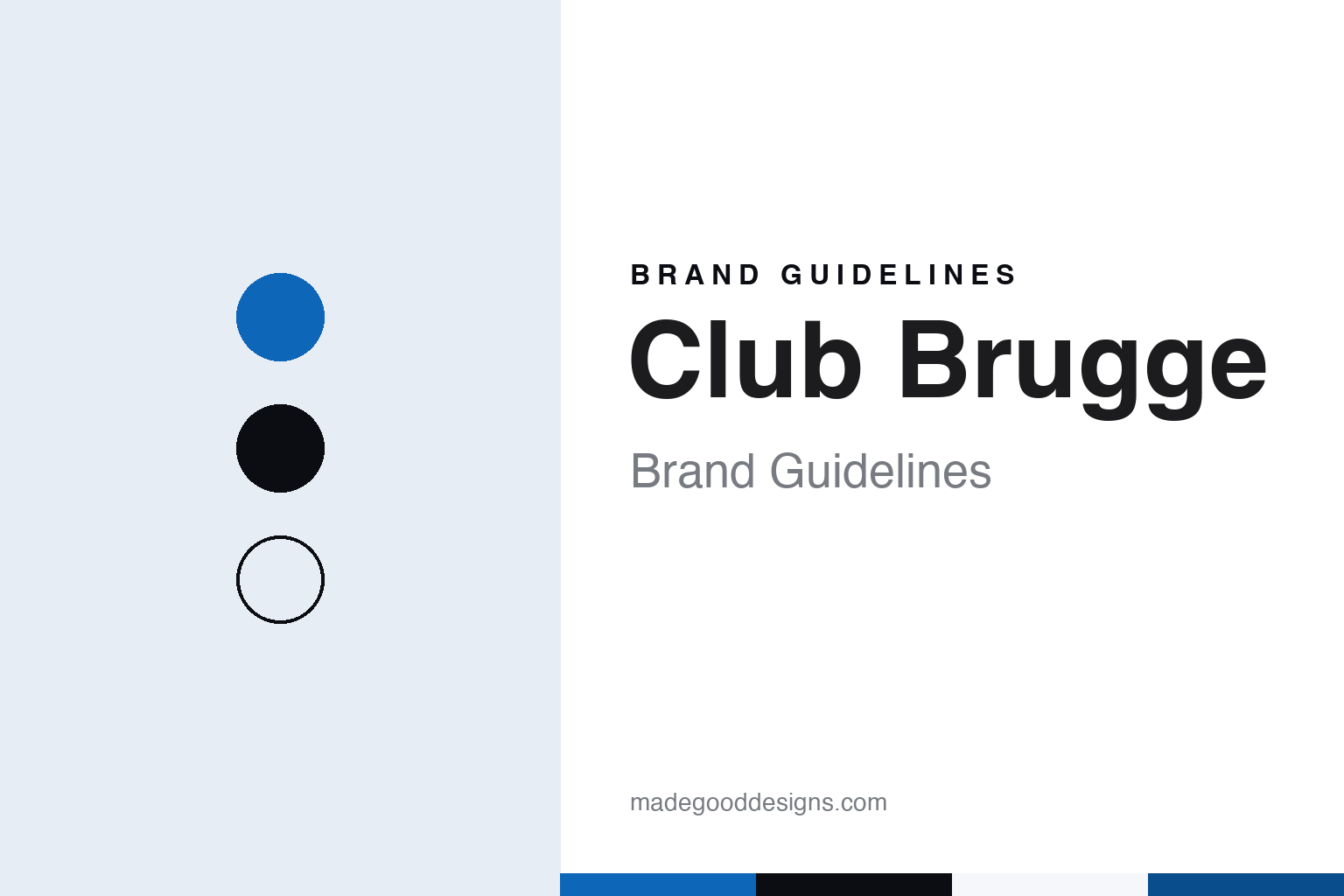
Club Brugge Brand Guidelines
Blue and black, with a flash of white.
Aa
Two constants: a Brugge blue, stripe black and flash white palette and a semi-condensed arrow sans register. Abstract homage — not a Club Brugge product or mark; no crest, shirt or logo is reproduced.
Club Brugge KV
Two schools, a split and a French name that turned Dutch.
Club Brugge was started by former pupils. English Wikipedia says that in 1890 students from the Catholic school of the Broeders Xaverianen and the neutral Koninklijk Atheneum in Bruges came together to form the Brugsche Football Club, with the Latin motto “mens sana in corpore sano”, a healthy mind in a healthy body. Dutch Wikipedia says the city had a sizeable English community in the 19th century, and that the game reached both schools through it. Running a team while also playing proved difficult, and on 13 November 1891 the club was formed again. That date is counted as the official foundation of today’s Club Brugge, and a board was installed a year later.
A split followed. Dutch Wikipedia says that in 1894 a group of members left to found Football Club Brugeois, a side made up mainly of wealthy French speakers, while Brugsche FC stayed a club for ordinary townspeople. FC Brugeois joined the national association at once and played in the inaugural Belgian league season in 1895–96, then withdrew a year later. In 1897 the two clubs came back together, and the merged club carried on under the French name FC Brugeois. In 1902 it also absorbed Vlaamsche FC.
The royal title and the Dutch name came later. English Wikipedia says the club changed its title to Royal FC Brugeois after the 1919–20 season, a royal status now reflected in the letters KV, for Koninklijke Vereniging. It did not take its Dutch name until 1972, when it became Club Brugge Koninklijke Voetbalvereniging, known simply as Club Brugge, or Club Bruges in English. Among supporters it is also known by its colours, Blauw-Zwart. Wikipedia lists Bart Verhaeghe as the club’s president since 2011.
Colour
From light blue sashes to blue and black.
The colours were not the original ones. Dutch Wikipedia says FC Brugeois began in a light blue shirt with a dark blue diagonal band running from the left hip to the right shoulder, and changed to blue and black only in 1909. English Wikipedia says blue and black have been the club’s traditional home colours since, and that away kits are usually lighter, with white, light blue and yellow all used in recent years. The colours are written into the club song too: Dutch Wikipedia says the official anthem is “Blauw en zwart forever”, composed by Roger Danneels with words by the Bruges singer Willy Lustenhouwer, who released it on an LP of Club Brugge songs in 1974.
The mascot comes from the city’s own legend. English Wikipedia says Club Brugge’s official mascot is a bear, a symbol of Bruges, linked to the story of Baldwin I, Count of Flanders, who was said to have fought and defeated a bear in his youth. Since the end of 2000 two bears, Belle and Bene, have walked the edge of the pitch at home games, and in 2010 a third, Bibi, was added as their child and aimed at young supporters. Dutch Wikipedia says Belle and Béné were created by the club director of the time, Antoine Vanhove.
Kit suppliers have changed often. Dutch Wikipedia says Club Brugge had an exclusive deal with Adidas in the early 1970s and wore Puma from 1976 to 1995. Adidas returned in 1995, Puma came back in 2007, Nike took over in summer 2013 and Macron from the 2017–18 season. In summer 2024 the club signed with the British brand Castore, which English Wikipedia lists as the current supplier.
Sponsors on the shirt began in 1972. Dutch Wikipedia says that was the year the Belgian football association began allowing outside advertising on shirts, and that the Bruges car dealer Carad was the club’s debut shirt sponsor. Later names included 49R Jeans, the beers St.-Louis Geuze and Bacchus, the insurer Assubel, the television channel VTM, Gemeentekrediet and its successor Dexia, renamed Belfius in 2012. In 2014–15 the club played the whole season without a commercial front sponsor, wearing the logo of the Club Brugge Foundation instead. Daikin followed from 2015–16, and from 2023–24 the back of the shirt has carried Allianz below the number.
Typography
Design and documentation.
Many football club identities are assembled from a handful of borrowed symbols, and each one sets a different design problem. A national flag placed inside a crest brings a fixed set of colours and shapes with it, such as a star, a crescent or a cross, and the designer has to fit the club’s own colours around them without the two schemes fighting at small sizes.
Laurel wreaths come from classical imagery and frame a figure or a set of initials. They read well when embroidered on a shirt, but their fine leaves tend to fill in on a phone screen, so a simplified outline is often drawn for digital use. Animal emblems, from birds of prey to lions, give a club a nickname and a mascot as well as a mark, and the same animal may exist as a detailed drawing, a flat silhouette and a matchday costume.
Two-colour kits are durable brand assets in sport, because stripes or halves in a fixed pair of colours can be recognised from the top of a stand long before any badge is legible. Stadium names add another layer: a ground named after a person or a district carries its own lettering on gates, roofs and tickets, and that signage becomes part of how the club is pictured.
Aa
A semi-condensed arrow sans — the register of a motion graphic and a shirt number. (Specimen set in Barlow Semi Condensed, a sans-serif STAND-IN; NOT the Club Brugge logo.)
Club Brugge
Arrows, Club YLA and Club NXT.
The modern brand was refreshed by a Dutch studio. Studio Dumbar, now part of DEPT, describes on its case page a refresh of Club Brugge’s brand for digital media, social channels and motion graphics. It says the club badge was off limits, and that the new look is built on arrows, bold typography, a more stylised approach to photography and a colour palette led by the club’s traditional blue and black, with flashes of white. The studio says the arrows became a shared graphic motif across the teams in the Club Brugge family, including CLUB YLA and CLUB NXT.
The women’s team got its own name in 2020. Creative Boom reported on 20 April 2020 that Studio Dumbar had worked with Club Brugge to rebrand its women’s team, previously Club Brugge Women, as Club YLA, with a new logo, clothing, merchandise, social media, website, photography and motion graphics. The project was coordinated by the independent art director Ludovic Beun. Creative Boom said a black and white palette replaced the team’s former blue and black, and the logotype used a slanted typeface for YLA with a more rounded sans for “club”. The name honours Yvonne Lahousse, a former pub owner and long-time supporter known as the mother of the club’s Spionkop. Dutch Wikipedia says she helped start the Bruges Spionkop terrace in the 1960s. Club NXT is the name under which the under-23 side plays in the Challenger Pro League.
The ground has had several names. English Wikipedia says the club’s early home was the Rattenplein, the “rats’ ground”, owned by a local fox terrier club. In 1911 it moved to De Klokke, named after a nearby pub and later renamed the Albert Dyserynckstadion after a club chairman. Since 1975 Club Brugge has played at the city-owned stadium that Dutch Wikipedia says was named the Olympiastadion in the spirit of the 1972 Munich Olympics. It was renamed the Jan Breydel Stadium, after the Bruges butcher who led a rising against French rule in the early 14th century; English Wikipedia dates the renaming to 1998 and Dutch Wikipedia ties it to the stadium’s expansion for Euro 2000. Club Brugge shares the ground with its city rival Cercle Brugge.
For a design guide, Club Brugge shows how a club can leave its badge alone and still renew its look, using colour, arrows and motion to tie a men’s team, a women’s team and an academy together. Compare it with Feyenoord, another club now kitted by Castore, and Puma, which supplied Club Brugge’s kit for two long spells. For this guide we use Brugge blue, stripe black and flash white with a sans, an unofficial interpretation; no product or logo is reproduced.
Explore & save
Keep Club Brugge’s identity on hand — save it to a board in the Made Good inspiration library.
Club Brugge identity set
Pin the Club Brugge Brugge blue, stripe black and flash white palette and the semi-condensed arrow sans register to your own board.