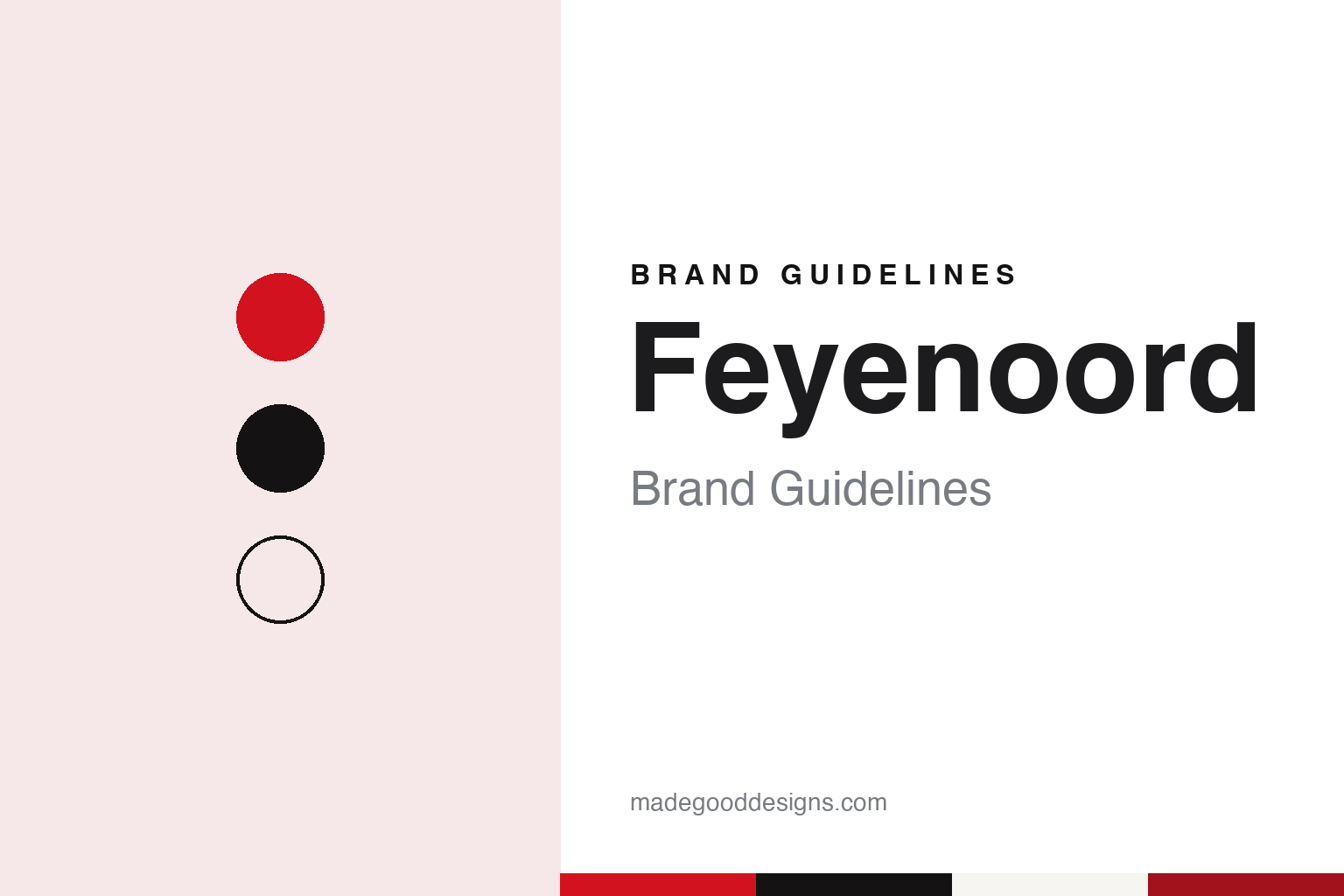
Feyenoord Brand Guidelines
Red on one side, white on the other, black below.
Aa
Two constants: a Kuip red, short black and shirt white palette and a condensed harbour sans register. Abstract homage — not a Feyenoord product or mark; no crest, shirt or logo is reproduced.
Feyenoord Rotterdam
A café meeting, three names and a district.
Feyenoord began under another name. English Wikipedia says the football club Wilhelmina was founded on 19 July 1908 in the pub De Vereeniging in Rotterdam, and Dutch Wikipedia adds that the café belonged to Jac. Keizer. The new club played in red shirts with blue sleeves and white shorts. Over the next few years the club changed its name and its colours several times. It became Hillesluise Football Club in 1909 and then RVV Celeritas.
The name that stuck came in 1912. Wikipedia says that when the club was promoted into the national football association that year, it renamed itself SC Feijenoord, after the district of southern Rotterdam where it had been founded, and changed its kit again, to the red and white shirts, black shorts and black socks it still wears. In 1917 the club moved to a ground on the Kromme Zandweg.
The spelling changed later for practical reasons. English Wikipedia says that as the club played more often in international tournaments, it changed its name in 1974 because supporters abroad who did not know Dutch could not pronounce the “ij” in Feijenoord. The “y” spelling has been used since. In 1978 the professional side split from the amateur club it had sheltered, which kept the name SC Feyenoord, and the professional club has been called simply Feyenoord, or Feyenoord Rotterdam, since then.
Ownership of the brand sits in a layered structure. Dutch Wikipedia says Feyenoord Rotterdam N.V. owns the Feyenoord brand and runs the professional club. Its shares are divided between the Stichting Continuïteit Feyenoord, a foundation that guards the club’s cultural heritage and holds a golden share, the Vrienden van Feyenoord, a group of supporters led by Pim Blokland that took a stake in the club in October 2010, and the Stichting Supporters Steunen Feyenoord. Dutch Wikipedia adds that the club took over the company that ran its stadium, Stadion Feijenoord N.V., and that since 2026 the two have formed one organisation.
Colour
A crest protected as heritage.
Feyenoord treats its badge as something to be guarded. Dutch Wikipedia calls the logo an important part of the club’s cultural heritage and says it is protected by the Stichting Continuïteit Feyenoord. The crest has developed in two ways over the decades: through the name changes of the early years and through cosmetic redrawings. One thing has held since the 1930s, Dutch Wikipedia says: the club colours of red, white and black, the same three colours worn on the pitch.
The crest has come and gone from the shirt. According to Dutch Wikipedia, the Feyenoord logo appeared on the match shirt in the 1956–57 season, the opening season of the Eredivisie. It disappeared from the kit again from 1961–62 and returned on the left breast in 1983–84, in a form with the same features as the badge in use today. From 1997–98 the lettering on the crest was white rather than gold, and the gold letters were restored for the club’s centenary season, 2008–09.
The centenary also produced a new mark. Dutch Wikipedia says a special jubilee logo was unveiled for the club’s hundredth birthday in 2008, and a simplified version of it has been the regular crest since the following year. The logo underwent small changes in 2024. Since August 2025 the club has also used a monogram in part of its social media output, a single letter F taken from the main crest.
The home shirt itself is a fixed design. Dutch Wikipedia describes the split adopted with the 1912 name change: the shirt is white on the player’s left side and red on the right, with the sleeves in the opposite colour, red on the left and white on the right. The collar follows either the body or the sleeves depending on the season, and is often black. Shorts and socks are black, though white shorts and socks are sometimes worn to avoid a clash. Away kits change every season. Dutch Wikipedia says green appears often, as a link to Rotterdam, whose flag and coat of arms both carry green, and blue is also common.
The club has a cast of mascots. Dutch Wikipedia says the official mascot is Coentje, named after the former player Coen Moulijn, who was given a makeover in 2021 with help from De Kameraadjes. Two animals from the Rotterdam zoo became unofficial mascots: the gorilla Bokito, after his escape made international news in May 2007, and the elephant Olli, after Diergaarde Blijdorp appeared on the Feyenoord kit for half a season in 2013.
Typography
Design and documentation.
Many football club identities are assembled from a handful of borrowed symbols, and each one sets a different design problem. A national flag placed inside a crest brings a fixed set of colours and shapes with it, such as a star, a crescent or a cross, and the designer has to fit the club’s own colours around them without the two schemes fighting at small sizes.
Laurel wreaths come from classical imagery and frame a figure or a set of initials. They read well when embroidered on a shirt, but their fine leaves tend to fill in on a phone screen, so a simplified outline is often drawn for digital use. Animal emblems, from birds of prey to lions, give a club a nickname and a mascot as well as a mark, and the same animal may exist as a detailed drawing, a flat silhouette and a matchday costume.
Two-colour kits are durable brand assets in sport, because stripes or halves in a fixed pair of colours can be recognised from the top of a stand long before any badge is legible. Stadium names add another layer: a ground named after a person or a district carries its own lettering on gates, roofs and tickets, and that signage becomes part of how the club is pictured.
Aa
A condensed harbour sans — the register of a turnstile sign and a shirt number. (Specimen set in Oswald, a sans-serif STAND-IN; NOT the Feyenoord logo.)
Feyenoord
Kit makers, sponsors and De Kuip.
The kit maker changed in 2023. Inside World Football reported on 30 January 2023 that the British sportswear brand Castore had signed a six-year kit deal with Feyenoord, starting with the 2023–24 season, and would also become the club’s retail partner. It replaced Adidas, which had been Feyenoord’s kit partner since 2014. Sportcal, reporting the same deal on 27 January 2023, said Adidas had returned as kit supplier ahead of the 2014–15 season and that Castore was moving its European headquarters and distribution to Rotterdam at the same time.
Sponsors have taken more of the shirt over time. Dutch Wikipedia says sponsor names have been allowed on the shirt since the 1982–83 season. A sleeve sponsor was added in 2020–21, and a back-of-shirt sponsor was reintroduced in 2023–24; from 2024–25 that position has been filled by the Feyenoord Foundation, an arrangement Dutch Wikipedia says UEFA approved.
The ground is as much a part of the identity as the shirt. The club’s stadium in the IJsselmonde district, officially Stadion Feijenoord, is nicknamed De Kuip, Dutch for “the tub”. English Wikipedia says it opened on 27 March 1937, and Dutch Wikipedia says it was built on the initiative of chairman Leen van Zandvliet and designed by the architect Leendert van der Vlugt. English Wikipedia says Feyenoord did not own the stadium until 2026, when the club bought and absorbed the organisation that owned it. Plans for a new ground came and went: a proposed Feyenoord City stadium was announced in 2016, and in May 2022 the director of Stadion Feyenoord, Jan van Merwijk, said it would not be feasible.
The club’s sound is fixed too. English Wikipedia says the official hymn since 1961 has been “Hand in Hand”, with lyrics written that year by Jaap Valkhoff to a 19th-century melody by Wilhelm Speidel.
For a design guide, Feyenoord shows how a club can keep one shirt layout for more than a century and protect its crest through a foundation, while letting the lettering, the away kit and a single-letter monogram carry the change. Compare it with PSV Eindhoven, another Dutch club in red and white, and Adidas, the club’s kit supplier from 2014 to 2023. For this guide we use Kuip red, short black and shirt white with a sans, an unofficial interpretation; no product or logo is reproduced.
Explore & save
Keep Feyenoord’s identity on hand — save it to a board in the Made Good inspiration library.
Feyenoord identity set
Pin the Feyenoord Kuip red, short black and shirt white palette and the condensed harbour sans register to your own board.