PSV Eindhoven Brand Guidelines
Red and white lines in an oval, and a flag with three letters.
Aa
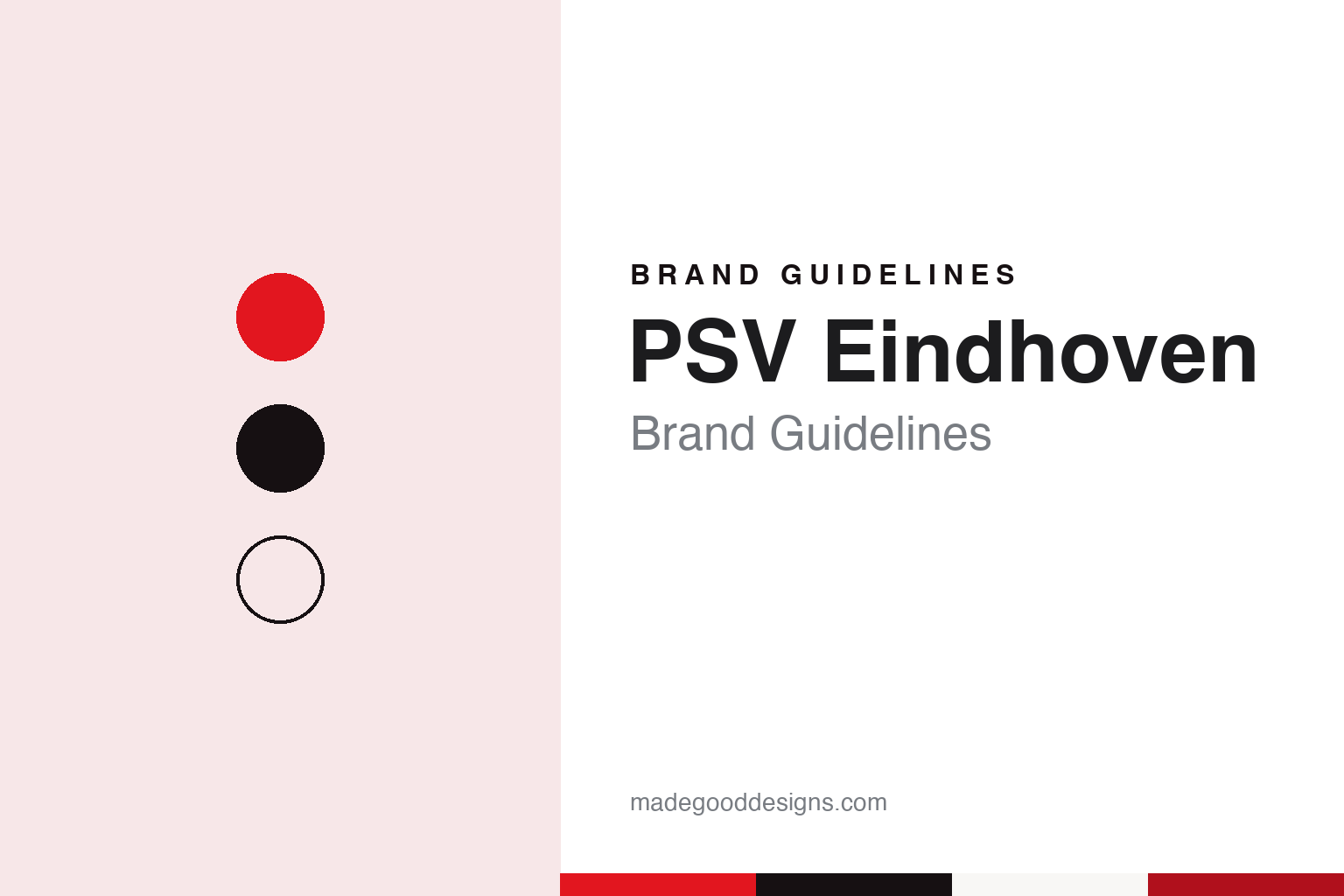
Two constants: a raspberry red, ink and notepad white palette and a semi-condensed works sans register. Abstract homage — not a PSV product or mark; no crest, shirt or logo is reproduced.
Philips Sport Vereniging
A works team, a strike and a new association.
PSV’s name still spells out its origin. The letters stand for Philips Sport Vereniging, the Philips Sports Association, and English Wikipedia says the club was founded in 1913 as a team for employees of the electronics company Philips in Eindhoven. The trade press repeats the point: Inside World Football, in a report dated 25 April 2016, said Philips SV was founded in 1913 as a team for Philips employees in Eindhoven, which explains the Philips name in the club’s name.
There was an earlier works side. Wikipedia says that to provide activities for its staff, Philips set up its own football team in 1910, the Philips Elftal, which played at the Philips Sportpark. Financial trouble and strikes brought that team to an end, and its successor, Philips Sport Vereniging, was founded on 31 August 1913. Wikipedia says that was the day Philips held celebrations and sports competitions to mark the centenary of the defeat of the French in the Napoleonic Wars. The football department only changed its name from Philips Elftal to PSV in 1916, and because of the First World War its first chance to enter a league came in the 1915–16 season.
For decades the club and the company were closely bound together. Wikipedia says that in its early years PSV was open only to Philips employees, and that players who were offered a football contract were also offered a job at Philips. The company used the club to show its technology. Wikipedia says that in 1950 a match between PSV and FC Eindhoven was televised in the Netherlands using equipment supplied by Philips, and that in 1958 Philips installed four floodlights at the stadium, which made evening matches possible.
The football club sits inside a wider sports association, which is why the full name refers to sport in general rather than to football. Wikipedia says Frans Otten became chairman of the whole PSV sports union in the 1920s and oversaw new facilities and stadium expansions, and that Frits Philips, chairman of the company from 1961 to 1971, took the ceremonial kick-off at the first Philips Elftal match in 1911 and kept his own seat in the stands.
Colour
From a light bulb to an oval with a flag.
The first crest was a piece of company branding. English Wikipedia says PSV’s original badge consisted of a light bulb and the words “Philips Sport” arranged in a circle. The next version moved toward a conventional football badge: a shield with red and white vertical lines, topped by the letters PSV.
The third design has lasted. Wikipedia describes it as an oval with red and white horizontal lines and a flag carrying the letters PSV, and says it remains in use. Changes since then have been small: the colour of the border, the addition of horseshoe-shaped figures, a circle around the three letters and two stars above the badge. Early versions of the oval spelled the name with full stops, as P.S.V. For the centenary in 2013, a laurel wreath and the number “100” in gold were added to the crest for a time.
The colours were chosen at a table. Wikipedia says red and white were picked at the founding meeting in 1913 by Jan Willem Hofkes, the club’s first chairman, who is said to have liked the contrast between his red raspberry drink and his white notepad. The first kit used both: a shirt with red and white vertical stripes, black shorts and socks with red and white hoops.
The shirt has moved between stripes and plain red. Wikipedia says the striped combination was worn until the 1970s, when the club switched to an all-red shirt worn with white or black shorts. Stripes came back in 1989 and have stayed, in many different arrangements, while the shorts have changed between black and white. Wikipedia says Ruud Gullit, while at the club, personally changed the shorts from black to white. For the 2013 centenary PSV wore an all-red shirt with white shorts and socks, recalling the kit of the late 1980s.
Typography
Design and documentation.
Football club identities are often built from a handful of recurring devices, and the clubs in this part of the round show several of them. The first is the monogram: interlocking initials that compress a long formal name into a mark small enough for a shirt, a scarf or a stadium gate. Monograms tend to survive redesigns because supporters read them as a signature rather than a picture, so designers usually redraw the letters, adjust their weight and spacing, and leave the arrangement alone.
The second device is the motto. Some crests carry a short phrase, sometimes in the home language and sometimes in Latin, set on a ribbon or band. A motto gives a club a line of copy that can move from the badge to banners, stands and advertising without a change of meaning.
The third is origin. A number of European clubs began as works teams or sports associations attached to a factory, a school or a parish, and the founding organisation’s name or initials can remain in the club name long after the link has loosened. Finally there is the stadium name, which may honour a former president, a place or a sponsor, and which becomes part of the brand on tickets, signage and broadcast graphics.
Aa
A semi-condensed works sans — the register of a factory sign and a shirt number. (Specimen set in Barlow Semi Condensed, a sans-serif STAND-IN; NOT the PSV logo.)
PSV Eindhoven
Kit makers, a shirt sponsor change and the Philips Stadion.
Kit makers have changed several times. English Wikipedia lists Le Coq Sportif as PSV’s first clothing supplier, from 1970 to 1974, followed by Adidas until 1995, then Nike until 2015, when Umbro took over.
The front of the shirt carried the company name for decades. Wikipedia says Philips was PSV’s shirt sponsor from 1982, the year shirt sponsorship was introduced in the Eredivisie, until 2016. Inside World Football reported on 25 April 2016 that the energy supplier Energiedirect would replace Philips as shirt sponsor, and that Philips said the decision fitted its move away from consumer electronics toward medical equipment. Philips stayed involved. Dutch broadcaster NOS reported on 25 March 2019 that Philips, ASML, VDL, Jumbo and High Tech Campus Eindhoven would jointly back the club under the name Metropoolregio Brainport Eindhoven, which would appear on the front of the shirts, and that the individual company names would not appear on the chest. NOS said Energiedirect.nl would stay with the club in a smaller role, on the back of the kit.
The ground has always been on the same site. Wikipedia says PSV have played at the Philips Stadion since the club’s founding, when it was still called the Philips Sportpark. It stands in the Strijp district, in the Philipsdorp neighbourhood that Anton Philips set up in 1910 to house employees. A football field was laid out at the same time, and the Philips Elftal played its first match there on 15 January 1911. Wikipedia says the first wooden stand was built in 1916, and that the main stand was rebuilt in 1977. The Philips name has stayed on the stadium throughout.
Supporters have a name for themselves too. Wikipedia says PSV fans call themselves boeren, Dutch for farmers or peasants, a word chanted after home goals and taken up with pride in Eindhoven’s place in the province of North Brabant. The club has reserved shirt number 12 for its supporters.
For a design guide, PSV Eindhoven shows how a works-club origin can stay visible in a name, a stadium and a pair of colours long after the company stops being the shirt sponsor. Compare the electronics identity of Philips, and the city crests of Benfica and FC Porto. For this guide we use raspberry red, ink and notepad white with a semi-condensed sans, an unofficial interpretation; no product or logo is reproduced.
Explore & save
Keep PSV Eindhoven’s identity on hand — save it to a board in the Made Good inspiration library.
PSV Eindhoven identity set
Pin the PSV Eindhoven raspberry red, ink and notepad white palette and the semi-condensed works sans register to your own board.