Florida Panthers Brand Guidelines
A cat on the endangered list, a leaping crest and a shield, in red, navy and gold.
Aa
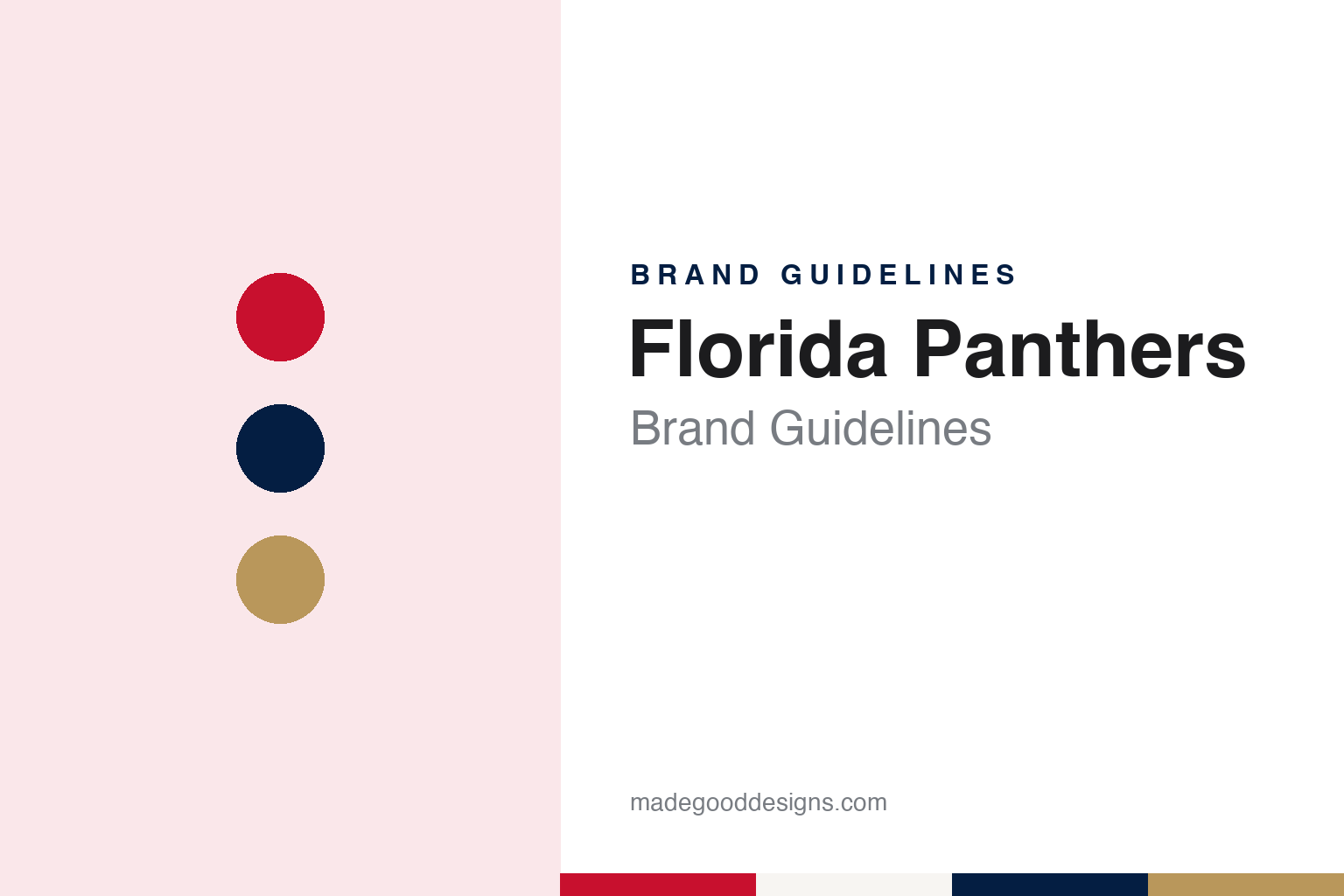
Two constants: a Panther red, Everglades navy and flat gold palette and a condensed sans register. Abstract homage — not a Florida Panthers product or mark; no crest, sweater or logo is reproduced.
A video-store owner and an endangered cat
A name meant to point at the animal, not just the team.
The Florida Panthers were created by Wayne Huizenga, the businessman behind the Blockbuster Video chain. English Wikipedia says the NHL awarded him a franchise for Miami on 10 December 1992, the same day the Walt Disney Company won the rights to the team in Anaheim that became the Mighty Ducks. Huizenga already owned baseball’s newly founded Florida Marlins and a share of the Miami Dolphins, and he announced that the new hockey team would play at the Miami Arena, sharing it with the NBA’s Miami Heat until a new building could be built.
The name Huizenga wanted at the start came straight from his business. Wikipedia says he wanted to call the team the “Block Busters”, in the blue and gold of the video chain, and that a uniform concept was drawn before the league rejected the nickname. On 20 April 1993, at a press conference in Fort Lauderdale, the club announced that it would be called the Florida Panthers, with the former New York Islanders general manager Bill Torrey as president.
The name had a purpose beyond the rink. NHL.com, in its team-nickname feature of 23 November 2016 by Cristina Ledra and Pat Pickens, says Huizenga chose “Panthers” to bring attention to the plight of the Florida panther, the state animal and an endangered species. Wikipedia says the panther in question is native to the nearby Everglades, and that when the logos and uniforms were unveiled on 15 June 1993 the team also announced a financial commitment to panther preservation. The same source records a detail of trademark history: Huizenga had held the rights to the Panthers name since 1991, when he bought it from a group of Tampa investors who had hoped to start a baseball team.
The team began play in the 1993–94 season, and its home moved in 1998 from downtown Miami to a new arena in Sunrise, in Broward County, now known as Amerant Bank Arena. Huizenga sold the team after the 2000–01 season, Wikipedia says, to a group led by Alan Cohen.
Colour
A leaping panther, a palm tree and a sky of rubber rats.
For more than two decades the club used a single primary crest. Wikipedia says the original logo, in use from 1993 to 2016, showed a leaping panther. Around it sat a family of secondary marks: a version of the leaping panther clutching a pair of broken hockey sticks, and a logo with a yellow sun behind a hockey stick and a palm tree.
The first uniforms set the colour story. Wikipedia says the set worn from 1993 to 2007 came in red for road games and white at home, with the leaping panther on the front and the palm-tree logo on the shoulders, diagonal stripes on the sleeves and a triangular yoke, with yellow and navy as accents. In 1998 a navy alternate arrived carrying the broken-sticks panther, and before the 2003–04 season navy became the main home colour, with red moved to alternate status.
The later years of the leaping panther brought smaller changes. Wikipedia says the Reebok Edge template of 2007 added thicker sleeve stripes and piping. A navy alternate of 2009 used a roundel crest with a panther head surrounded by the team name, swapped red for powder blue as trim and put an “FLA” sunshine logo on the shoulders; it lasted three seasons. Before 2011–12 the club returned to red at home.
The club’s rat ritual began in its third season, in a locker room. ESPN’s Kristen Shilton, writing on 9 June 2023, described how the forward Scott Mellanby killed a rat with his stick before the 1995–96 home opener at Miami Arena and then scored twice against Calgary. The goaltender John Vanbiesbrouck joked that this was a “rat trick”, and fans began throwing plastic rats on the ice after Panthers goals through the run to the 1996 Final. Shilton wrote that the NHL then banned the practice because of the delays it caused, though rats have returned at times since. Wikipedia says the club added a second mascot, an anthropomorphic rat called Viktor E. Ratt, in October 2014, alongside Stanley C. Panther, introduced in 1995–96.
Typography
Design and documentation.
Hockey clubs added during expansion periods usually begin with a blank sheet: a new name, a new crest and a set of colours chosen before a single game has been played. Those early decisions tend to lean on place. Designers often reach for local landscape, wildlife, regional history or a civic symbol, so that the mark feels rooted in the city even though the club itself is new. Colour names follow the same instinct, with teams describing their reds, greens, golds and blues through references to local industry, forests, rivers or civic heritage rather than plain swatch labels.
Crests also change over time. A club may introduce a sharper, more illustrative mark in one era, then later return to a simpler letterform or an older emblem drawn from the city’s earlier hockey history. These heritage returns are usually presented as a reconnection with the past and often arrive alongside new jerseys, refreshed wordmarks and updated arena graphics. Arenas carry their own visual traditions too, from goal songs and horns to banners and entrance rituals, and those elements become part of how a hockey brand is experienced as much as any logo printed on a sweater.
Aa
A condensed sans — the register of block sweater numbers and arena signage. (Specimen set in Oswald, a condensed sans STAND-IN; NOT the Florida Panthers logo.)
A shield and a state flag
A new owner from New York, a new crest and the leaping panther kept in reserve.
The current ownership dates from 2013. The Associated Press, in a report carried by the Everett Herald on 26 September 2013, said Vincent Viola, chairman and chief executive of the trading firm Virtu Financial and a graduate of West Point, had become the new owner, replacing Cliff Viner, who had led the team’s ownership since 2010. An Agence France-Presse report in the Gulf Times on 28 September 2013 added that the purchase included the operating rights to the team’s arena, which remained owned by Broward County. Viola has owned the Panthers since 2013.
Three years later the leaping panther gave way as the primary crest. CBS Miami reported on 2 June 2016 that the Panthers had unveiled a new logo and uniforms at a free fan event at their arena in Sunrise, with Viola on stage. The new primary mark is a shield with a panther front and centre: the home version carries the word “Panthers” above the cat and the road version reads “Florida.” An alternate mark, embroidered on both sleeves, shows the Florida state flag with a panther prowling on top and an arch reading “Florida” or “Panthers.” CBS Miami described red home jerseys crossed by a horizontal white stripe at the arms and midsection, gold accents and a white lace-up tie at the collar, and white road jerseys with the same band in red and navy numbers.
Wikipedia adds that the 2016 redesign replaced yellow with flat gold as the trim colour, and that the leaping panther was redrawn and kept as an alternate logo. The basic design stayed when Adidas became supplier in 2017. The old crest has since returned on special uniforms: a 2020–21 “Reverse Retro” recoloured the 1990s leaping-panther uniform on a navy base with flat gold, a second used a powder-blue base with the palm tree, sun and stick logo on the front, and for the 2026 Winter Classic the club wore red with cream lettering and a chain-stitched felt version of the leaping panther.
For a design guide, the Florida Panthers show how a team name can carry a cause, and how a club can move to a new crest while keeping its old one close at hand. Compare it with Miami Marlins, the baseball club Huizenga also owned when the Panthers were founded, and Tampa Bay Lightning, the state’s other NHL club. For this guide we use Panther red, Everglades navy and flat gold with a sans, an unofficial interpretation; no product or logo is reproduced.
Explore & save
Keep Florida Panthers’s identity on hand — save it to a board in the Made Good inspiration library.
Florida Panthers identity set
Pin the Florida Panthers red, navy and flat gold palette and the condensed sans register to your own board.