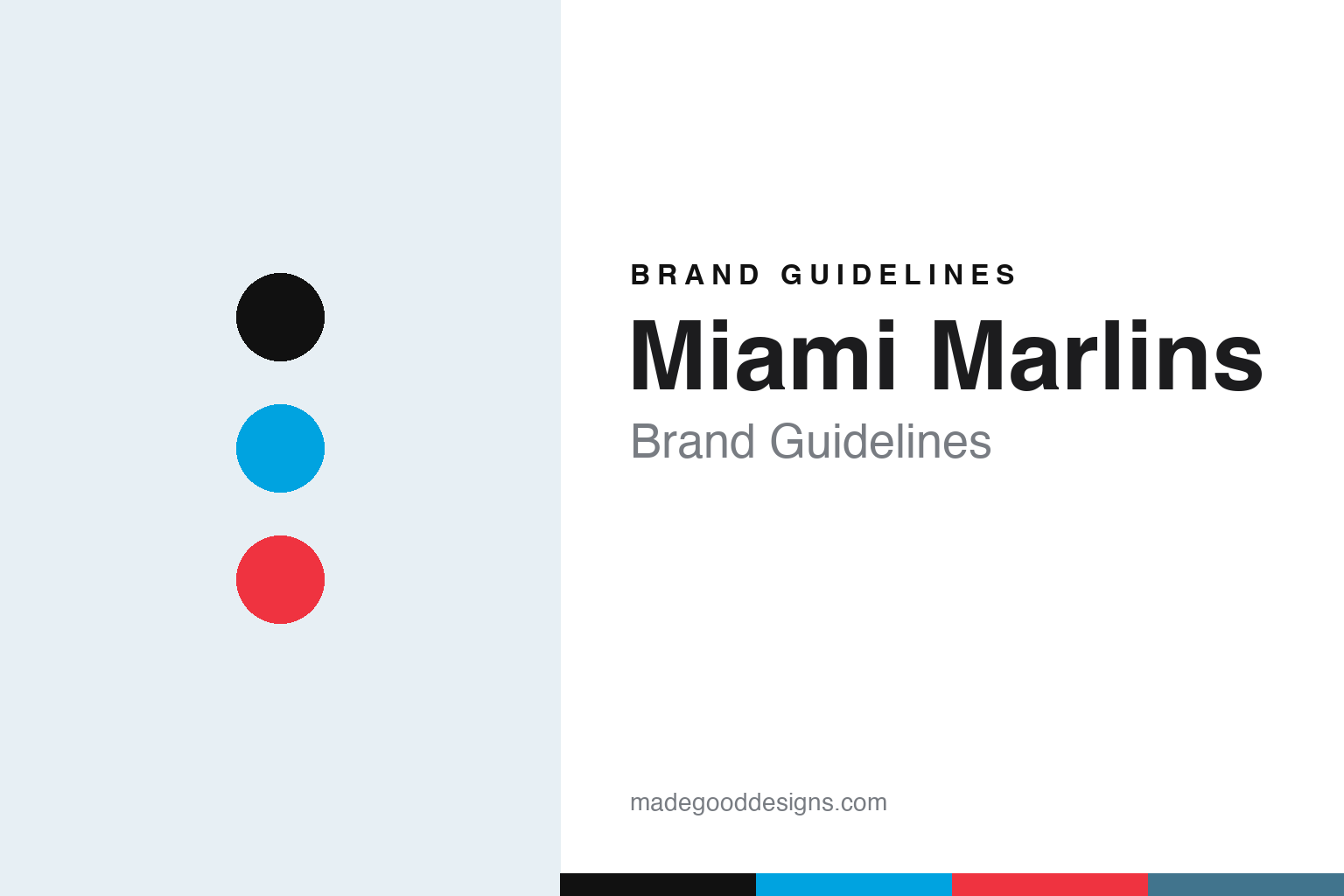
Miami Marlins Brand Guidelines
A minor-league name, three palettes in three decades, and a marlin that learned to leap upright.
Aa
Two constants: a midnight black, Miami blue and Caliente red palette and a tapered serif M and script register. Abstract homage — not a Miami Marlins mark; no cap logo, marlin or wordmark is reproduced.
A Florida name for a Miami club
A video-rental chief, a borrowed minor-league name and a statewide choice.
The Marlins began as a statewide bet. In a history of the club’s ownership for the Society for American Baseball Research, posted in January 2017 and last revised on 10 December 2018, Stephen R. Keeney traces how the National League chose Miami and Denver for its 1993 expansion in 1991. English Wikipedia records that the Miami franchise was awarded on 10 June 1991 to Wayne Huizenga, then chief executive of Blockbuster Entertainment, and that the team began play in 1993 at Joe Robbie Stadium, which it shared with the Miami Dolphins.
The name was borrowed from local history. Keeney writes that “Marlins” was an homage to a line of minor-league clubs that had called Miami home, and Wikipedia lists them: the Miami Marlins of the Triple-A International League from 1956 to 1960, and two later Miami Marlins sides in the Florida State League. Keeney adds that league officials hoped the new owners would choose the alliterative “Miami Marlins,” but that the ownership group wanted to appeal to as many customers as possible across the state, and so the club took the field as the Florida Marlins.
The first look was built on teal. Wikipedia describes home uniforms with “Marlins” in teal with black trim, an underline trailing from the final “S,” and teal pinstripes; a sleeveless alternate worn over teal undershirts; and road uniforms reading “Florida,” with a marlin wrapped around the “F.” All three caps carried an “F” in front of a leaping marlin: an all-teal home cap, a teal road cap with a black brim, and an all-black alternate. By the late 1990s, Wikipedia says, teal was gradually played down and the club wore black caps and undershirts for the rest of that set’s run.
Owners changed while the uniforms stayed largely the same. Keeney writes that Huizenga sold the team in November 1998 to John Henry, another South Florida businessman, and that Henry later passed it to the art dealer Jeffrey Loria, then running the Montreal Expos, in an arrangement brokered by the league that let Henry buy the Boston Red Sox. Huizenga died on 22 March 2018, Keeney records.
Colour
Black and silver, then a city name and orange.
A second uniform set arrived in 2003. Wikipedia says that on the home uniforms teal was reduced to an accent, with black taking over as the main lettering and pinstripe colour and silver added to the letters. A sleeved pinstriped alternate carried the “F” logo on the chest, and the same “F” replaced the primary logo on the sleeve. The road set kept “Florida” in a matching script, and a black alternate jersey carried “Marlins” in silver with teal, black and white accents. In 2010 the road uniform switched from “Florida” to “Marlins” and the sleeve patches were removed.
The deeper change came with a new building. Keeney writes that the club’s new ballpark, Marlins Park, opened in time for the 2012 season with a retractable roof, air-conditioning, a home-run sculpture in the outfield and an aquarium behind home plate. Along with the ballpark, he writes, came a new name, the Miami Marlins, a new logo and a new colour scheme, moving from teal and black to orange, blue, black and yellow. Wikipedia says the rename was part of the agreement with the park’s owner, Miami-Dade County.
The 2012 mark was unlike anything the club had worn. Wikipedia describes a white “M” with orange, yellow and sky blue accents and a stylised, abstract marlin across its top, used on caps and as a left-sleeve patch. Home, road and black alternate uniforms read “Miami,” with the first “M” shaped like the cap logo, black letters trimmed in silver and orange drop shadows on the numbers. An orange alternate jersey put the team name in white with sky blue accents and moved the abstract marlin onto the letter “I.” The club mostly wore all-black caps, with all-orange caps for a short period. The ballpark is now called loanDepot park, Wikipedia notes.
Typography
Design and documentation.
Baseball clubs founded in later expansion waves arrive without decades of inherited imagery, so their identities are built deliberately and often rebuilt within a generation. A new club usually launches with a full kit of parts at once: a name chosen with public input, a primary logo, a script or block wordmark, a cap insignia, home and road uniforms and a colour set meant to read clearly on television. When the club later changes its name, moves into a new ballpark or passes to new owners, that kit is frequently redrawn as a whole rather than adjusted piece by piece.
Renames tend to simplify. A long or regional name may be shortened, or a state name swapped for a city name, so the club can claim a home market more directly. Colour is the other lever. Warm-climate clubs often borrow from local surroundings, with sea blues, sunset oranges, citrus yellows and tropical greens, while later redesigns sometimes move to darker, more restrained palettes that hold up on screens, merchandise and cap fronts.
Domed and retractable-roof ballparks add their own design layer. Signage, wayfinding and scoreboard graphics sit under artificial light or shifting daylight, and the building itself often becomes part of the club’s visual story, appearing in advertising, ticketing and broadcast graphics alongside the logo and wordmark.
Mm
A curved, tapered serif — the register of a script “M” drawn with a nod to Latin-American lettering. (Specimen set in Playfair Display, a serif STAND-IN; NOT the Miami Marlins logo, marlin or wordmark.)
Miami Marlins
New owners, new colours, and a nod to Havana.
The current owners arrived in 2017. Keeney writes that in September 2017 the league’s owners unanimously approved the sale of the club by Loria to a group led by the investment manager Bruce Sherman and the former New York Yankees shortstop Derek Jeter, with Sherman as managing general partner and Jeter running baseball operations. Sherman’s group has owned the Marlins since 2017; Wikipedia records that Jeter stepped down as chief executive in February 2022.
A year after the sale the identity was redrawn again. Ballpark Digest reported on 15 November 2018 that the club had unveiled new colours and logos after teasing them on social media, replacing the block “M” with its rainbow of colours. The new palette was named Caliente Red, Miami Blue, Midnight Black and Slate Grey. According to the club’s description, as reported by Ballpark Digest, the pairing of Miami blue and Caliente red against black was meant to suggest the city’s energy and nightlife; the modern script “M” and a curved, tapered serif were influenced by lettering common in Latin-American culture; and the font and accent colours recalled the 1950s Miami Marlins and the Havana Sugar Kings. The marlin in the primary logo was redrawn to look more athletic, its body turned upward. The uniforms were unveiled the following morning.
Wikipedia describes how that kit has settled. Home and road uniforms read “Miami,” the black alternate reads “Marlins,” and the letters are black with red drop shadows and blue accents; the all-black cap carries a stylised “M” with a more realistic marlin on top, and the marlin logo sits on the left sleeve. A red City Connect uniform with Miami blue trim followed in 2021 as a tribute to the Cuban Sugar Kings. In 2024 the black alternate switched to white letters for visibility and a Miami blue alternate was added. A second City Connect uniform in 2025, black with teal and pink, looked back to the original Florida Marlins and the city’s neon skyline, and in 2026 a teal throwback became the Sunday home uniform, replacing the blue alternate.
For a design guide, Miami Marlins shows how a club can change its palette three times in three decades and still find its way back to its starting colour as a throwback. Compare the city’s basketball club in our Miami Heat guide, and the league-wide marks in the MLB guide. For this guide we use midnight black, Miami blue and Caliente red with a serif, an unofficial interpretation; no product or logo is reproduced.
Explore & save
Keep Miami Marlins’s identity on hand — save it to a board in the Made Good inspiration library.
Miami Marlins identity set
Pin the Miami Marlins midnight black, Miami blue and Caliente red palette and the tapered serif M and script register to your own board.