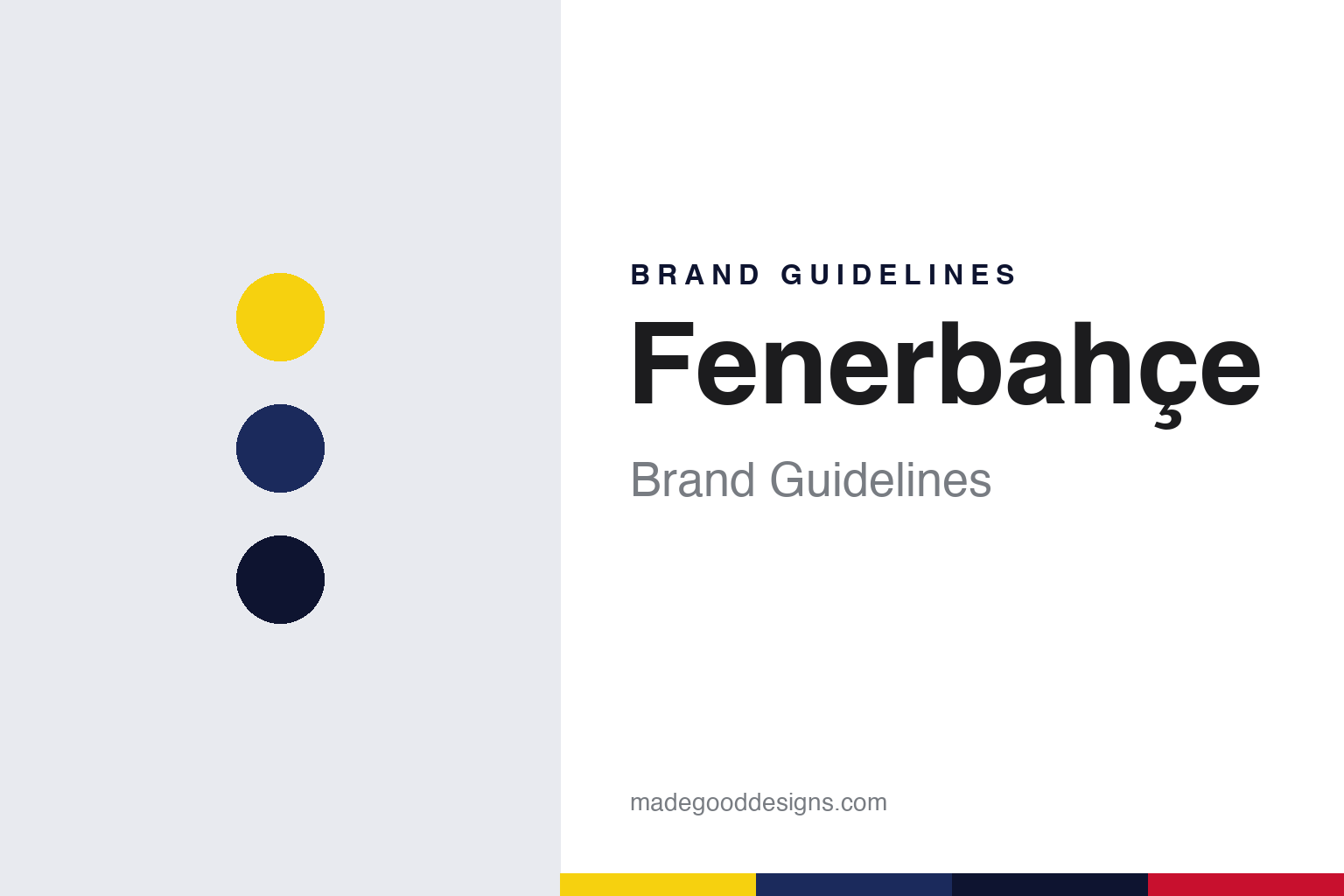
Fenerbahçe Brand Guidelines
A lighthouse, a cape and a striped summer shirt.
Aa
Two constants: a canary yellow, Kadıköy navy and night ink palette and a condensed matchday sans register. Abstract homage — not a Fenerbahçe product or mark; no crest, shirt or logo is reproduced.
The lighthouse garden
A club named after the view from a window in Moda.
Fenerbahçe takes its name from a place. English Wikipedia says the club was officially founded on 3 May 1907 in Kadıköy, by three local men: Ziya Songülen, Ayetullah Bey and Necip Okaner. Songülen became the first president, Ayetullah Bey the first general secretary and Okaner the first captain. Wikipedia says the group worked in secret at first, because football clubs were not tolerated under Sultan Abdul Hamid II, and only registered in the open after a legal reform in 1908.
The founder had found the game abroad. According to Wikipedia, Songülen, also known as Nurizade Ziya, studied in England between 1903 and 1906, saw football there and, on his return to Istanbul, gathered friends from Kadıköy to form a team. A teacher from his old school, Enver Yetiker, helped set it up and became its first coach. The squad was complete as a team of eleven only in the spring of 1907, which is why that date is treated as the official founding.
The name came from the view. Wikipedia quotes Songülen recalling that the founders lived in Moda, but a club called Moda FC already existed, so they could not use their own district’s name. Looking out of a window, they saw the Fenerbahçe cape and its lighthouse and chose to call the club after it. Fener is the Turkish word for a lighthouse or lantern and bahçe means garden, and Wikipedia says the lighthouse on the cape was built in the time of Suleiman the Magnificent, in 1562.
The name is used in two lengths. Wikipedia gives the formal title as Fenerbahçe Spor Kulübü, “Fenerbahçe Sports Club”, and says the team is commonly known simply as Fener. The football team is the football branch of a wider multi-sport organisation, and Wikipedia says the club plays in yellow and navy striped shirts in all of its branches. The team is also called the Sarı Kanaryalar, the Yellow Canaries, a nickname that UEFA used in January 2026 when previewing the Europa League knockout phase, Wikipedia notes.
Colour
Daisies, a shop in Tünel and an oak leaf.
The club’s first colours were not its current ones. English Wikipedia says that because Fenerbahçe was founded in spring, the founders chose yellow and white, after the yellow and white flowers growing around the Fenerbahçe district, and that the first crest showed the lighthouse on the cape. The first shirts were designed by Ziya Songülen and bought in England, from the shop of the merchant Frank Sugg on Lord Street in Liverpool. Wikipedia says they were long-sleeved winter shirts made of flannel, and too warm once the weather turned.
The switch to the present colours was a matter of stock. According to Wikipedia, in 1908 Songülen went to the shop of a British merchant named Baker in the Tünel district of Beyoğlu to order lighter shirts for summer. Baker said the order would not arrive in time, and offered instead a set of yellow and navy striped summer shirts he already had. Songülen bought them all and decided the team would play in yellow and navy, which Wikipedia says fixed the club’s colours from that year on.
The crest followed. Wikipedia says the club was restructured in 1911 and updated its identity, and that the badge still in use was designed in 1914 by Hikmet Topuzer, a right winger known as “Topuz Hikmet”. It was first produced as lapel pins, made in London through Tevfik Haccar Taşçı, one of the early players.
The badge is built from five colours, and Wikipedia gives a meaning for each. A white band carries the lettering Fenerbahçe Spor Kulübü ★ 1907 ★ and stands for purity and open-heartedness. A red section stands for love and attachment to the club and refers to the Turkish flag. The yellow and navy sections carry the club’s colours, and an oak leaf in green rises from them, standing for strength. Wikipedia also records that for the 2023–24 season the club showed five stars above its badge in a dispute with the Turkish Football Federation over the recognition of pre-1959 championships, and that the federation did not allow that badge in league matches.
Typography
Design and documentation.
Many football club identities are assembled from a handful of borrowed symbols, and each one sets a different design problem. A national flag placed inside a crest brings a fixed set of colours and shapes with it, such as a star, a crescent or a cross, and the designer has to fit the club’s own colours around them without the two schemes fighting at small sizes.
Laurel wreaths come from classical imagery and frame a figure or a set of initials. They read well when embroidered on a shirt, but their fine leaves tend to fill in on a phone screen, so a simplified outline is often drawn for digital use. Animal emblems, from birds of prey to lions, give a club a nickname and a mascot as well as a mark, and the same animal may exist as a detailed drawing, a flat silhouette and a matchday costume.
Two-colour kits are durable brand assets in sport, because stripes or halves in a fixed pair of colours can be recognised from the top of a stand long before any badge is legible. Stadium names add another layer: a ground named after a person or a district carries its own lettering on gates, roofs and tickets, and that signage becomes part of how the club is pictured.
Aa
A condensed matchday sans — the register of a shirt number and a stand sign. (Specimen set in Barlow Condensed, a sans-serif STAND-IN; NOT the Fenerbahçe logo.)
Fenerbahçe
A priest’s meadow, a prime minister’s name and a yoghurt brand.
Fenerbahçe has played on the same plot of land for most of its life. English Wikipedia says the club’s home matches have been played at the ground in Kadıköy since 1908. Before any stadium stood there, the field was known as Papazın Çayırı, “the priest’s meadow”, and it was used for the games of the Istanbul Football League. When it was enclosed and built up, the ground took the name Union Club Field, after the club that led the donations for its construction, and it was used by several Istanbul teams.
The ground passed to the state and was leased to Fenerbahçe. Wikipedia says that on 27 May 1933 Fenerbahçe bought it from the government while Şükrü Saracoğlu was the club’s president, and renamed it Fenerbahçe Stadium. In 1998 it was renamed again as the Fenerbahçe Şükrü Saracoğlu Stadium, after the former club president who also served as Turkey’s prime minister. Wikipedia says the stands were torn down and rebuilt one side at a time from 1999, with the project completed in 2006, and that the club’s museum has been housed in the stadium since 2005.
The stadium also carries a sponsor’s name. Sportcal reported on 29 July 2025 that Fenerbahçe had agreed a stadium naming rights and shirt sponsorship deal with Chobani, the US food brand founded by the Turkish-American entrepreneur Hamdi Ulukaya, and that the ground, traditionally known as the Şükrü Saracoğlu Stadium, would be renamed Chobani Stadium at least through the 2029–30 season. The same report said the shirt deal covered European competitions, and that the previous shirt sponsor had been the car dealership Otokoç. Wikipedia gives the full sponsored form as Chobani Stadyumu Fenerbahçe Şükrü Saracoğlu Spor Kompleksi, so the older name sits inside the sponsor’s.
For a design guide, Fenerbahçe shows how a place name, a borrowed set of shirts and a small lapel badge can become a full identity: a lighthouse in the name, yellow and navy from 1908 and Topuz Hikmet’s five-colour crest from 1914. Compare it with Galatasaray, another Istanbul club with a two-colour pattern, and Beşiktaş, whose ground stands by Dolmabahçe Palace. For this guide we use canary yellow, Kadıköy navy and night ink with a sans, an unofficial interpretation; no product or logo is reproduced.
Explore & save
Keep Fenerbahçe’s identity on hand — save it to a board in the Made Good inspiration library.
Fenerbahçe identity set
Pin the Fenerbahçe canary yellow, Kadıköy navy and night ink palette and the condensed matchday sans register to your own board.