Olympiacos Brand Guidelines
A laurel-crowned youth, in red and white, by the sea at Neo Faliro.
Aa
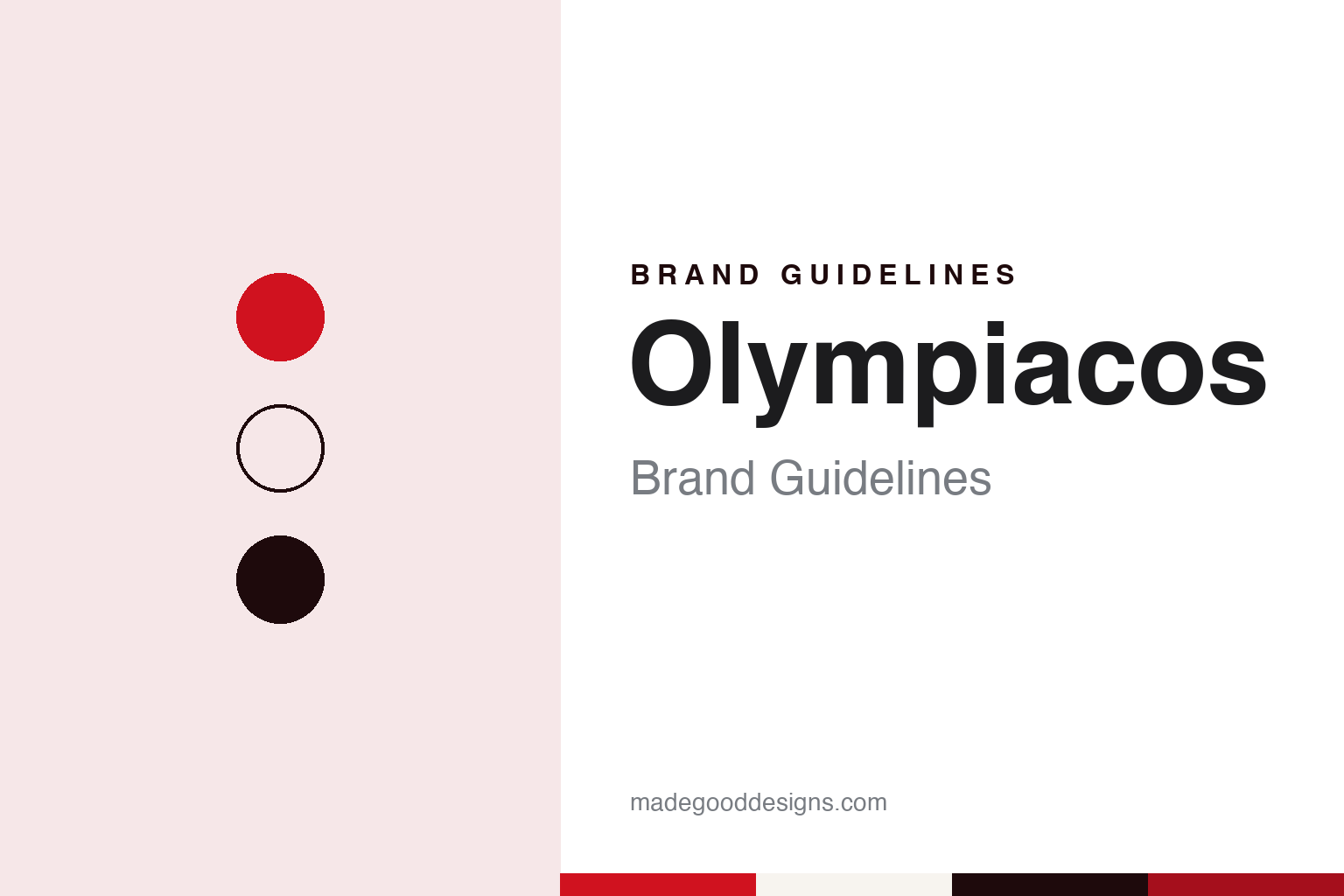
Two constants: a Piraeus red, marble white and ink palette and a classical inscription serif register. Abstract homage — not an Olympiacos product or mark; no crest, shirt or logo is reproduced.
Olympic Association of Piraeus
A name and an emblem taken from the ancient Games.
Olympiacos comes from Piraeus, the port city next to Athens. English Wikipedia says the club was founded on 16 May 1924 and officially recognised on 10 March 1925, after members of two Piraeus clubs, described as the Piraeus football club and the Piraeus fans’ club, met and agreed to dissolve both and form a single new one.
The name was proposed by a naval officer. Wikipedia says Notis Kamperos, a senior officer of the Hellenic Navy, suggested Olympiacos, and that he later said he had wanted a name that would signify strength, athletic power, ethics, fair competition and the Olympic ideal. A Piraeus industrialist, Michalis Manouskos, extended it to the full form, Olympiacos Syndesmos Filathlon Pireos, which Wikipedia translates as the Olympic Association of Friends of Sport of Piraeus. The football team is now one part of the multi-sport club Olympiacos CFP, and in English it is often called Olympiacos Piraeus.
The founding statutes, as quoted by Wikipedia, set out both the purpose and the image of the new club. They described the aim as the advancement of physical education among the youth and the cultivation of a love of athletics, and they specified that the club’s seal would show the head of a laurel-crowned youth, with the club’s name written around it. That instruction is the origin of the crest.
A family shaped the early club. Wikipedia names the Andrianopoulos brothers, Yiannis, Dinos, Giorgos, Vassilis and Leonidas, from a family of Piraeus merchants, as central to its founding and its first teams, alongside other founding members including a post office director, a merchant, an army officer, an attorney, a notary and a stockbroker. Wikipedia says the Greek press began calling the team Thrylos, Greek for “Legend”, in the late 1920s, and the nickname is still used. The club’s centenary was marked in March 2025 with events at its stadium and around Piraeus, Wikipedia says.
Colour
A laurel wreath, red for passion and white for virtue.
The crest is a portrait. Wikipedia says that, on Notis Kamperos’s proposal, the club adopted the laurel-crowned adolescent as its emblem, a figure representing a winner at the ancient Olympic Games, and that the crest has undergone only minor changes over the years. The name and the emblem were meant to be read together: Wikipedia says both were inspired by the ancient Games and by the ideals of fair play and sportsmanship associated with them.
The colours are red and white. Wikipedia says red and white were chosen as the colours of the crest, red for passion and victory and white for virtue and purity. In its account of the founding years, Wikipedia adds that, according to historians of the period, it was Yiannis Andrianopoulos who chose them, red symbolising the passion for victory and white purity and noble rivalry.
The kit follows the crest. Wikipedia describes the typical Olympiacos kit as a shirt with red and white vertical stripes, worn with red or white shorts and socks, and says the stripes have varied over time between thin and wide. Other regular kits are all red and all white, and among the away and third kits Wikipedia singles out black and silver. Wikipedia says the club has had a named kit manufacturer since 1979, when Greek football turned professional, and a shirt sponsor since 1982.
Supporters use the colours as shorthand. Wikipedia’s own text refers to the team as the Red-Whites and the Reds, alongside Thrylos.
Typography
Design and documentation.
Many football club identities are assembled from a handful of borrowed symbols, and each one sets a different design problem. A national flag placed inside a crest brings a fixed set of colours and shapes with it, such as a star, a crescent or a cross, and the designer has to fit the club’s own colours around them without the two schemes fighting at small sizes.
Laurel wreaths come from classical imagery and frame a figure or a set of initials. They read well when embroidered on a shirt, but their fine leaves tend to fill in on a phone screen, so a simplified outline is often drawn for digital use. Animal emblems, from birds of prey to lions, give a club a nickname and a mascot as well as a mark, and the same animal may exist as a detailed drawing, a flat silhouette and a matchday costume.
Two-colour kits are durable brand assets in sport, because stripes or halves in a fixed pair of colours can be recognised from the top of a stand long before any badge is legible. Stadium names add another layer: a ground named after a person or a district carries its own lettering on gates, roofs and tickets, and that signage becomes part of how the club is pictured.
Aa
A classical inscription serif — the register of a name carved around a seal. (Specimen set in Cinzel, a serif STAND-IN; NOT the Olympiacos logo.)
Olympiacos
An Olympic velodrome, a general’s name and a new plan.
The club’s ground is older than the club. English Wikipedia says the stadium at Neo Faliro in Piraeus was built in 1895 as the Neo Phaliron Velodrome, to host the cycling events of the 1896 Summer Olympics in Athens, and that Olympiacos has used it since its foundation. In 1964 it was renovated and given its present name, after Georgios Karaiskakis, a military commander of the Greek War of Independence.
The club has also played elsewhere. Wikipedia says Olympiacos moved its home matches to the new Athens Olympic Stadium from 1984 to 1989 and again from 1997 to 2002, and played at the Georgios Kamaras Stadium in Rizoupoli from 2002 to 2004 while the Olympic Stadium was renovated for the 2004 Games.
The present Karaiskakis Stadium dates from 2004. Wikipedia says that in 2003 its use passed to Olympiacos so that a football-only ground could be built for the football tournament of the 2004 Olympics, that the old stadium was demolished in spring 2003, and that the new one was completed on 30 June 2004. Under the agreement, Olympiacos received exclusive use of the stadium until 2052. The ground also houses the club’s museum.
Ownership has changed hands twice in recent decades. Wikipedia says Sokratis Kokkalis became majority shareholder and president in 1993, and that Evangelos Marinakis, a shipowner, bought the club from him in 2010; Marinakis has owned it since. On 2 July 2026 Marinakis presented plans for a rebuilt stadium at the Municipal Theatre of Piraeus. MondoStadia, reporting on 3 July 2026, and StadiumDB, in July 2026, said the project, called Neo Karaiskaki, would be financed by Olympiacos and by Marinakis personally, and StadiumDB wrote that the club says it will include more than 10,000 square metres of LED displays.
For a design guide, Olympiacos shows how a single classical figure can serve as a club’s mark for a century: a laurel-crowned youth written into the 1925 statutes, framed by the club name and set against red and white stripes. Compare it with the Olympic Games, whose ancient ideals gave the club its name, and Benfica, another club dressed in red and white. For this guide we use Piraeus red, marble white and ink with a serif, an unofficial interpretation; no product or logo is reproduced.
Explore & save
Keep Olympiacos’s identity on hand — save it to a board in the Made Good inspiration library.
Olympiacos identity set
Pin the Olympiacos Piraeus red, marble white and ink palette and the classical inscription serif register to your own board.