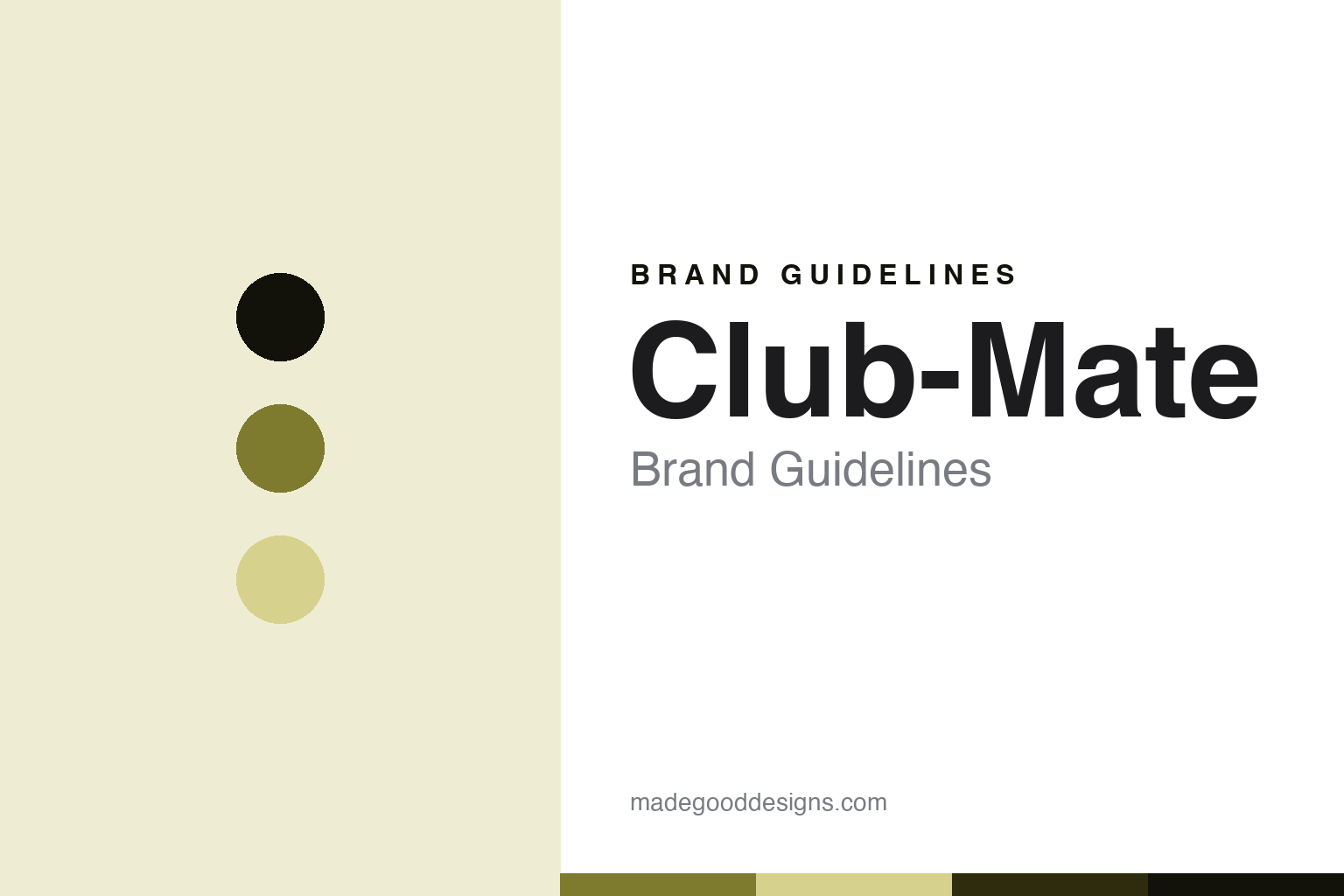
Club-Mate Brand Guidelines
The hacker’s mate.
Aa
Two constants: a mate-olive palette and a subculture-sans register. Abstract homage — not a Club-Mate product or mark.
The hacker’s mate
Club-Mate is the Bavarian yerba-mate soft drink — and the subcultural icon of hacker culture.
Club-Mate brings the round its subculture — the caffeinated, yerba-mate-based soft drink from Bavaria, in its distinctive glass bottle, that became the unofficial fuel of European hacker culture, the Chaos Computer Club and the tech and techno scenes. Club-Mate makes a mate soft drink, and its answer to a round about the new drinks aisle is a subcultural icon: low sugar, high caffeine, and a bottle that means something in a scene. A brand, of the scene.
Its identity is the hacker’s mate. Club-Mate’s yerba-mate formula, its Bavarian making and its subcultural icon status are the story here. A brand, subcultural. The hacker’s mate.
(Honest notes, so the story stays precise. Club-Mate — at club-mate.de, made by Brauerei Loscher — is a caffeinated, carbonated yerba-mate-extract soft drink, low in sugar and high in caffeine, sold in a distinctive half-litre glass bottle, with variants including a Cola, a spiced Winter Edition, a higher-caffeine Kraftstoff, and Granat, Zero and berry editions. On its history, it originated in 1924 as a drink called Sekt-Bronte, and the name and rise of Club-Mate came under Brauerei Loscher, which acquired it in 1994; the exact renaming is disputed, with some sources dating the Club-Mate name to the 1950s, so we frame it as originated 1924 as Sekt-Bronte, with the Club-Mate name and its rise under Loscher from 1994. On ownership, it is made by the independent German brewery Brauerei Loscher, family-owned being plausible but not hard-confirmed. It is made in Münchsteinach, in Bavaria, with the brewery’s own well water. On culture — a theme here — it is a genuine subcultural icon, prominent in hacker culture, tied to the Chaos Computer Club and spread through European tech, startup, hackerspace, festival and techno scenes, the archetypal hacker fuel, and its retro bottle is a subcultural design icon. Yerba mate is South American in origin, which we reference respectfully. Its name and retro bottle are IP we describe but do not reproduce; there is no official brand hex; these tones are an unofficial interpretation. This is design commentary.)
Colour
Club-Mate lives in a mate olive. Click a swatch to copy the hex.
Club-Mate’s identity is Bavarian, subcultural and mate-toned — a mate olive, an ink, a straw, a deep olive, and a paper. The palette leans mate olive and straw: a muted, retro register that nods to a yerba-mate brew and a retro glass bottle rather than a loud palette. It signals a subcultural icon. The honest caveat: with no published brand hex, these values are an original, unofficial interpretation, not first-party colours.
The lesson is a mate olive signals a Bavarian, subcultural identity. Club-Mate’s world is a retro, made object. For designers, it is a reminder that a mate olive and a soft straw can carry a drink brand — the tone of a yerba-mate brew. Because these tones can fail as small text, keep type dark and let the colour live in the accents, palette and band. The takeaways: earn a subculture; keep a retro bottle; be honest about a disputed history; and treat any single hex as unofficial.
Typography
The register is a subculture sans — Bavarian, retro, plain.
Club-Mate’s identity carries a Bavarian, retro, plain spirit — a subcultural mate, not a fashion. A subculture sans captures the mood: plain, retro and confident, the register of a scene’s drink. Set in a mate-olive palette, the subculture sans feels Bavarian and retro — exactly the personality Club-Mate carries. It is a subculture rather than a logo, mirroring glass and mate. (Club-Mate’s real retro bottle is a thing we describe but do not reproduce, and the exact typeface is not ours to use.) Because it is not ours to use, the honest description is “a subculture-sans spirit,” shown here in a stand-in. The type behaves like the brand: Bavarian, retro and plain.
Aa
A subculture-sans spirit — Bavarian and retro. (Specimen set in Libre Franklin, a subculture-sans STAND-IN; NOT the Club-Mate logo.)
The new drinks aisle
Club-Mate stands for the hacker’s mate.
Club-Mate brings the round its subculture. A mate-olive palette, a subculture sans and a retro bottle make one thing — the hacker’s mate — the whole identity: Bavarian, subcultural and mate-toned. The subcultural icon status is the meaning, and the retro bottle is the design. The point is a Bavarian yerba-mate soft drink that became the unofficial fuel of European hacker culture.
Put to work, the identity is a subculture told straight, as design. A maker in this spirit would earn a subculture, keep a retro bottle, and be honest about a disputed history. A reader in this spirit would keep the facts right: Club-Mate is a caffeinated yerba-mate soft drink made by Brauerei Loscher; it originated in 1924 as Sekt-Bronte, with the Club-Mate name and rise under Loscher from 1994, a renaming date that is disputed; it is made in Münchsteinach, in Bavaria; and it is a subcultural icon of hacker culture and the Chaos Computer Club. Club-Mate sits in the round’s design-object thread with Jarritos and United Sodas, and its mate joins Guayakí, the two yerba-mate drinks. The honest editorial moves are to frame the 1924 origin and the disputed 1994 renaming, to say made in Münchsteinach, to say independent brewery not family-owned as fact, and to reference the South American mate origin. The lesson Club-Mate teaches is that a subculture can be a whole identity, and honesty about the disputed history keeps it credible.
For designers and brand-builders, Club-Mate continues the new drinks aisle: earn a subculture — and keep a retro bottle. The lessons: become a scene’s drink; keep an iconic retro format; frame a disputed history honestly; credit an ingredient’s origin; and never reproduce a bottle. It is also a reminder to stay precise: Club-Mate is the Bavarian yerba-mate soft drink and subcultural icon of hacker culture — with the palette here an unofficial interpretation. Read that way, Club-Mate is less a drink than a scene: a Bavarian mate in a hacker’s hand. The lesson for a brand is that a subculture and an honest history reinforce each other, and framing the 1924 origin keeps the story earned. Club-Mate made the-hackers-mate the identity — proof that a subculture can define a brand.
Explore & save
Keep Club-Mate’s identity on hand — save it to a board in the Made Good inspiration library.
Club-Mate identity set
Pin the mate-olive palette and the subculture-sans register to your own board.