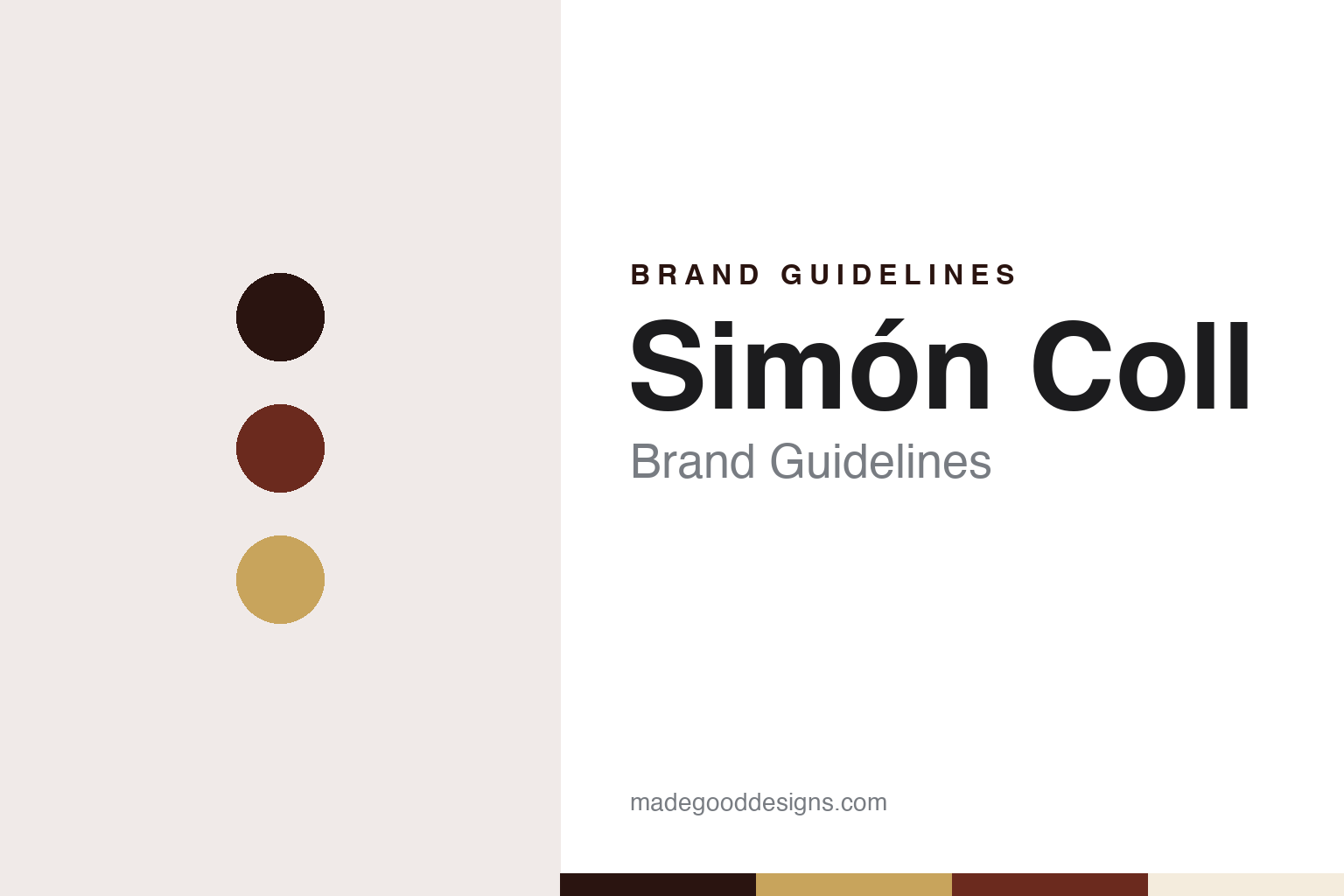
Simón Coll Brand Guidelines
The Sant Sadurní family chocolate maker since 1840, and keeper of Chocolate Amatller.
Aa
Two constants: a Simón Coll roasted-cocoa, cellar-red and tin-gold palette and a modernista display serif register. Abstract homage — not a Simón Coll or Chocolate Amatller product or mark; no bar, tin, poster, logo or photograph is reproduced.
From the cava town
A chocolate workshop in Sant Sadurní d’Anoia.
Simón Coll is a family chocolate maker in Sant Sadurní d’Anoia, a town west of Barcelona that is also home to the Codorníu cava cellars. The company dates itself to 1840, and Spanish Wikipedia gives the same year, describing Chocolates Simón Coll as a Sant Sadurní company “founded 1840”. The trading company named on its website today is Chocolates Simón Coll, S.A.
The name on the wrapper is not quite the founder’s. In the company’s own timeline, the business was started by Simón Mestres, “the son of winemakers”, who began making chocolate to his own formulas, which it says became the main attraction for the customers of Casa Simón. It says the business passed to Miquel Mestres, that the first packaging selling chocolate under the Simón brand appeared in that period, and that about three decades later a mechanised production line was set up in a space next to the workshop — the point at which, in its words, “we begin to talk about the first chocolate factory.”
The Coll name enters the company’s timeline in the period from 1950 to 1970 with Miquel Coll, whom it describes as a pastry chef as well as a chocolatier. It says this was when the firm first advertised in the media, with radio advertisements and sticker albums, and built a sales network across Spain. His son Xavier Coll, whom the company calls the fifth generation, brought Chocolate Amatller into the company in 1972, it says, and the company names Maria Coll, of the sixth generation, as its current chief executive. La Vanguardia reported in 2012 that she had joined the family business about ten years earlier, after working at Henkel and Danone, and was then in charge of sales and marketing.
The sources we checked record no sale of the company outside the family; it describes itself as having been run by six family generations since 1840.
Colour
Seasonal figures, bars and its own beans.
For much of its modern history Simón Coll has been a seasonal business. The company says that in 1982 it chose to set itself apart from competitors by moving into chocolates for Christmas and Easter, and that this, with export sales, put it among the better-known chocolate makers in Europe — its own description. In 2012 La Vanguardia described it as a specialist in Easter monas and seasonal novelties: chocolate umbrellas, coins and the small chocolates that the Catalan Christmas log, the tió, “gives” to children, as well as eggs and rabbits for Easter. Maria Coll told the paper that the firm had mechanised in the 1980s and specialised in products for children, and that half its sales came at Christmas.
The same 2012 article gave a rare set of figures. It reported turnover of €12.7 million in 2011, up 6% on the previous year, about a hundred employees, and exports of around a fifth of production. Bars, bonbons and drinking chocolate accounted for about €3 million, Easter for about €2 million and the Amatller brand for about €1.4 million; bars were then sold mainly through pastry shops and bakeries, alongside couverture for professionals. The figures are from 2011 and we have not found more recent ones in the sources checked.
The company makes its chocolate from the bean. Maria Coll told La Vanguardia that Simón Coll was one of very few makers that still made its own chocolate: “we buy the cocoa bean and roast it.” The company’s website describes a process that starts with choosing the origin of the cocoa, checks a sample of each batch when beans reach the factory, and roasts them at 100 to 120 degrees for 20 to 30 minutes. It says the entire range is made locally on its two production lines in Sant Sadurní d’Anoia, and that one of its factories runs on its own renewable energy. Its quality policy, dated April 2024, says it manages food safety to the FSSC 22000 standard.
Since 2018, the company says, the original workshop site has housed a small research-and-development factory it calls Bean-to-Bar, together with a tasting room and a remodelled Casa Simón chocolate shop.
Typography
Six countries, seven makers.
The seven brands in this group all make chocolate, and they come from six countries on four continents: Ganong and Chocolats Favoris from Canada, Abuelita from Mexico, La Ibérica from Peru, Glico from Japan, Orion from the Czech Republic and Simón Coll from Spain. Read together, they show how differently a chocolate name can be built, kept and presented from one market to the next.
A chocolate brand can belong to the family that started it or to a group that bought it later, and the name on the wrapper and the company that owns it are not always the same thing. It can be known for bars and boxed chocolates, for a drink or for a seasonal novelty, and its packaging can draw on very different local traditions. Each guide looks at how one brand’s own history shows up in what it puts on the shelf.
Each guide also separates what independent sources record from what the company says about itself — who founded it, who owns it now, where its cocoa comes from and where its chocolate is made — and marks plainly what rests only on the company’s own word.
Aa
A modernista display serif — poster lettering, tins and gold. (Specimen set in Playfair Display, a serif STAND-IN; NOT the Simón Coll or Chocolate Amatller logo.)
Simón Coll & Amatller
A family firm that bought Barcelona’s oldest chocolate name.
Much of the design interest around Simón Coll comes from the brand it bought. Chocolate Amatller was founded in Barcelona in 1797 by Gabriel Amatller, according to Spanish Wikipedia and the company, and grew under his grandson Antoni Amatller, the chocolate maker for whom Josep Puig i Cadafalch remodelled the Casa Amatller on Passeig de Gràcia. Spanish Wikipedia says the firm was a pioneer of advertising in Spain, commissioning modernista posters from Alfons Mucha, running a poster competition in 1914 and putting collectible picture cards by artists such as Apel·les Mestres and Alexandre de Riquer in its bars. After Teresa Amatller died without heirs in 1960, it says, the business changed hands several times and was close to disappearing when Simón Coll bought it in 1972; the Amatller factories closed, but the brand was kept. La Vanguardia called it the oldest chocolate brand in Barcelona and probably the oldest still trading in Europe, attributing the second claim to others.
Simón Coll relaunched the brand for gourmet buyers. The company says it moved Amatller towards adult and gourmet tastes from 2007, “recovering its authentic designs”, and La Vanguardia reported in 2012 that the Mucha posters made for the brand’s centenary were being used again to decorate its wrappers and metal tins. The company says it opened a Casa Amatller shop at Passeig de Gràcia 41 in 2014 and later a second Amatller shop next to La Pedrera.
In Sant Sadurní the company runs the Espai Xocolata Simón Coll, which it calls a visitor centre and dates to 2012, with tours on the history of cocoa, how chocolate is made and how to taste it. Catalan Wikipedia lists it among the town’s sights, alongside the Codorníu cellars.
For a design guide, Simón Coll shows two identities under one roof: a family name built on seasonal novelties, and a 1797 Barcelona brand whose modernista poster archive does the work of a brand book. Compare Blanxart, another Barcelona-area chocolate maker, and Valor, a Spanish family chocolate maker from Villajoyosa. For this guide we use roasted cocoa, cellar red and tin gold with a display serif, an unofficial interpretation; no product or logo is reproduced.
Explore & save
Keep Simón Coll’s identity on hand — save it to a board in the Made Good inspiration library.
Simón Coll identity set
Pin the Simón Coll roasted-cocoa, cellar-red and tin-gold palette and the modernista display serif register to your own board.