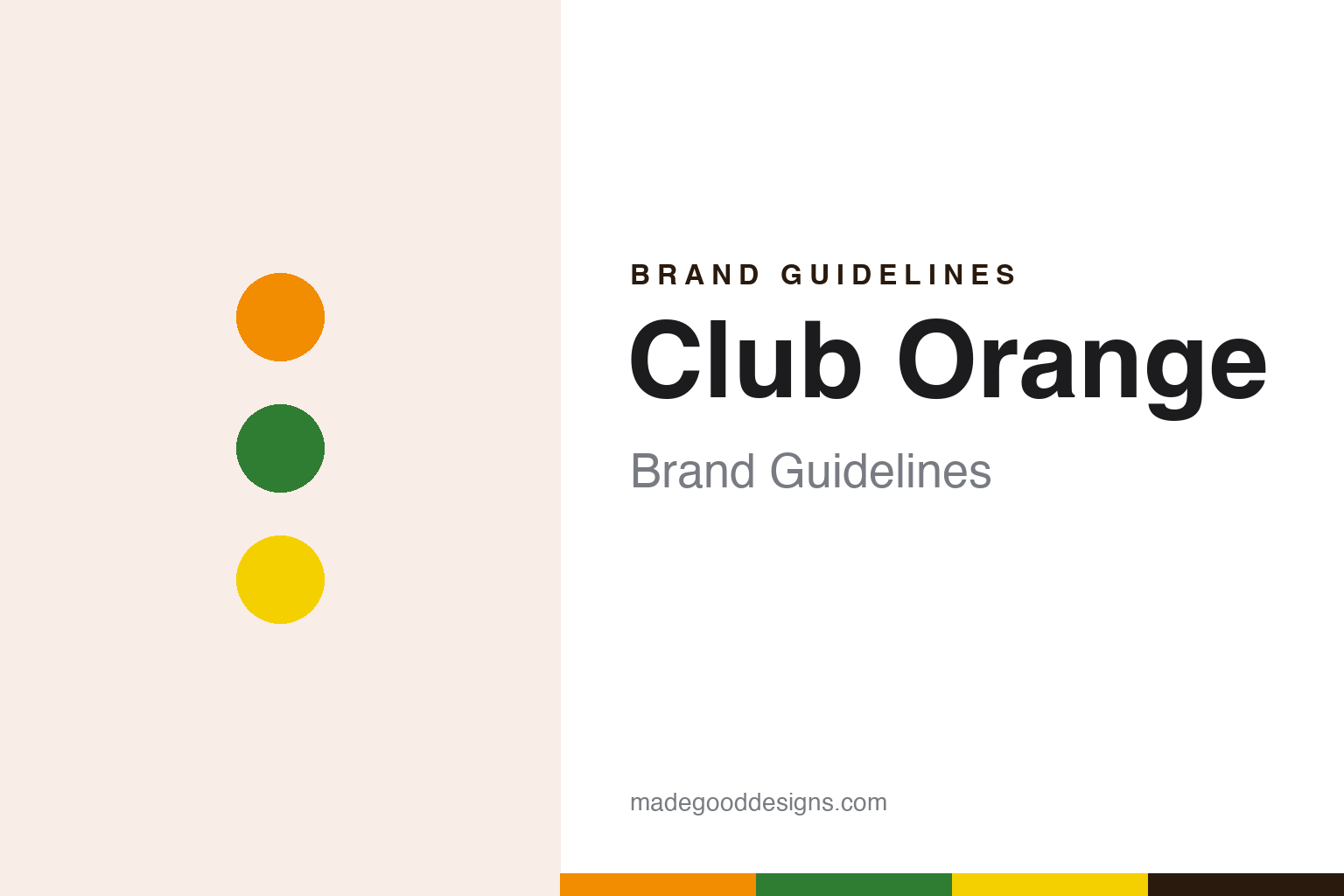
Club Orange Brand Guidelines
The Dublin orange drink built on its bits.
Aa
Two constants: a Club orange, leaf green and lemon yellow palette and a rounded bold sans register. Abstract homage — not a Club product or mark; no bottle, can or logo is reproduced.
A drink for the Kildare Street Club
A gentlemen’s club, a commission and a whole orange.
Club began in Dublin as a commission. Its maker, Cantrell & Cochrane, better known as C&C, traced its own roots to a shop selling soft drinks that Dr Thomas Cantrell opened in Belfast in 1852; he went into partnership with Alderman Henry Cochrane in Dublin in 1868 (English Wikipedia, citing the Beverage Council of Ireland). The drink’s name comes from the Kildare Street Club, the Dublin gentlemen’s club. The brand’s website said in 2010 that the club commissioned C&C to create an orange drink bearing its name, later shortened to “Club.” The current site tells it a little differently: the C&C “boss man” named the drink after his favourite haunt, the Kildare Club, and brought in a drinks-maker, Oliver Grace, to create something more special than anything else on the market, which Grace did by using the whole fruit.
Dates for the launch vary within the brand’s own material. The current Club website gives 1930 as the year “the bits are born” and says wartime rationing kept Club off the shelves in 1945. The 2010 version of the site said the drink was released just before the Second World War and came back on the market in 1945, and the Love Irish Food campaign, of which Club was a member, said in the early 2010s that Club had been bringing its fruit bits to Irish families since 1945. C&C’s English Wikipedia entry, citing Britvic, places its development in the 1930s. The 2010 site also called Club Orange the first orange fruit juice drink on the Irish market, a claim made by the brand itself.
The range grew around the orange. Club Lemon followed in 1960, according to the 2010 site and English Wikipedia, or in 1952, according to the brand’s current timeline. Club Rock Shandy, a non-alcoholic mix of orange and lemon, has two origin stories from the same company. The 2010 site said it was named after a group of swimmers from Blackrock, among them a former managing director of C&C, whose favourite drink mixed the two; today’s timeline credits staff at O’Rourke’s with the mix in 1960, and the brand’s FAQ says the name comes from Blackrock, in Dublin, where it was first made. By 2010 the site counted eleven Club drinks, including mixers such as soda water, tonic and ginger ale.
Colour
Bits, a big O and the best bits in the world.
Club’s identity rests on its bits, the pieces of fruit that stay in the glass. The brand says they are made from “100% orange” and that it uses the whole fruit rather than only squeezing out the juice. Its advertising has circled the same idea for decades. The brand’s timeline dates its first television advertisement to 1981, with the line “Let the Big O Flow,” and lists an earlier advert in 1965 prompted by counterfeit Club, six-packs in 1976 and a can in 1980. English Wikipedia records an older slogan, “the bits inside make it come alive,” then “Some bits are crucial” from 2009 and “The Best Bits in the World” from 2011; the brand’s timeline adds “Taste every refreshing bit” in 1997.
The 2011 campaign travelled furthest. Love Irish Food said the “Best Bits in the World” advertisement, released online in June 2011 and aimed at a new generation of drinkers, was ranked by YouTube as the top homegrown video ad of that year; the brand’s timeline remembers 2011 as the year “Mariana shows us the best bits in the world.” A decade earlier, in 2001, an advert had Tom Hickey telling viewers how Club is produced, an account the brand now cheerfully calls “not very accurate.” Later marketing kept the humour: in 2019 the brand launched a joke cryptocurrency called “Club Bitscoin,” and in 2021 it brought out a limited edition, Club Pat Frog.
The look has been refreshed more often than the idea. The brand’s timeline marks “a brand new facelift” in 2013 and another new look in 2021, when, it says, Club “looks different but still tastes unreal.” The current range, as listed on its website, takes in Club Orange, Club Lemon and Club Rock Shandy, Zero versions of each, starting with Club Zero Orange in 2015, Club Dark Stuff and an energy line, Club Loaded Energy. The company says its small 220ml glass bottles go mainly to pubs and bars, while its other bottles are plastic. Its website signs off with the line “Real Fruit. Real Club.”
Typography
Design and documentation.
The seven brands in this group are all food and drink names from the Netherlands and Ireland: Calvé, Duyvis, Chocomel, Unox, Odlums, Club Orange and Brennans. Dutch and Irish food and drink brands in general sit at many different points in the trade, from family firms that still carry a founder’s name to names that now belong to much larger food and drink groups, and a single brand can be sold everywhere from a corner shop to a supermarket shelf.
A food or drink brand’s identity is usually carried less by a single product than by a pack, a name and the meal, snack or drink it promises, because the company behind the name may have changed hands, moved its production or grown far beyond the place where it started. That makes the questions behind each name worth asking plainly: who started it, who owns it now, and where its products are actually made and packed.
Each guide separates what independent sources record from what the company says about itself — its founding story, its owners over time, where its products are made and how its packaging has changed — and marks plainly what rests only on the company’s own word.
Aa
A rounded bold sans for a drink built on its bits. (Specimen set in Baloo 2, a sans STAND-IN; NOT the Club logo.)
Club Orange
From C&C to Britvic to Carlsberg.
For most of its life Club belonged to C&C, which later became the listed drinks group C&C Group and concentrates on cider. In May 2007 C&C sold its soft-drinks and bottled-water division, Club included, to the British soft-drinks company Britvic. The Irish Times reported that C&C would now focus purely on alcohol, that the division had not been for sale, and that the group had received what it called a “compelling” offer; its chief executive, Maurice Pratt, pointed to the growth potential of its cider, spirits and liqueur brands. Britvic’s Irish business, Britvic Ireland, also took on brands such as Ballygowan water, Cidona and MiWadi, English Wikipedia says.
The next change came from Denmark. The Carlsberg Group announced its offer for Britvic in July 2024, and the UK Competition and Markets Authority cleared the deal that December. In January 2025 Carlsberg said it had completed the acquisition and combined Britvic with its UK beer business as Carlsberg Britvic; its announcement added that Britvic Ireland, led by its managing director Kevin Donnelly, was now part of the Carlsberg Group. Club’s website now points to Carlsberg’s sustainability programme, Brewing Tomorrow.
Club is still made in Ireland. The brand says it is “made and distributed in Ireland,” refers to “our Kylemore production facility,” and gives Britvic Ireland’s address at Kylemore Park West in Ballyfermot, Dublin; Love Irish Food likewise described it as manufactured in Dublin.
For a design guide, Club shows how one product detail, the bits, can carry a soft drink’s advertising for decades. Compare Tayto, the Dublin crisp brand, and Tuborg, a sister brand under Carlsberg. For this guide we use a Club orange, a leaf green and a lemon yellow with a rounded bold sans, an unofficial interpretation; no product or logo is reproduced.
Explore & save
Keep Club Orange’s identity on hand — save it to a board in the Made Good inspiration library.
Club Orange identity set
Pin the Club orange, leaf green and lemon yellow palette and the rounded bold sans register to your own board.