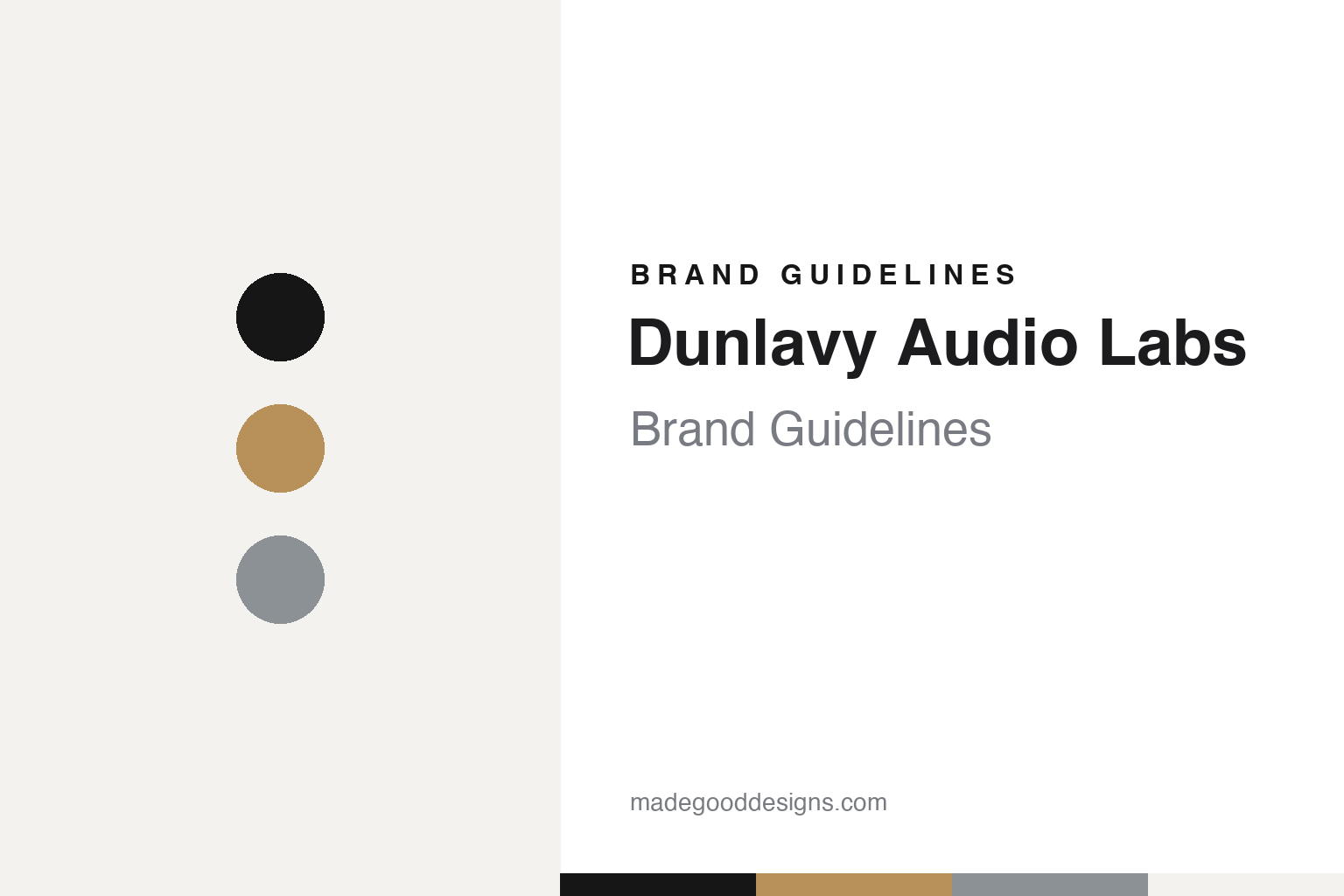
Dunlavy Audio Labs Brand Guidelines
The Colorado speaker maker that designed by measurement.
Aa
Two constants: a Dunlavy felt-black and oak palette and an Engineering sans register. Abstract homage — not a Dunlavy product or mark; no speaker, logo or nameplate is reproduced.
From antennas to speakers
John Dunlavy’s second career.
Dunlavy Audio Labs was the Colorado loudspeaker company of John Dunlavy, an engineer who came to hi-fi from antennas. Its 1999 website said it was “founded in Colorado Springs, Colorado in 1992” by Dunlavy, with “one simple goal — to design and manufacture the best high end loudspeakers and cables in the world.” Stereophile’s Robert Deutsch first saw its Signature Collection at the 1993 Summer Consumer Electronics Show in Chicago, and the magazine’s John Atkinson described Dunlavy as “Kansas-born.”
Dunlavy’s first career was in radio engineering. The company said he joined an Air Force research group in 1949 to develop wide-band antennas. English Wikipedia, citing a 1996 Stereophile interview, credits him with inventing the log-periodic antenna in 1952; the work was classified “Secret,” so, as he told Atkinson, “I didn’t get the credit!” He also said he held the patent on a cavity-backed spiral antenna designed for NASA’s ground stations in the Gemini programme, and the company said he had written books on antenna theory.
Audio came next. The company said he formed Duntech Labs in Texas in the early 1970s. He told Atkinson that, after playing string bass “two to three nights a week for nearly 22 years,” he moved to Australia in 1981, and English Wikipedia describes Duntech as an Australian loudspeaker maker he started there; it records that The New York Times praised a Duntech speaker’s “sheer musicality” in 1987. In 1994 Stereophile noted that Dunlavy kept part-ownership of Duntech but was no longer involved in its designs. Duntech is still active in Australia under its owner Kiat Low, English Wikipedia says.
Colour
Measurements first.
Dunlavy’s brand was measurement. Deutsch’s 1994 review opened with the company’s creed: “DAL firmly believes that a full set of credible measurements … can reliably predict the potential of a loudspeaker to accurately reproduce the complex sounds of music.” Dunlavy told Atkinson that he designed by watching a speaker’s step response while adjusting the crossover — “Listening comes later” — and argued for first-order crossovers, drivers time-aligned to within a few microseconds and sealed boxes without ports. Deutsch called him “probably the most outspoken exponent of the use of measurement in loudspeaker design.”
The speakers looked the part: tall, narrow columns with a symmetrical array — a tweeter in the centre, midrange drivers either side and woofers at top and bottom — set in felt to control diffraction, a method Dunlavy had patented, Stereophile said. The SC-IV, reviewed in 1994, stood six feet tall, weighed 180lb and cost $4,995 a pair, with Vifa tweeters and midranges modified at the factory and Morel woofers. It became Stereophile’s 1994 Loudspeaker of the Year and Product of the Year; the small SC-I was its Budget Component of the Year in 1995, and the 530lb SC-VI, at $24,995 a pair, its Loudspeaker of the Year in 1996. Deutsch bought his review pair of SC-IVs. A prototype shown at the 1998 CES as the Sigma, on an artificial granite base, became the SC-IV/A; without the granite, it replaced the SC-IV that August, Deutsch reported.
The range grew to include the SC-II, SC-III and SC-V, the Aletha, Athena and Cantata, centre channels and subwoofers, and the company sold its own speaker cables and interconnects. Its pitch was value: “We just don’t feel that it is necessary to have our products out-cost every other loudspeaker,” the 1999 site said. In 2002 it named Harris Audio Systems of Miami its first professional dealer, saying Dunlavy speakers “have been popular in mastering labs and recording studios for a number of years.”
Typography
Design and documentation.
The seven names here are loudspeaker brands sold in America. The oldest is Altec Lansing, formed on 1 May 1941, English Wikipedia says, when the theatre-sound firm Altec Service Company bought the nearly bankrupt Lansing Manufacturing Company. After many owners, the name now appears on Bluetooth speakers and headphones; its website does not say who owns it.
Infinity Systems was founded in Los Angeles in 1968 by Arnie Nudell, John Ulrick and Cary Christie and has belonged to Harman since 1983, according to English Wikipedia; Harman now belongs to Samsung. Snell Acoustics began in Newburyport, Massachusetts, in 1976, moved to Haverhill and then Peabody, and ceased manufacturing in May 2010, its website said. Dunlavy Audio Labs, the physicist John Dunlavy’s company in Colorado Springs, was listed by Stereophile in 2008 as no longer in existence.
Two are small current makers. Fritz Speakers is the Southern California workshop of John “Fritz” Heiler, who has built speakers since 1973, trade press reports. Philharmonic Audio, which says it now assembles its speakers in Vienna, Virginia, was launched by the crossover designer Dennis Murphy in 2012, by its own account, and relaunched in 2020 with Kenneth Lin, who the company says oversees production.
PureAudioProject is the exception: it sells in the United States but is not an American company. Its 2025 terms name PureAudioProject LTD of Ramat Gan, Israel, with an operating company in Paredes, Portugal; in 2018 Enjoy the Music described a US arm in Iowa City.
This guide sets out what can be checked about each brand — who founded it, who owns it, and what it says about where its products are made — and marks clearly what rests only on the company’s own word.
Aa
An engineering sans — measurements first. (Specimen set in IBM Plex Sans, a sans STAND-IN; NOT the Dunlavy logo.)
Dunlavy
A sale, then a short notice.
The end came quickly. A company press release dated December 10, 2001 said DAL, LLC had bought the assets of Dunlavy Audio Labs, Inc. on November 19 that year. The buyer was owned by Keny Whitright, who also owned Wybron, a stage-lighting maker next door in Colorado Springs. John Dunlavy was to stay on as principal engineer, saying the sale “allows me the freedom to work exclusively on R&D and new product design.” Less than a year later the website carried a short notice: “As of November 7, 2002, Dunlavy Audio Labs, LLC has ceased operations.” Stereophile’s online archive lists the company as no longer in existence.
We found no revival of the Dunlavy name in the sources we checked. The old web address, dunlavyaudio.com, later carried unrelated pages and now forwards to a parking page, and dunlavy.com belongs to an unrelated executive-search firm. Nor did we find colour or typeface rules; the palette here — the black of the felt, the oak of the review pair, the grey of a test chamber — is our own.
For a design guide, Dunlavy shows how an engineering argument can become a brand: the tall, felt-faced column was the measurement philosophy made visible. Compare Thiel and Vandersteen, both named alongside Dunlavy by Stereophile’s Atkinson in 1996 among the few makers whose speakers produced time-coherent impulse responses. For this guide we use felt black, oak and an anechoic grey with a sans, an unofficial interpretation; no product or logo is reproduced.
Explore & save
Keep Dunlavy Audio Labs’s identity on hand — save it to a board in the Made Good inspiration library.
Dunlavy identity set
Pin the Dunlavy felt-black and oak palette and the Engineering sans register to your own board.