Earth’s Best Brand Guidelines
Two brothers from natural-food shops, a concrete building in Middlebury and a jar of apple puree.
Aa
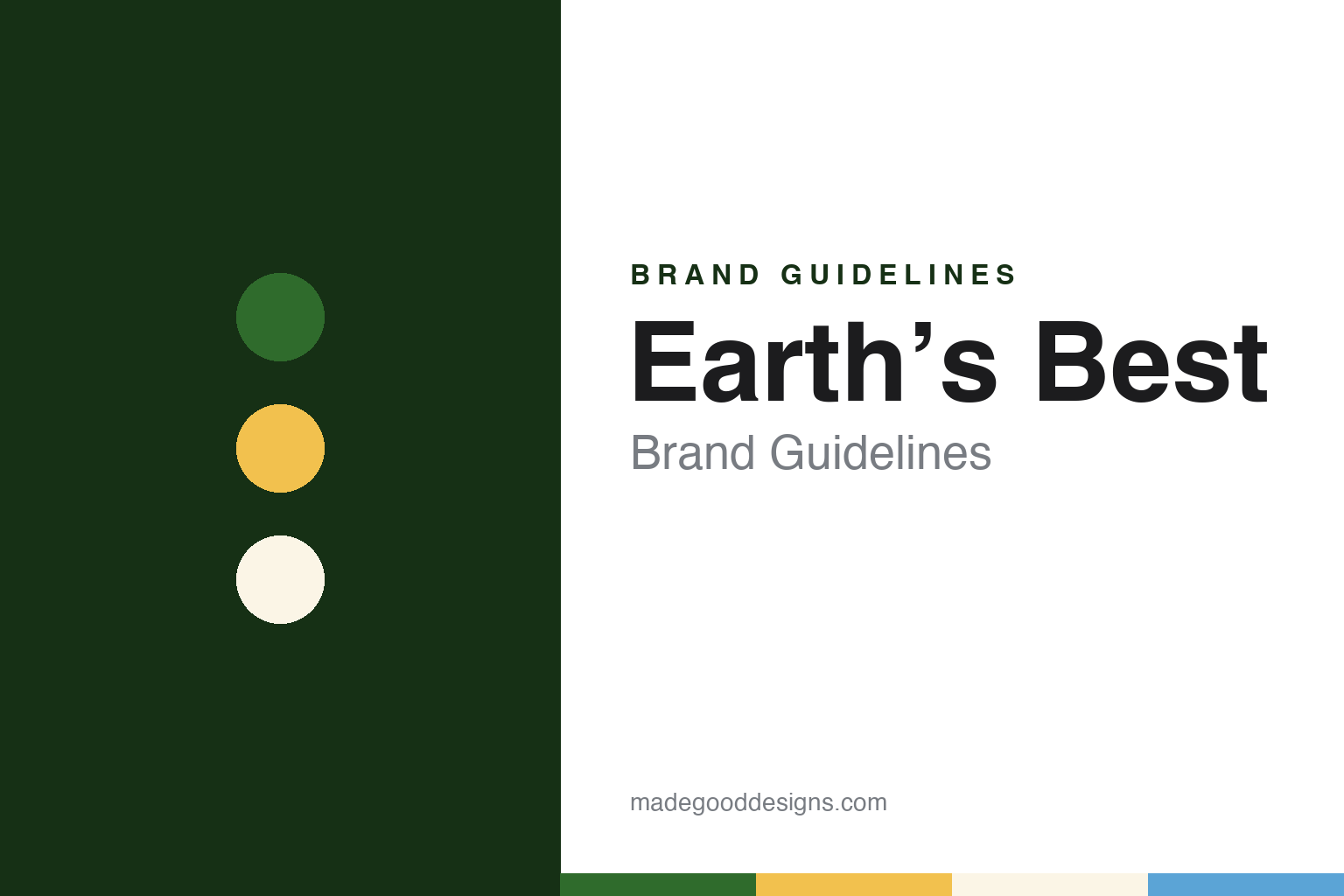
Two constants: a meadow green, sun yellow and oat cream palette and a rounded friendly sans register. Abstract homage — not an Earth’s Best product or mark; no jar, pouch, character or logo is reproduced.
Two clerks and an idea
Natural-food shops in upstate New York, a broom business in Burlington and a line in Middlebury.
Earth’s Best is an American brand of organic baby food, owned today by The Hain Celestial Group. It began with two brothers. The New York Times reported on 5 May 1996 that Ron and Arnie Koss, twin brothers, had moved from New York State to Vermont and developed an organic baby food for their own children. The idea, the paper said, came to them in the mid-1970s, while they were working as clerks in natural-food stores in upstate New York and noticed that the shelves of health merchandise for adults held nothing organic for babies.
The brothers took years to act on it. The Times said Ron managed a Ronald McDonald House in Burlington, Vermont, while Arnie ran a small company in the same town that made handmade brooms in the style of the old Shaker communities. Ron told the paper that he remembered reading Rachel Carson’s Silent Spring, and he described himself as an environmentalist. In 1984, the Times said, the brothers decided the time was right to revive the plan. Arnie sold his broom business, and a local businessman, Ray Pecor, backed an early bank loan, which paid for product research.
Raising enough to build a plant took longer. The Times described the brothers knocking on the doors of banks and private investors, and quoted Arnie Koss recalling that the pair “looked like a couple of curly haired flakes” but did not go away. In December 1987, in a small concrete building on Pond Lane in Middlebury, Vermont, with a view of the Green Mountains, the brothers watched the earliest jars of Earth’s Best come off the production line. “They were filled with organic apple puree,” Arnie Koss told the paper.
Dates for the beginning vary with the source. The Los Angeles Times reported on 20 September 1990 that Earth’s Best was founded in 1987 by brothers Ron and Arnie Koss and was based in Middlebury, and that its products came on the market in 1988, in natural food stores before regular grocery stores. The brand’s own website says that Earth’s Best began in 1985 as an organic baby food company based in Vermont, and its pages carry the line that it has been making food for little ones “since 1985.”
The early years were difficult. Within months of opening, the Times said, the company ran short of money and had to lay off the workers it had just hired while it searched for more financing. Arnie Koss explained the problem to the paper: perishable fruit such as blueberries and plums had to be bought a year ahead, in season, and frozen, and competition for space on grocery shelves was fierce. “Large amounts of money disappear quickly,” he said.
Colour
Venture capital, a move to Boulder, Heinz and then Hain.
The brothers kept the brand alive but not the company. In late 1989, The New York Times reported, they turned to venture-capital firms, and in return for the money gave up a controlling interest. The new majority holders included firms run by Gregory Peters, general partner of North Atlantic Venture Funds and the Venture Capital Fund, both of Burlington, along with other venture investors in the Northeast. Their conditions included Arnie Koss stepping down as president. Both brothers stayed on as executive vice presidents until mid-1990, the paper said, and then left the business.
Professional managers followed. In November 1991 the company hired Jay G. Shoemaker, a former president of Whitman’s Chocolates who had also worked at General Mills, as chief executive. In January 1992, the Times reported, he moved the headquarters from Middlebury to Boulder, Colorado, and in May of that year he closed the Middlebury factory and farmed out production to a company in California. New investors came in, including the investment arm of SunAmerica and the Oregon venture firm Orien Ventures.
A large food company had been watching. According to the Times, H. J. Heinz had considered a bid for Earth’s Best in 1991 and walked away, partly because it thought organic baby food might be a fad. Its view changed in 1995, when Brian Ruder became president of the retail division of Heinz U.S.A., with responsibility for baby food and ketchup. Ruder called Shoemaker within two weeks of his promotion, the paper said, and in March 1996 Heinz bought the company. The brothers told the Times that they would have preferred Earth’s Best to stay independent. Supermarket News, in a report by Barbara Murray on 24 May 1999, also dated the Heinz U.S.A. acquisition to 1996.
The Heinz years were short. Supermarket News reported that in April 1999 the brand moved from Heinz to Hain Food Group of Uniondale, New York. Irwin Simon, Hain’s president and chief executive, told the paper that “Earth’s Best got lost in the Heinz organization,” and said Hain planned to add more items under the same name for infants and toddlers. The paper described Earth’s Best on store shelves at that time as a jarred line with dry cereals, sold alongside conventional baby food.
Hain itself changed shape soon afterwards. English Wikipedia says the company was founded by Irwin D. Simon in 1993 as Hain Food Group, and that it took the name Hain Celestial Group after merging with the tea company Celestial Seasonings in 2000. The same article says Hain moved its headquarters to Hoboken, New Jersey, in 2023. The Hain Celestial Group has owned Earth’s Best since the 1999 move; its website lists the brand among its American and British brands, and the Earth’s Best website carries a 2026 copyright notice in Hain Celestial’s name.
Typography
Design and documentation.
The brands in this group sit in three corners of the freezer and the baby-food shelf: bagged frozen vegetables, pints and tubs of ice cream and gelato, and food for babies sold in jars and squeeze pouches. Each of those formats asks a lot of a small surface. A frozen bag is read through frost and at a glance from an open case; an ice-cream pint is turned in the hand, its lid seen from above; a jar or pouch is bought by a parent who wants to know quickly what is inside.
Names in these categories have often started with a family, a farm or a single shop and later passed to larger food companies, sometimes more than once. A label can therefore outlast several owners, and the place on the front of a pack is not always the place where the food is now grown, churned or packed.
Each guide separates what independent, dated sources record from what the company says about itself — who started the brand, who owns it now, where its food is made and how its packs and logos have changed — and marks plainly what rests on the company’s own word.
Aa
A rounded, friendly display sans — the soft, playful register of a jar or snack box made for small hands. (Specimen set in Fredoka, a rounded display STAND-IN; NOT the Earth’s Best logo.)
A name, a jar and a slogan
Apple jars in California, a Heinz plan for the name and Sesame Street on the box.
The name was the brand’s early asset. When the Los Angeles Times wrote about Earth’s Best in September 1990, it described the brand as a line of organic products for babies and listed its apple items: plain apples, apples mixed with plums, bananas, blueberries or apricots, and apple juice and an apple-grape blend. The paper said the brand had entered the Los Angeles market that year, carried by Vons and then by Ralphs, Hughes, Alpha Beta and natural-food shops, and it suggested the jars of fruit for adults’ packed lunches as well.
Heinz saw the name as something it could stretch. The New York Times reported in May 1996 that Brian Ruder, the Heinz executive then in charge of Earth’s Best, hoped to extend the name from baby food to adult soups and sauces and perhaps to accessories such as pacifiers and baby bottles, all “made in an environmentally sensitive way.” He told the paper that the trademark had come to work like a seal of approval for parents.
Today’s Earth’s Best website uses the registered slogan “Good food made fun”, and describes its approach through “shapes, colors, flavors, characters, activities, ideas and imagination.” Its range runs from purees and finger foods to toddler snacks and infant formula, and several products carry the characters of Sesame Street; the website notes that those characters, trademarks and design elements are owned by Sesame Workshop and used under licence. The company says it works with growers committed to sustainable farming practices, and it describes its brand story under the heading “30 years of organic.”
The brand has had more than one home. The company’s own account ties it to Vermont, where the brothers began; the New York Times account places the early headquarters in Middlebury, then in Boulder, with production handed to a California contractor from 1992.
For a design guide, Earth’s Best shows how a plain, idealistic name chosen by two founders can carry through venture investors, Heinz and Hain while its voice moves from the founders’ idealism to the registered slogan “Good food made fun.” Compare it with Gerber, the baby-food maker that competed with it in the 1990s, and Horizon Organic, another organic brand from Boulder, Colorado, where Earth’s Best kept its headquarters in the 1990s. For this guide we use meadow green, sun yellow, oat cream and Vermont sky blue with a rounded sans, an unofficial interpretation; no product or logo is reproduced.
Explore & save
Keep Earth’s Best’s identity on hand — save it to a board in the Made Good inspiration library.
Earth’s Best identity set
Pin the Earth’s Best meadow green, sun yellow and oat cream palette and the rounded friendly sans register to your own board.