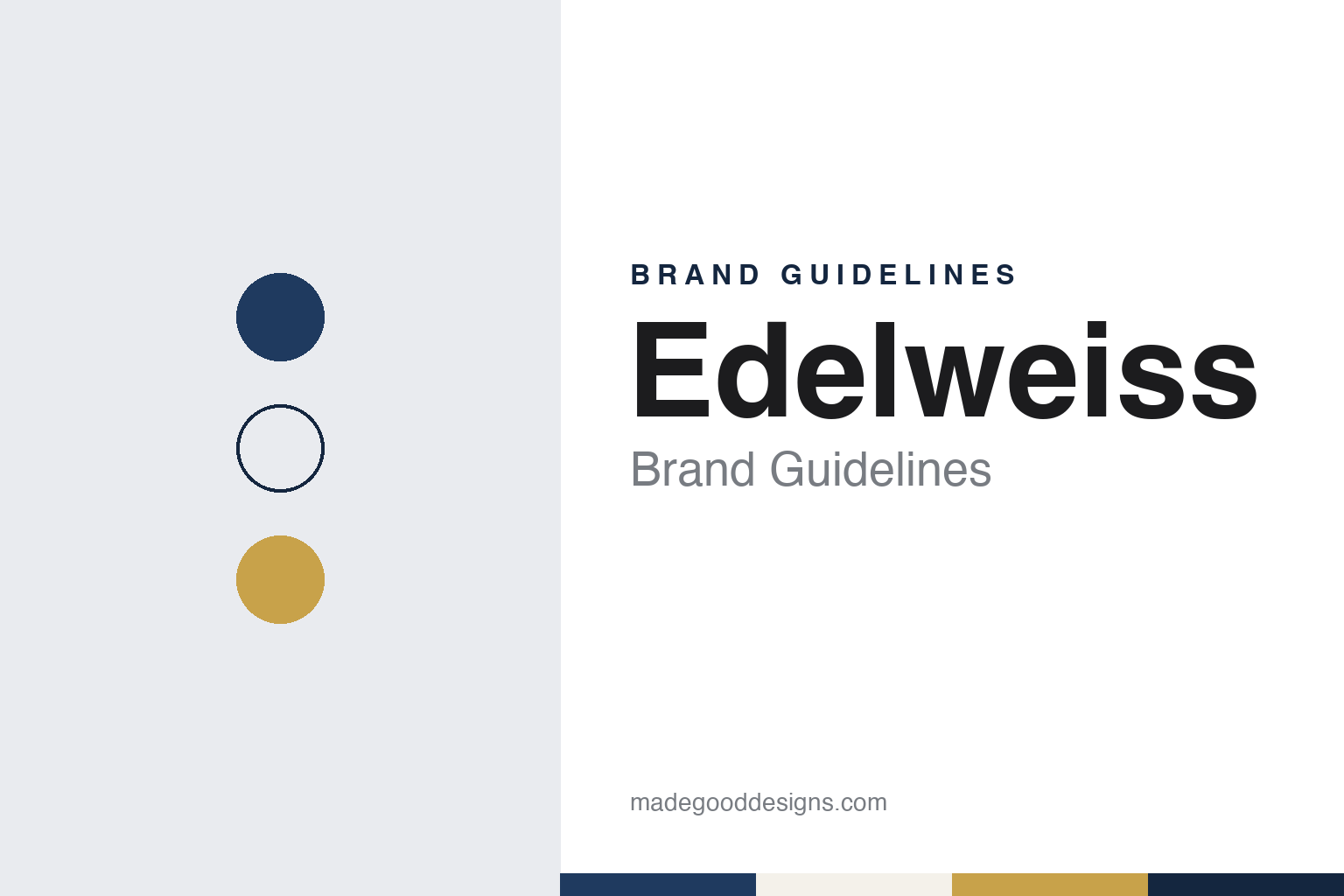
Edelweiss Brand Guidelines
The Austrian rope name that became part of a French rope family.
Aa
Two constants: an Edelweiss navy, white and gold palette and an Alpine sans register. Abstract homage — not an Edelweiss product or mark; no rope, logo or label is reproduced.
An Austrian rope
A rope name with an Austrian past.
Edelweiss is a climbing-rope brand named after the white Alpine flower, and its story starts in Austria. On the history page of its website, the company says the first rope that it counts as the ancestor of today’s Edelweiss ropes was made in Austria in 1790, at a time when mountaineering as a sport had barely begun and the first ascent of Mont Blanc was recent news. That date is the company’s own account, and it presents the rope as a beginning rather than as a climbing product in the modern sense.
The company’s second milestone is more specific. Edelweiss says that in 1953 it launched a “core-enclosed” rope: a rope with a separate inner core wrapped in a braided outer sheath, the construction known in English as kernmantle. It says the design was more resistant to abrasion and much more durable than what came before, and that the same principle now underlies every climbing rope, dynamic or static.
That claim sits alongside another one. The two brands therefore put their names to the same invention in the same year, and the sources do not settle it.
Colour
Ropes for alpinism, sport and work.
Edelweiss has been on the web for a long time. The Internet Archive holds copies of edelweiss-ropes.com from 2001, when the site opened in German, with links to English and French versions. Its pages that year were organised around alpine climbing ropes, sport climbing ropes, static ropes, canyoning ropes, harnesses, via ferrata sets and accessories, the same broad territory its range covers today.
By 2009 the archived site had separate sections in German, English, French, Spanish and Italian, a sign of how widely the ropes were sold across Europe before and after the change of owner.
The current site, in French and English, divides the range into two families, Pro and Sport, each with its own catalogue: the first for professional work at height, the second for climbing and mountaineering. The company describes its approach as product development handled in-house, “from design to finished product,” and says it combines parameters and materials to make a rope for each application. It also says its ropes are tested against the standards that govern climbing equipment, and that it aims to go beyond them.
Its own history page ends on a line it puts in quotation marks, “I can rely on my EDELWEISS rope,” and the brand writes its name in capitals throughout its text, which is one of the few consistent visual cues in its own copy.
Typography
Design and documentation.
The seven brands in this group all make equipment or clothing for climbing: Evolv, Mad Rock, Edelweiss, So iLL, E9, Red Chili and AustriAlpin. They cover shoes, ropes, holds, apparel and metal hardware such as carabiners and buckles, and they range from small founder-led workshops to names that now sit inside larger outdoor companies.
A climbing brand’s identity is usually carried by a logo stamped on a shoe heel, printed on a rope bag or engraved into a piece of metal, more than by any single advertisement. The company behind that mark may have changed owners, moved its factories or grown well beyond the town where it started, so the plain questions are worth asking for each name: who founded it, who owns it now, and where its products are actually made.
Each guide separates what independent sources record from what the company says about itself — its founding story, its owners over time, where it makes its products and how its marks have changed — and marks plainly what rests only on the company’s own word. None of these guides assesses how any product performs or how safe it is; that is a matter for the relevant standards and testing bodies, not a design guide.
Aa
An alpine sans — the Austrian rope name now made in Isère. (Specimen set in Archivo, a sans STAND-IN; NOT the Edelweiss logo.)
Beal
A competitor bought by a family firm in Isère.
Edelweiss did not stay independent. The French rope maker Beal says in its company timeline that it “diversifies by acquiring its Austrian competitor Edelweiss,” an entry it places under the year 2000, alongside new products for activities and work at height. Beal has owned Edelweiss since 2000, by that account, and Edelweiss still trades under its own name, website and catalogues.
Beal is a family company from the same part of France. Its history says Pierre and Janine Beal founded it in 1951 and settled in Vienne, in Isère; the Austrian magazine Bergsteigen.com wrote in January 2024 that it began as a small shoelace workshop and that its son Michel later ran it, and that braiding moved from Vienne to the company’s logistics site in the neighbouring town of Pont-Évêque. Beal’s timeline adds that Pierre and Janine’s son joined the company in 1974 and that the climber Patrick Edlinger joined in 1977, and it names Frédéric Beal as general manager today. Beal describes its history as “a family story, but also a story of friendship,” and the Edelweiss purchase sits in that timeline as the moment the firm reached beyond its own name.
Edelweiss now gives its contact address as an industrial zone in Pont-Évêque, the same town in Isère where its owner braids its own ropes.
One domain trap is worth noting: in 2000 the address edelweiss.at belonged to the Hotel Edelweiss in Lermoos, in Tyrol, according to the Internet Archive, and has nothing to do with the rope maker, whose address is edelweiss-ropes.com.
For a design guide, Edelweiss shows how a brand can keep its own name, flower and history after it joins a larger family, and how an origin story can be told in a few dated lines. Compare it with Beal, its owner, and Edelrid, which claims the same 1953 rope. For this guide we use alpine navy, Edelweiss white and flower gold with a sans, an unofficial interpretation; no product or logo is reproduced.
Explore & save
Keep Edelweiss’s identity on hand — save it to a board in the Made Good inspiration library.
Edelweiss identity set
Pin the Edelweiss navy, white and gold palette and the Alpine sans register to your own board.