Efe Rakı Brand Guidelines
İzmir’s private rakı, born as the state monopoly ended.
Aa
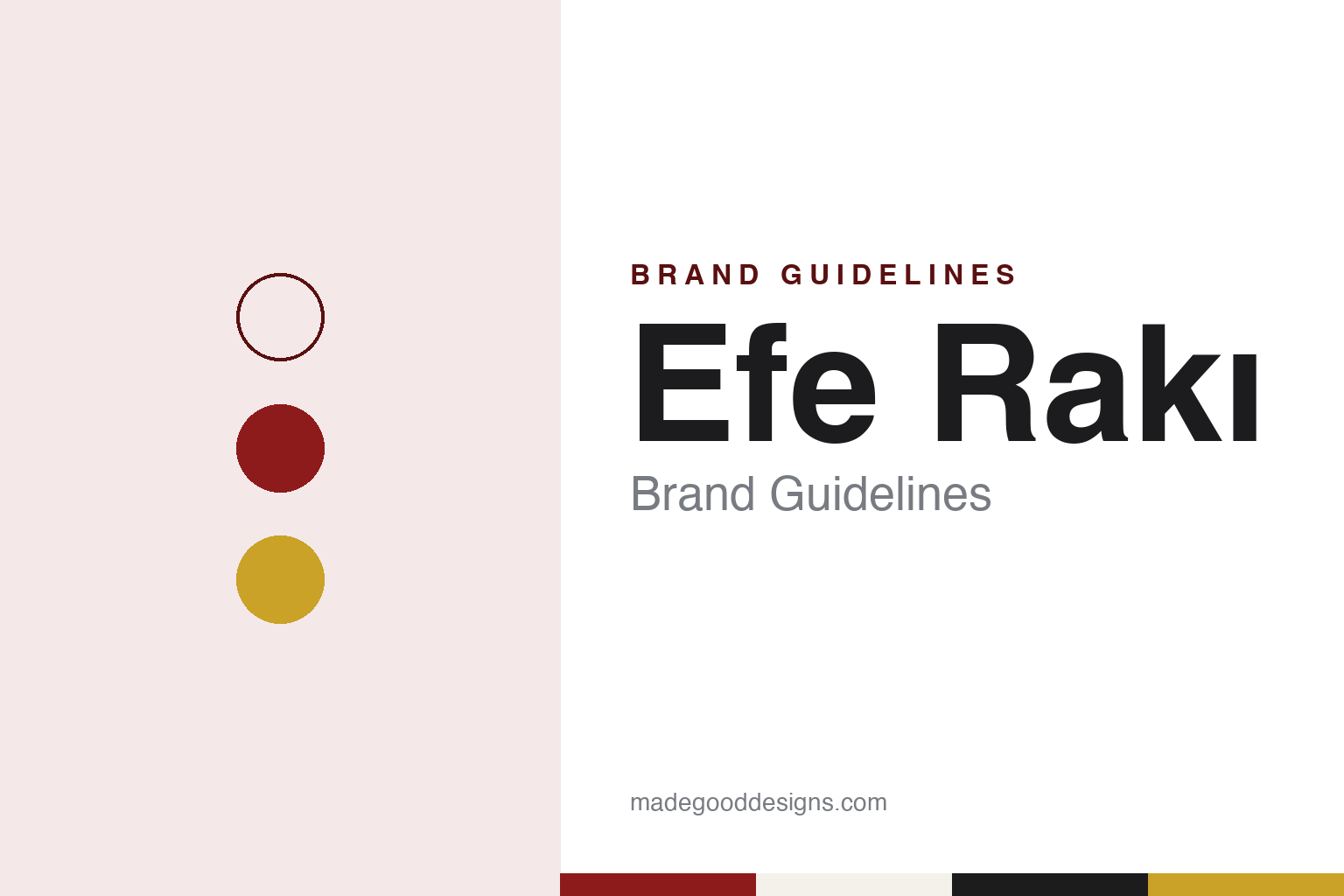
Two constants: a zeybek red, lion’s-milk white and Aegean gold palette and a condensed sans register. Abstract homage — not an Efe Rakı product or mark; no label, logo or bottle is reproduced.
After the monopoly
A group of İzmir entrepreneurs builds a rakı distillery.
For most of the twentieth century, rakı in Turkey was a state product, made by the spirits monopoly Tekel. Efe Rakı was one of the first brands to emerge when that changed. Patronlar Dünyası reported in 2017 that after the law ending the monopoly passed in 2002, Ekrem Demirtaş, then president of the İzmir Chamber of Commerce, set up a company with hundreds of local partners to make rakı; the newspaper gave the number of partners as both 480 and 565.
The company was Elda İçecek ve Enerji Hizmetleri, a name that reflected an earlier plan to work in electricity distribution, Patronlar Dünyası said. Ground was broken on 19 May 2003 at the Tekeli Organised Industrial Zone in Menderes, south of İzmir. The Istanbul practice MATU lists the Efe rakı factory among its industrial projects, dated 2003, with production halls, a management building and a laboratory on a site of about 21,000 square metres.
Production began in 2004. Bigpara reported in September 2005 that Elda had opened its plant in September 2004, and The Moodie Davitt Report wrote in 2018 that Efe reached the German market the same year.
The founder’s family stayed at the helm. Hürriyet reported in 2008 that Ekrem Demirtaş’s son, Egemen Demirtaş, had become chief executive of Efe and Elda in February 2006, and Patronlar Dünyası said that on 18 April 2016 the father handed him the chairmanship and sold his own shares.
Colour
A folk hero’s title and a family of sub-brands.
The brand name draws on the Aegean. Turkish Wikipedia defines an efe as the title given to the leaders of the armed bands of western Anatolia, in provinces such as Aydın, Denizli and Muğla and around Ödemiş, who rose against the established order. Zeybek, English Wikipedia notes, is also the name of a folk dance of western Anatolia. Efe’s oak-aged line is called Sarı Zeybek, “yellow zeybek”.
Efe built its range quickly. Brewer & Distiller International, in a January 2011 item indexed by the British Glass library, reported that in March 2005 Efe added a rakı distilled only from fresh grapes, sold as Yaş Üzüm; that Sarı Zeybek, launched in 2006, is double-distilled in copper alembics and matured in oak, taking on colour but still turning milky white when water is added; and that Kara Efe is triple-distilled. The same item said Efe used non-refillable caps on its bottles to prevent adulteration.
Sub-brands gave the company several faces on the shelf. Bigpara reported in September 2005 that Elda had launched Çilingir, a 45 per cent rakı that Ekrem Demirtaş said was made for drinkers who liked a rakı that burns the throat. Hürriyet listed the range in 2008 as Klasik Efe, Efe Yaş Üzüm, Kara Efe, Organik Efe, Sarı Zeybek, 1907 and Çilingir, and reported that Efe had set up facilities at Torbalı in 2007 to make wine under the İdol name. The Moodie Davitt Report named Efe Gold, Boğaziçi and Efe Classic among its brands in 2018.
Typography
Design and documentation.
The seven brands in this group are drinks names from Greece, Cyprus and Turkey: Barbayanni, Vallindras, KEO, Mythos, Babatzim, Efe Rakı and Tekirdağ Rakı. Around the eastern Mediterranean, anise spirits, grape spirits, citron liqueur, wine and beer sit at many different points in the trade, from family houses that still carry a founder’s name to labels that began inside a state monopoly or now belong to much larger drinks groups.
A drinks brand’s identity is usually carried less by a single bottle than by a label, a name and the place it promises, because the company behind the name may have changed hands, moved its production or grown far beyond the town where it started. That makes the plain questions worth asking: who started it, who owns it now, and where its drinks are actually distilled, brewed or bottled.
Each guide separates what independent sources record from what the company says about itself — its founding story, its owners over time, where its drinks are made and how its labels have changed — and marks plainly what rests only on the company’s own word.
Aa
A condensed sans for a short, upright Turkish name. (Specimen set in Barlow Condensed, a sans-serif STAND-IN; NOT the Efe Rakı logo.)
Efe Rakı
Exports, partners and a factory under the hammer.
Efe looked abroad from the start. Hürriyet reported in 2008 that it was exporting to Germany and elsewhere in Europe, Northern Cyprus, Australia, Japan, Canada and the United States, and that Diageo had chosen Efe as its distributor in Turkey in September 2007; Diageo later became the owner of Yeni Rakı. The Moodie Davitt Report wrote in July 2018 that Efe had worked with Bacardi and Beam Suntory since 2012 and was looking for duty-free partners to expand in travel retail.
The company also ran into difficulty. Milliyet reported in December 2017 that the tax office in Menderes had put the Tekeli factory of Elda İçecek ve Enerji Hizmetleri up for public auction over unpaid taxes, with a sale set for March 2018. Ekrem Demirtaş told Patronlar Dünyası that he had transferred his shares and was no longer the factory’s owner. Ege’de Son Söz reported in February 2018 that larger rakı producers were following the sale.
The brand has outlasted those headlines. The Turkish newspaper İstiklal reported on 1 January 2026 that the Efe range, alongside Yeni Rakı and Tekirdağ Rakı, had gone up in price at the start of the year, and listed Efe Sarı Zeybek among the rakı on sale. English Wikipedia, citing a study reported by the news site P.A. Turkey in October 2025, names Efe among the main rakı producers in Turkey alongside Diageo, Burgaz and Tariş.
One naming trap: Efe is not Efes, the Anadolu Efes beer brewed in Istanbul and İzmir.
For a design guide, Efe Rakı shows how a regional folk title and a ladder of named variants can give a new spirits company a recognisable family on the shelf in a category long defined by one state brand. Compare Yeni Rakı, the former Tekel rakı now made by Diageo, and Tekirdağ Rakı, the Thracian rakı of a 1931 state factory. For this guide we use zeybek red, lion’s-milk white and Aegean gold with a sans, an unofficial interpretation; no product or logo is reproduced.
Explore & save
Keep Efe Rakı’s identity on hand — save it to a board in the Made Good inspiration library.
Efe Rakı identity set
Pin the Efe Rakı zeybek red, lion’s-milk white and Aegean gold palette and the condensed sans register to your own board.