Embassy Suites Brand Guidelines
The all-suite chain built around an atrium.
Aa
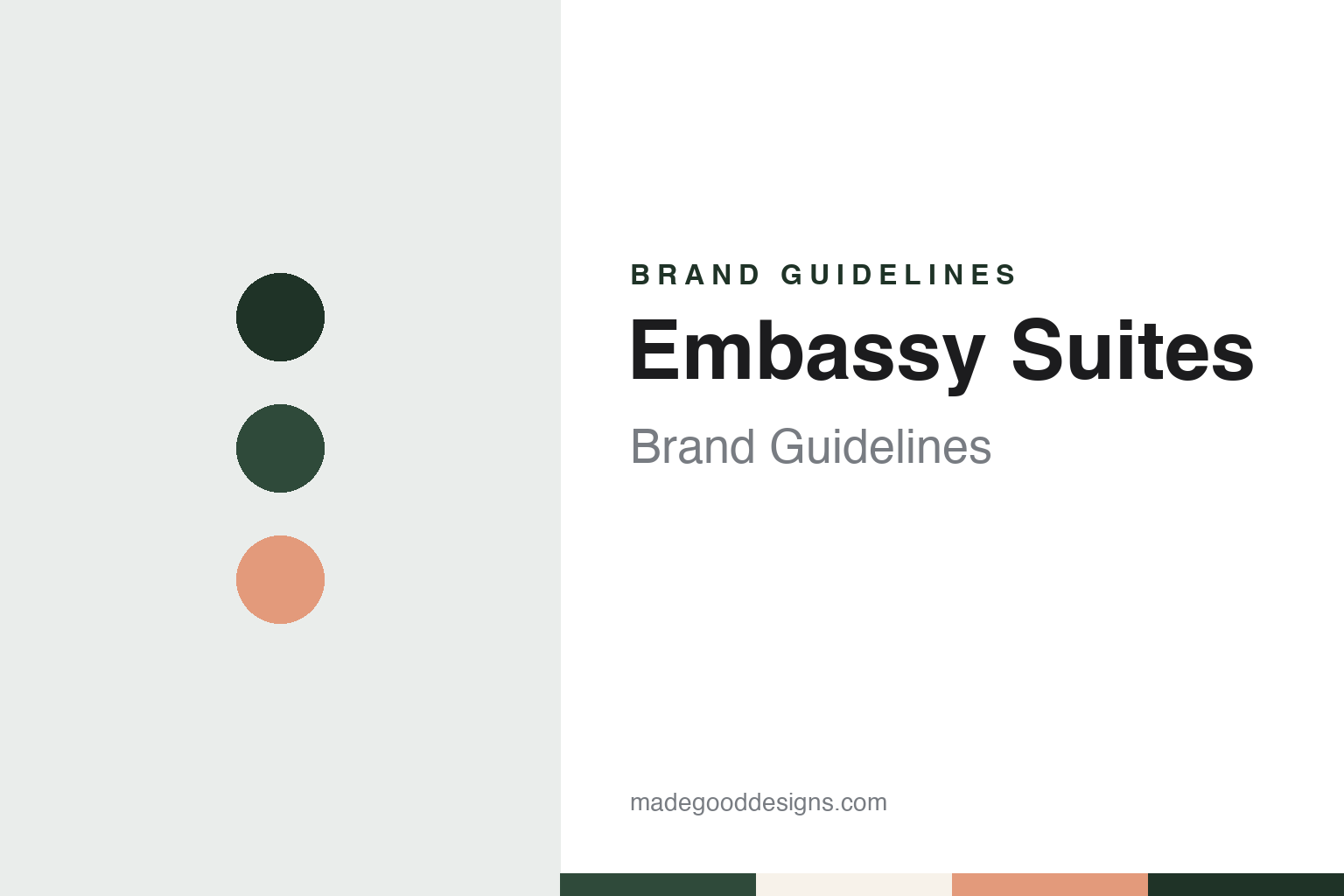
Two constants: an atrium green, salmon stucco and Garfield orange palette and an upscale display serif register. Abstract homage — not an Embassy Suites or Hilton asset; no logo, character or building is reproduced.
Two rooms
Holiday Inn’s answer to the upscale market.
Embassy Suites was created inside Holiday Inns, Inc. as the parent company of Holiday Inn looked for new markets. The International Directory of Company Histories (St. James Press, 1994) says that as the Holiday Inn image began to falter, chief executive Michael Rose chose to launch new chains rather than remake the flagship, and that the Embassy Suites chain, offering only suite-sized rooms, was created in February 1983. English Wikipedia names Hervey Feldman as a co-founder alongside Rose and says Feldman served as president and chief executive of Embassy Suites until 1990 and as executive chairman until 1992.
The Sun-Sentinel of Fort Lauderdale, reporting in September 1986, described the reasoning in the words of one of the chain’s general managers: Holiday’s core product was being squeezed from above by upscale hotels and from below by budget chains, so it created Hampton Inns for the economy traveller and Embassy Suites for the upscale market. The paper said Holiday built a few hotels and then acquired the Granada Royale all-suite chain, expanding on its concept, and that the Embassy Suites name was adopted in early 1985. The International Directory of Company Histories dates the Granada Royale Hometels purchase to 1984, the year it says both new chains became operational, and says the business was merged with Embassy. Wikipedia places the first Embassy Suites hotel in Overland Park, Kansas, in 1984.
The product was the suite itself. The 1986 Sun-Sentinel article described two connected rooms with a wet bar, a microwave oven, a refrigerator, table settings for four and a convertible sleeper couch alongside the bed, and said the chain was then headquartered in Dallas. It also described the look of two new Fort Lauderdale hotels: floor-to-ceiling atriums surrounded by suites, wrapped in a salmon-coloured, Mediterranean-style shell. One general manager told the paper he expected the suite format to suit guests staying more than a single night and travelling as families.
Colour
Promus, Hilton and the “by Hilton” name.
When the British brewer Bass bought the Holiday Inn business between 1988 and 1990, Embassy Suites did not go with it. The International Directory of Company Histories says Rose set up a new holding company, Promus, in November 1989 for the businesses Bass was not buying, and that it became the parent of Harrah’s casinos and three hotel chains: Embassy Suites, Hampton Inns and Homewood Suites. Wikipedia says the parent of Embassy Suites became The Promus Companies Incorporated in 1990.
The Sun-Sentinel profiled the chain again in March 1992, describing it as the upscale suite division of Promus, based in Irving, Texas, and led by president and chief executive Clyde Culp, who had come from Holiday Inn’s hotel division. Culp told the paper that he saw single-room upscale hotels, rather than other suite chains, as his competition, and that a two-room suite with a mini-kitchen and a free cooked-to-order breakfast offered an alternative to a more formal hotel. Guests, he said, could be in tuxedos or in jogging suits and feel equally comfortable. Wikipedia says the chain opened its first property outside the United States in Toronto in 1992.
In 1999, Wikipedia says, Embassy Suites joined Hilton after the merger of Hilton Hotels Corporation and Promus Hotel Corporation, and Hilton has owned the brand since that year. Most of the hotels are run by franchisees, with a smaller group managed by Hilton, Wikipedia says. The brand marked its 25th anniversary in 2009 with a hotel opening in Brooklyn Center, Minnesota, and opened in the Dominican Republic, in Santo Domingo, in 2014.
In 2015 the chain became Embassy Suites by Hilton. Wikipedia dates the rebrand to that year, and the entry for Hampton by Hilton records a single Hilton announcement that the official names of Embassy Suites and Hampton would include “by Hilton” in every location.
Typography
Design and documentation.
The hotel names in this group work at many different scales at once. A single brand can be read from a motorway sign at night, from a canopy over a front door, from a lobby wall and from a plastic key card that fits in a wallet, and each of those surfaces asks something different of the same mark. A name that sits comfortably in illuminated letters on a roofline has to survive being printed small on a door hanger or a folded room-service card.
A hotel brand’s identity is also carried by spaces as much as by graphics. Lobbies, corridors, room furnishings, uniforms and printed room collateral are all places where a name, a colour or a typeface can appear, and a hotel that carries a brand name may be built, owned or run by a company other than the one that owns the name. That makes the questions behind each name worth asking plainly: who started it, who owns it now, and how the name and its mark have changed over time.
Each guide separates what independent sources record from what the company says about itself — its founding story, its owners over time and how its signs and marks have changed — and marks plainly what rests only on the company’s own word.
Aa
A tall display serif — the register of a lobby directory and a suite door. (Specimen set in Cormorant Garamond, a serif STAND-IN; NOT the Embassy Suites logo.)
Atrium and cat
A building type and a cartoon spokescat.
Two things have carried the Embassy Suites identity more than any single logo: a building type and a cartoon cat. Wikipedia describes the chain as all-suite, with every guest room divided into a living area and a sleeping area, and says the majority of Embassy Suites hotels use an atrium-style layout with glass elevators, though some lack it. The 1986 Sun-Sentinel report shows the same arrangement in two new Fort Lauderdale hotels, with suites stacked around floor-to-ceiling atriums. Wikipedia also lists an evening reception with drinks and light snacks and a breakfast of made-to-order omelettes among the chain’s standard features.
Advertising gave the chain a mascot. The Sun-Sentinel reported in 1992 that Embassy Suites had used Garfield, the cartoon cat, in its promotions since the late 1980s as the company’s “spokescat”. His line was “You don’t have to be a fat cat to enjoy the suite life”, and the paper said that when Clyde Culp arrived in Dallas, Embassy was known as the suite chain with the cat. Wikipedia dates the Garfield commercials to the 1980s and early 1990s.
Later campaigns used other characters. Wikipedia says commercials in the early 2000s featured a boy named Austin describing a family holiday at an Embassy Suites hotel, and that in March 2011 the chain began airing three 30-second spots featuring a character called “Mr. More”, directed by Roman Coppola, each built around one of the chain’s standards: two-room suites, the cooked-to-order breakfast and the manager’s reception.
The name has moved with its owners. It began as a Holiday Corporation brand, passed to Promus in 1990 and to Hilton in 1999, and since 2015 has carried its owner’s name as Embassy Suites by Hilton.
For a design guide, Embassy Suites shows how a hotel brand can be recognised by the shape of its building and the routines that happen inside it, with an atrium, a two-room suite and a cartoon spokescat each doing part of the work a logo does elsewhere. Compare it with Hyatt, another hotel name closely tied to the atrium lobby, and Hilton, its owner since 1999. For this guide we use atrium green, salmon stucco and Garfield orange with a serif, an unofficial interpretation; no product or logo is reproduced.
Explore & save
Keep Embassy Suites’s identity on hand — save it to a board in the Made Good inspiration library.
Embassy Suites identity set
Pin the Embassy Suites atrium green, salmon stucco and Garfield orange palette and the upscale display serif register to your own board.