Hampton Inn Brand Guidelines
The Memphis-born chain that took the Hilton name.
Aa
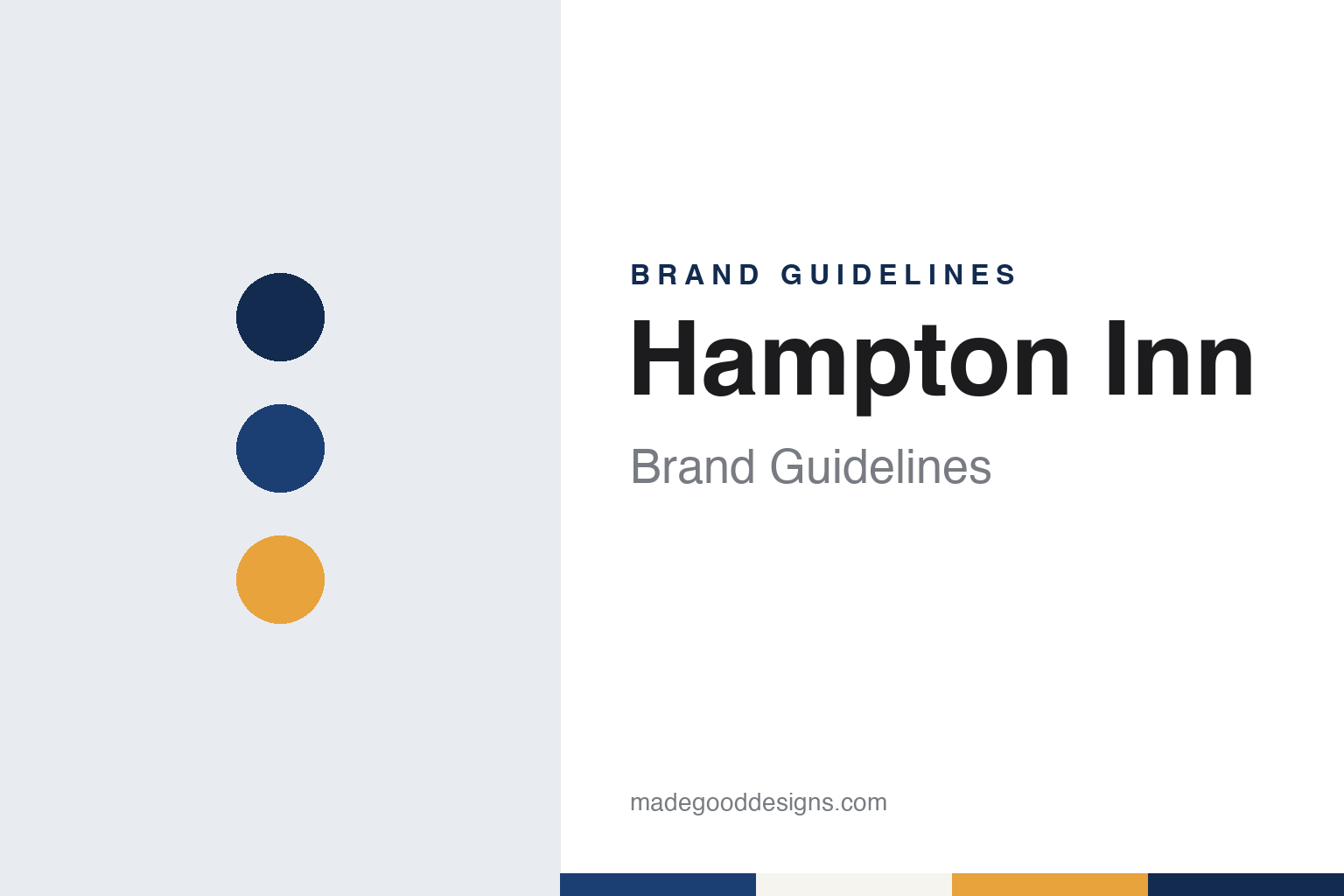
Two constants: a Hampton blue, morning amber and lobby cream palette and a plain roadside sans register. Abstract homage — not a Hampton or Hilton asset; no sign, logo or building is reproduced.
Sycamore View Road
A Holiday Inn spin-off for the economy traveller.
Hampton Inn was born inside the company that built Holiday Inn. By the early 1980s, the International Directory of Company Histories (St. James Press, 1994) says, Holiday Inns’ image had begun to falter, and rather than remake the flagship its chief executive, Michael Rose, launched new hotel chains aimed at specific niches. The suite chain Embassy Suites was created in February 1983, and Holiday founded Hampton Inns, a chain of budget hotels, shortly after; the directory says both chains became operational in 1984. The Sun-Sentinel of Fort Lauderdale put it in 1986 in the words of a Holiday hotel manager: the company had seen its core product squeezed from above by quality hotels and from below by budget chains, so it commissioned its low-price Hampton Inns concept to capture the economy-minded traveller.
English Wikipedia dates the chain to 1984 and places its first hotel in Memphis, Tennessee, on Sycamore View Road: a two-storey building whose rooms opened directly to the outside, in the manner of a roadside motel. Wikipedia credits Raymond E. Schultz with creating the Hampton Inn brand and says his wife, Erin Schultz, is credited with inspiring its name.
The chain sat alongside the parent company’s other new ventures. The International Directory of Company Histories says Holiday Inns, Inc. was renamed Holiday Corporation in May 1985 and moved into a new world headquarters in Memphis that July, and that in March 1988 it founded a fourth chain, Homewood Suites, for extended-stay travellers. For a few years Hampton, Embassy Suites and Homewood Suites shared a Memphis parent company with Holiday Inn itself.
That arrangement ended at the turn of the decade. The directory says the British brewer Bass plc bought the Holiday Inn hotel business in stages from May 1988, completing the purchase in January 1990, and that in November 1989 Rose created a new holding company for everything else. It was called Promus, which the directory glosses as Latin for “one who serves”, and it became the parent of Harrah’s casinos and the three newer hotel chains: Embassy Suites, Hampton Inns and Homewood Suites. Promus took its own New York Stock Exchange listing in 1990.
Colour
From budget motel to Hampton by Hilton.
Separated from Holiday Inn, Hampton changed what it was. The International Directory of Company Histories says that, no longer worried about taking business from its former sister chain, Promus recast Hampton Inns from a budget hotel into a middle-market chain that competed directly with Holiday Inn and with Courtyard by Marriott. English Wikipedia describes the physical result: the brand moved away from exterior-entrance buildings towards taller hotels, usually of three to five storeys, with indoor corridors. The original Memphis Hampton Inn closed in 2005, Wikipedia says, and the building later traded under other names. A year after the Promus listing, the directory says, the company opened a reservations call centre in Memphis to handle bookings for all three of its hotel chains.
The format widened in the 1990s. Wikipedia says the first Hampton outside the United States opened in Niagara Falls, Ontario, in 1993, and that Hampton Inn & Suites, with two-room suites that included living and kitchen areas, was introduced in 1995.
In 1999 Promus Hotel Corporation, which by then owned Hampton Inn, Embassy Suites, DoubleTree and Homewood Suites, was bought by Hilton, according to Wikipedia; Hilton has owned the Hampton brand since that year, and Wikipedia says most Hampton hotels are owned and run by franchisees, with a few managed by Hilton. Under Hilton the hotels were refreshed in named programmes. Wikipedia describes a 2004 initiative called “Make it Hampton”, which brought general renovations, a switch to white bedding, hot items at breakfast and a purpose-designed alarm clock with a dimmable display and oversized buttons; a 2012 programme called “Perfect Mix”, which reworked lobbies to add social space; and a 2013 campaign that brought new bedside tables, updated bathrooms and updated exteriors.
The name itself was rewritten in stages. Wikipedia says that from May 2007 the brand traded as Hampton by Hilton at its locations in Canada and Latin America, that the first Hampton by Hilton signage went up in the United Kingdom in 2009 with the brand’s first European hotel, and that in 2015 Hilton announced that the official names of Hampton and Embassy Suites would include “by Hilton” everywhere. In October 2014 the brand entered China through a licensing agreement with Plateno Hotels Group, Wikipedia says.
Typography
Design and documentation.
The hotel names in this group work at many different scales at once. A single brand can be read from a motorway sign at night, from a canopy over a front door, from a lobby wall and from a plastic key card that fits in a wallet, and each of those surfaces asks something different of the same mark. A name that sits comfortably in illuminated letters on a roofline has to survive being printed small on a door hanger or a folded room-service card.
A hotel brand’s identity is also carried by spaces as much as by graphics. Lobbies, corridors, room furnishings, uniforms and printed room collateral are all places where a name, a colour or a typeface can appear, and a hotel that carries a brand name may be built, owned or run by a company other than the one that owns the name. That makes the questions behind each name worth asking plainly: who started it, who owns it now, and how the name and its mark have changed over time.
Each guide separates what independent sources record from what the company says about itself — its founding story, its owners over time and how its signs and marks have changed — and marks plainly what rests only on the company’s own word.
Aa
A plain, upright sans — the register of a highway sign read at speed. (Specimen set in Libre Franklin, a sans-serif STAND-IN; NOT the Hampton logo.)
Hampton by Hilton
One short name and a parent’s endorsement.
The Hampton identity is mostly a matter of naming. It began as Hampton Inns in the plural, the form the International Directory of Company Histories and the 1986 Sun-Sentinel both use for the chain, and Wikipedia names it Hampton Inn, in the singular, as the brand’s former name. The 1995 extension added a second line, Hampton Inn & Suites, which kept the short first word and placed the format after it. The building type changed beneath the name in the 1990s, from a two-storey motel with outside doors to a taller box with an indoor corridor, Wikipedia says.
The final stage came from the owner. Wikipedia says that from 2007 the brand traded abroad as Hampton by Hilton, and that from 2015 the endorsement became part of the official name everywhere, in a single announcement that also covered Embassy Suites. Wikipedia notes that the chain is still commonly known by its former name, Hampton Inn.
The brand’s own story has its share of family history. Wikipedia credits Raymond E. Schultz with creating Hampton Inn and his wife Erin with inspiring the name, and the first building, on Sycamore View Road in Memphis, stood in the same city where Holiday Inn had opened its own first motel in 1952. Both chains grew out of the same Memphis company before Bass and Promus divided them at the start of the 1990s.
Hampton’s later refresh programmes gave its interiors named identities of their own. “Make it Hampton” in 2004 and “Perfect Mix” in 2012 are both described by Wikipedia as hotel-wide upgrades, the first centred on bedrooms and breakfast and the second on the lobby as a social space.
For a design guide, Hampton shows how a hotel name can move from one corporate family to another, gain an endorsement from its new parent and change its building type entirely while keeping the same short first word in front of the customer. Compare it with Hilton, the parent whose name it now carries, and Holiday Inn, the chain it was built beside in Memphis. For this guide we use Hampton blue, morning amber and lobby cream with a sans, an unofficial interpretation; no product or logo is reproduced.
Explore & save
Keep Hampton Inn’s identity on hand — save it to a board in the Made Good inspiration library.
Hampton Inn identity set
Pin the Hampton Inn blue, morning amber and lobby cream palette and the plain roadside sans register to your own board.